Inside the United States Taekwondo Museum: The Collection You Cannot Visit

Somewhere in New Jersey there is a collection that includes artefacts belonging to the founding president of the World Taekwondo Federation, artefacts associated with the founder of the ITF, Olympic and world championship medals, Dan certificates signed by pioneers who are now long dead — and, since 15 August 2026, Chuck Norris’s black belt. You cannot visit it. That is the point, and it is also the most interesting thing about it.
Disclosure. The United States Taekwondo Museum® is operated by the Official Taekwondo Hall of Fame®, which inducted this magazine’s publisher, Grand Master Stephen Oliver, for Lifetime Achievement in August 2026. Most of the information available about the museum comes from the organisation itself; where we could test a claim independently, we have, and where a claim is contested we say so below.
What it is
The United States Taekwondo Museum® is an online collection of Taekwondo artefacts operated as an arm of the Official Taekwondo Hall of Fame®. It has its own domain, unitedstatestaekwondomuseum.com, and a parallel presence within taekwondohalloffame.com. The only physical address associated with it is an administrative office in Hackensack, New Jersey. There is no public gallery, no opening hours and no ticket.
The organisation describes it as “what is widely believed to be the world’s first and only virtual museum dedicated exclusively to preserving and exhibiting Taekwondo artifacts from around the world.” That framing — a museum that exists as a catalogue and a custodial arrangement rather than a building — is worth understanding on its own terms before assessing the claim.
The “first Taekwondo museum” claim, tested
The museum’s promotional material carries the line “Home of the First World Taekwondo Museum.” We are not going to print that as settled, because a large physical institution makes a competing claim.
Korea’s National Taekwondo Museum, at Taekwondowon in Muju, describes itself on its own official site as “the world’s first and largest museum devoted to taekwondo.” It is a purpose-built 7,314-square-metre facility with three exhibition halls across three above-ground floors and a basement. A national institution of that size, in the art’s country of origin, making the same claim is a serious counterweight.
The defensible version of the New Jersey claim is narrower and probably true: it may well be the first virtual museum dedicated exclusively to Taekwondo artefacts. That is a real distinction and it does not need the broader wording.
What is actually in it
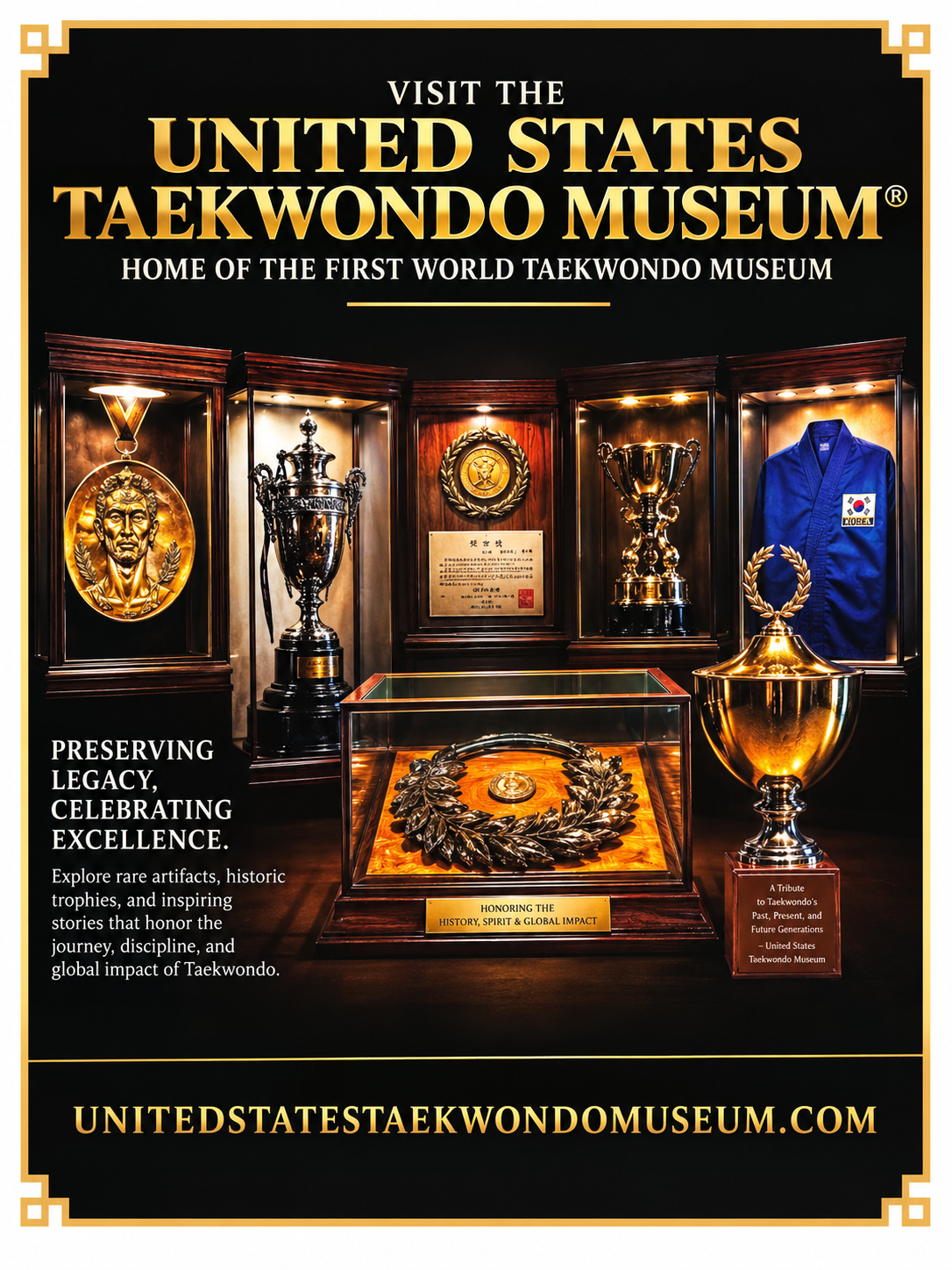
The collection, as catalogued by the organisation, includes:
- Artefacts relating to Dr. Un Yong Kim, founding president of the World Taekwondo Federation, the Korea Taekwondo Association and Kukkiwon
- Historic artefacts associated with General Choi Hong Hi, founder of the International Taekwon-Do Federation
- Olympic, World Championship and Korea National Championship medals, including those of Grandmaster Dong Keun Park, a six-time Korea National Champion
- Historic Dan certificates personally signed by pioneers and grandmasters
- Uniforms, black belts, jackets and ceremonial garments worn by instructors, coaches, referees and officials
- Championship trophies, awards and rare commemorative items
- Historic photographs, documents and publications
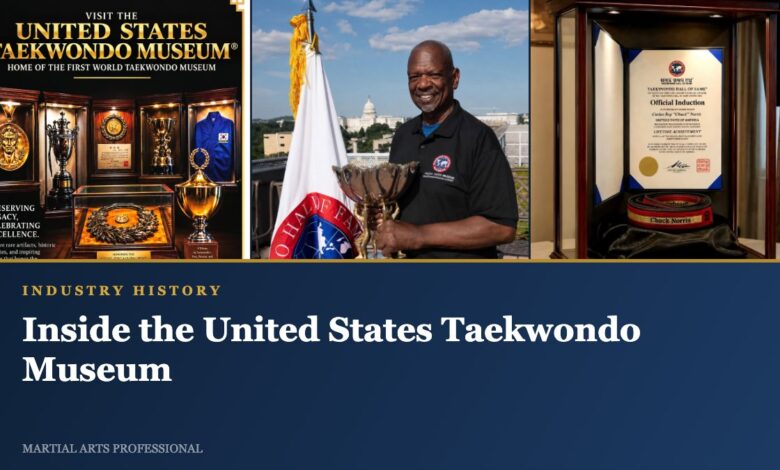
Two 2026 additions came out of the August ceremony: Chuck Norris’s black belt, made for him by the late Grandmaster Allen Steen and delivered from Texas by Grandmaster Keith D. Yates; and a set of first-edition books presented by Yates from his own library.
The organisation publishes Letters of Acknowledgement from figures and bodies including World Taekwondo, the ITF, the GTF, Kukkiwon and the Korea Taekwondo Association. Those letters are the strongest single piece of external validation available for the project, and they are worth a look before forming a view about it.
Two objects worth the visit the museum does not offer
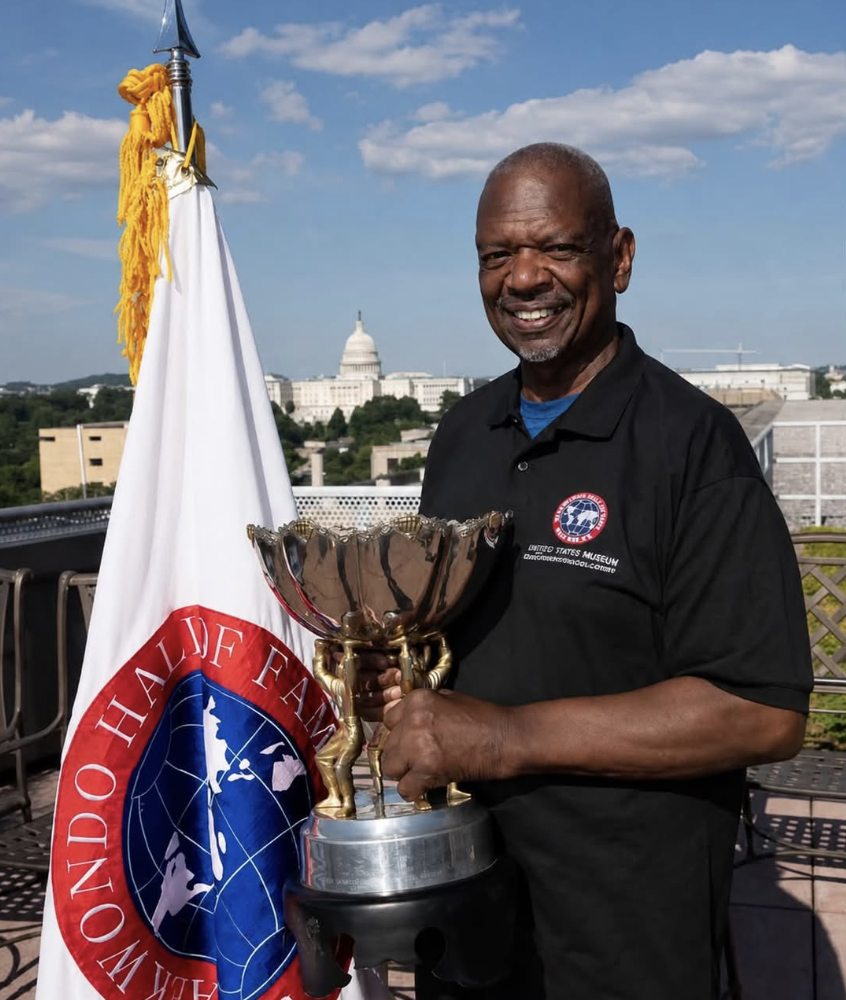
The 1973 trophy. The first World Taekwondo Championships were held at Kukkiwon in Seoul from 25 to 27 May 1973, with 19 nations competing. The United States finished second overall behind the host country. Albert Cheeks took bronze in the heavyweight division; Mike Warren took silver and Joseph Hayes, the team captain, took bronze. The museum holds Cheeks’s 1973 certificates and medals, and the photograph above — taken on a Washington rooftop with the Capitol dome behind — shows him with the trophy associated with that campaign.
One correction while we are here. That result has been described as a United States victory. It was a second-place team finish, which is a genuinely remarkable outcome for an American team at the first world championships and does not need upgrading. We also could not find independent documentation of a team trophy as such, nor a source confirming the coaching credit that sometimes accompanies the story.
Cheeks died on 11 August 2026, aged 74 — four days before the ceremony at which the collection gained the Norris belt. He is the same man reported by the Washington Post and WTOP as Bishop Kwabena Albert “Rainey” Cheeks.
The 2011 Kukkiwon banner. The museum holds the banner that hung above the VIP seating when the Official Taekwondo Hall of Fame held a ceremony at Kukkiwon World Taekwondo Headquarters in Seoul on 25 August 2011. That event is independently documented — a Korea Newswire release places it at the Kukkiwon gymnasium at 6:30 p.m. that Thursday, with a reception the previous evening. The organisation describes it as the first such ceremony presented at Kukkiwon by a non-Korean body; that particular characterisation appears only in its own materials, so we report it as its claim rather than as established fact.
How to give something to it
This is the part most readers of this magazine can act on. The museum accepts artefacts from collectors, pioneers, athletes, instructors, organisations and families. Accepted donations receive an Official Letter of Gratitude suitable for framing. The contact address is TkdHOF@gmail.com.
Before anyone sends anything anywhere, two practical cautions that apply to any private collection: establish in writing whether you are donating or lending, and what happens to the object if the organisation ceases to operate. Those are ordinary questions and a serious custodian will not mind being asked.
What a school owner should take from this
Your school is already a small museum and nobody has told you. The first uniform, the original sign, the first black belt certificate you ever signed, the photograph of the opening day — those are the objects that will be unrecoverable in thirty years. Photograph them, date them, write down who is in them while the people who know are still available to ask. It takes an afternoon.
Provenance is the whole value. A black belt in a case is worth nothing. A black belt in a case that is documented as having been made by a named grandmaster for a named recipient, and carried by a named student of the maker, is a historical record. The documentation is what turns an object into an artefact, and the documentation is the part that gets lost first.
Frequently asked questions
What is the United States Taekwondo Museum?
An online museum of Taekwondo artefacts operated by the Official Taekwondo Hall of Fame, with an administrative office in Hackensack, New Jersey. It has no public gallery. Its collection includes artefacts connected to Dr. Un Yong Kim and General Choi Hong Hi, Olympic and world championship medals, historic Dan certificates, uniforms and belts, and since August 2026 Chuck Norris’s black belt.
Can you visit the United States Taekwondo Museum?
Not in person. It is a virtual museum, viewable at unitedstatestaekwondomuseum.com. Korea’s National Taekwondo Museum at Taekwondowon in Muju is the large physical institution devoted to the art.
Is it the first Taekwondo museum in the world?
That claim is contested. Korea’s National Taekwondo Museum in Muju describes itself as the world’s first and largest museum devoted to taekwondo, and it is a 7,314-square-metre physical facility. The defensible narrower claim for the United States Taekwondo Museum is that it may be the first virtual museum dedicated exclusively to Taekwondo artefacts.
How do you donate an artefact to it?
By contacting TkdHOF@gmail.com. Accepted donations receive an Official Letter of Gratitude. Establish in writing whether you are donating or lending before you send anything.
Where is Chuck Norris’s black belt kept?
It was enshrined in the United States Taekwondo Museum on 15 August 2026 at the Official Taekwondo Hall of Fame ceremony in Jersey City. The belt was made for Norris by Grandmaster Allen Steen and delivered by Grandmaster Keith D. Yates.
Related reading
- The 2026 Official Taekwondo Hall of Fame: every honoree
- Chuck Norris and Stephen Oliver: the 2026 Lifetime Achievement inductions
- In Memoriam · Jhoon Rhee · Allen Steen
- The museum: unitedstatestaekwondomuseum.com · The Hall of Fame: taekwondohalloffame.com
Sources, and what we could not confirm
From the museum: the collection inventory, the mission statement, the donation process and the provenance of the 2011 Kukkiwon banner all come from the organisation’s own published material. It is an interested party describing itself, and that is how readers should weigh it.
Independently confirmed: the first World Taekwondo Championships in Seoul, 25–27 May 1973, 19 nations, United States second overall, with Albert Cheeks taking bronze in the heavyweight division; the 25 August 2011 Kukkiwon ceremony, via a Korea Newswire release; Korea’s National Taekwondo Museum and its own first-and-largest claim, via its official site; and Albert Cheeks’s death on 11 August 2026, via the Washington Post and WTOP.
Not established: the museum publishes no founding date, and we could not locate one. We could not independently document a 1973 United States team trophy, nor confirm the coaching credit that circulates with that story. The characterisation of the 2011 Kukkiwon event as the first presented there by a non-Korean organisation is self-sourced. We also could not fetch unitedstatestaekwondomuseum.com directly during reporting, so the inventory above is drawn from the organisation’s other published material.
Photographs were supplied by the Official Taekwondo Hall of Fame and by the publisher; subjects are identified as supplied to us.
Corrections. See our editorial policy. If you can document the museum’s founding date or the 1973 trophy, please write to us.