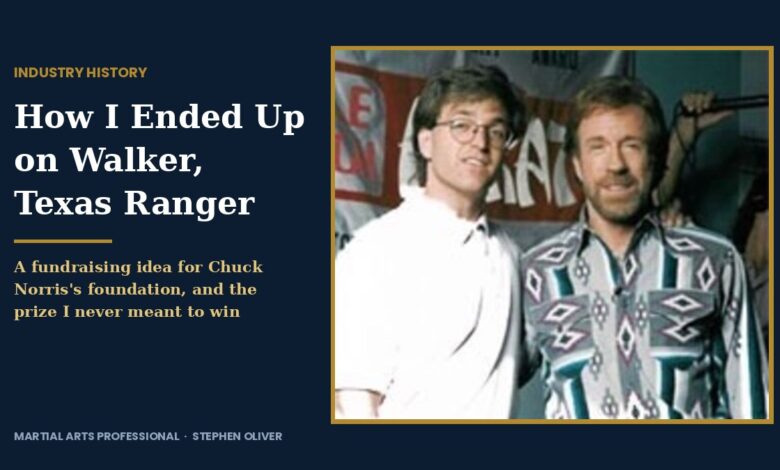
People find the episode and ask me about my “movie star” days. The truth is that I ended up on Walker, Texas Ranger because one of my own fundraising ideas backfired on me. I came up with a prize to motivate other school owners, and then I won it.
Disclosure: Chuck Norris (1940–2026) was a friend and a recipient of this magazine’s Lifetime Achievement Award, and the fundraising described here was for his foundation. I am the Publisher of Martial Arts Professional. This is my own recollection of events from the late 1990s. Where a document exists, I have checked my memory against it and say so below.
Watch me tell the story
How did a school owner from Denver end up on Walker, Texas Ranger?
It started in a brainstorming session, not an audition.
I was sitting down with Chuck Norris and Lloyd Ford, who was running Chuck’s foundation, Kick Drugs Out of America. (Today it is Kickstart Kids.) I believe Ed Saenz was there too. I had connected Chuck with the Educational Funding Company, and every year the EFC schools ran a fundraiser for Kick Drugs Out of America. Chuck’s deal at the time was simple: if a group raised $50,000 or more, he would come to the convention and collect the check in person. EFC had a strong group of schools, so we cleared that bar comfortably.
Each year we tried to come up with something new to get every school owner motivated. That meeting was about the next idea.
What incentives did we use to raise money for Kick Drugs Out of America?
We tried a different hook almost every year:
- The signed black belt. One idea, and I think it was mine, was a black belt signed and numbered by Chuck Norris, mounted in a plexiglass display case. If your school raised more than $500, you earned one. I still have the first one in my office.
- Chuck in your advertising. Another year I took one of my own ads, put Chuck’s face in it and branded it from Chuck. Schools that raised a set amount could run the ad with Chuck in it.
- The infomercial that wasn’t. We also tried to get an infomercial made, but that was more time than Chuck was willing to commit.
Whose idea was the Walker guest spot?
Mine, unfortunately.
In that session I said something like this: “It seems to me every one of these guys wants to be you. They want to be the karate action star. They want to see themselves on screen, kicking and punching the next guy. I don’t know if it’s possible, but why not give them a guest shot, or let them be an extra, or whatever you’d be willing to do on Walker?”
We kept the black belt for anyone who raised more than $500, and Chuck and his team liked the bigger idea. The deal was set: whoever raised the most money would get a guest spot on Walker, Texas Ranger.
What happened when I won my own contest?
Lo and behold, I raised the most.
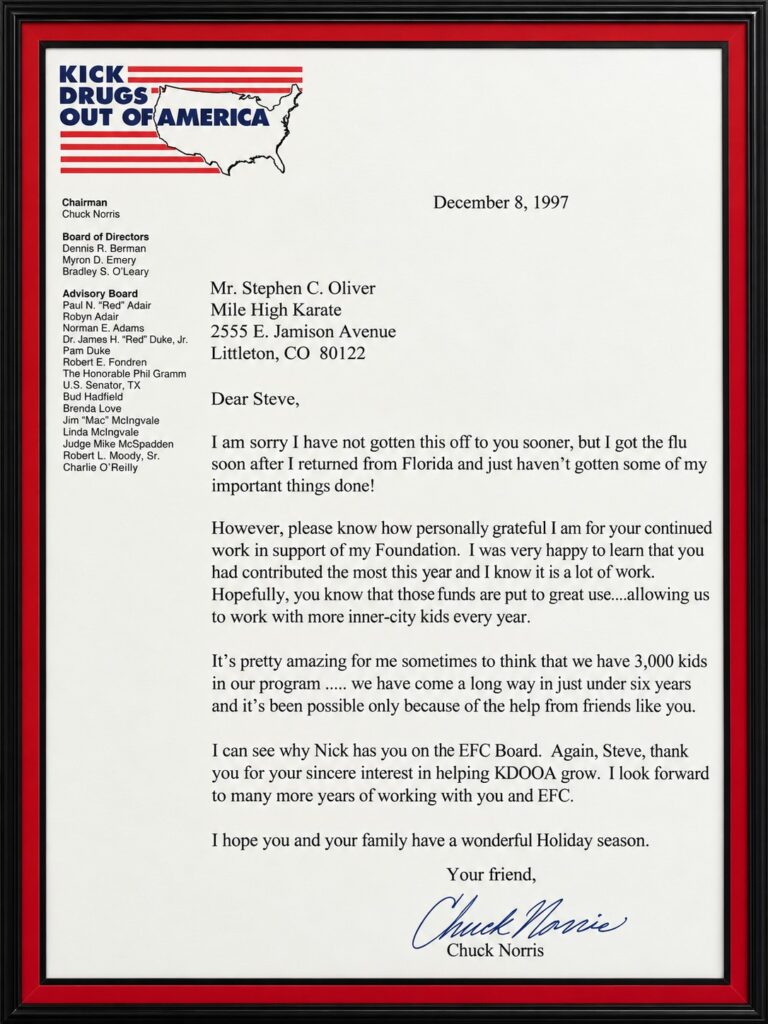
As I remember it, my schools accounted for something like 15 to 20 percent of everything the EFC schools raised that year, and the second-place school raised about a quarter of what we did. The paperwork points to 1997 as the year, and it puts the numbers a little differently. Chuck’s T.E.A.M. News for December 1997 reports that the EFC schools presented him with a check for $130,972 at their convention in Orlando, November 22–23, 1997, and it singles out “Steven Oliver, who contributed $15,000!” On December 8, 1997, Chuck wrote to me: “I was very happy to learn that you had contributed the most this year.” Fifteen thousand out of $130,972 is about 11 percent. I’ll trust the paper over my memory on the percentage. You can read both documents in full on the page that collects the original documents.
At the convention, while we were presenting the big check, Chuck turned to me and said, “Well, you won. You need to talk to the casting director and send her your photo.”
I said, “I don’t want to be a TV star. I was talking about those guys. I don’t need to do that. Don’t worry about it.”
He said, “No, no, no. That was the deal. You have to do it.”
Why did I turn down the first role?
I finally sent my photo to the casting director. Not long after, she called with a role. Walker was filmed in Dallas, and they were shooting a hospital scene. “You’re perfect for the surgeon,” she said. “Walker comes in and talks to the surgeon. You’ll be dressed as a doctor.”
I said no. There are plenty of working actors, many of them starving, who need that job. “Give it to somebody who’s looking for an acting role,” I told her.
She said, “Well, Chuck really wants you on the show.”
So I made her a counteroffer. “If you ever have a karate scene where I can be in uniform, call me if it’s a good fit. If not, don’t worry about it. Give the part to an actor who needs the work.”
What role did I end up playing?
Not long after, she called back. The show was building episodes around Trent Malloy, a martial artist, and his friend Detective Carlos Sandoval. Those characters later got their own spin-off, Sons of Thunder. This episode was built around a big karate tournament, the Texas State Karate Championship.
“You’re the Pat Johnson role from The Karate Kid,” she said.
“What’s that?”
“You’re the center referee running the climactic fight. You wear your own uniform.”
That I could do. I asked one favor: “Can I bring my mother? She’d love to meet Chuck.”
“Yes, yes, bring her.”
So I flew to Tulsa, picked up my mother, and we drove down to Dallas together so she could meet Chuck Norris.
How did a bit part turn into running the whole tournament?
The first person I saw on set was Ed Saenz. “What are you doing here?” he asked. I told him they’d asked me to come do this one thing.
Ed went straight to the director and said, “This guy runs one of the biggest karate tournaments in the country. He’s now in charge.”
He was right about the tournament. I had promoted the Mile High Karate Classic in Denver, a NASKA World Tour event, every year since 1989. So I walked onto the set as a bit player and was suddenly running a karate tournament. It was a fake tournament for television, but I ran it. Every scene came with questions: Would they really be wearing this? Where would the judges stand? What would the competitors be doing between matches?
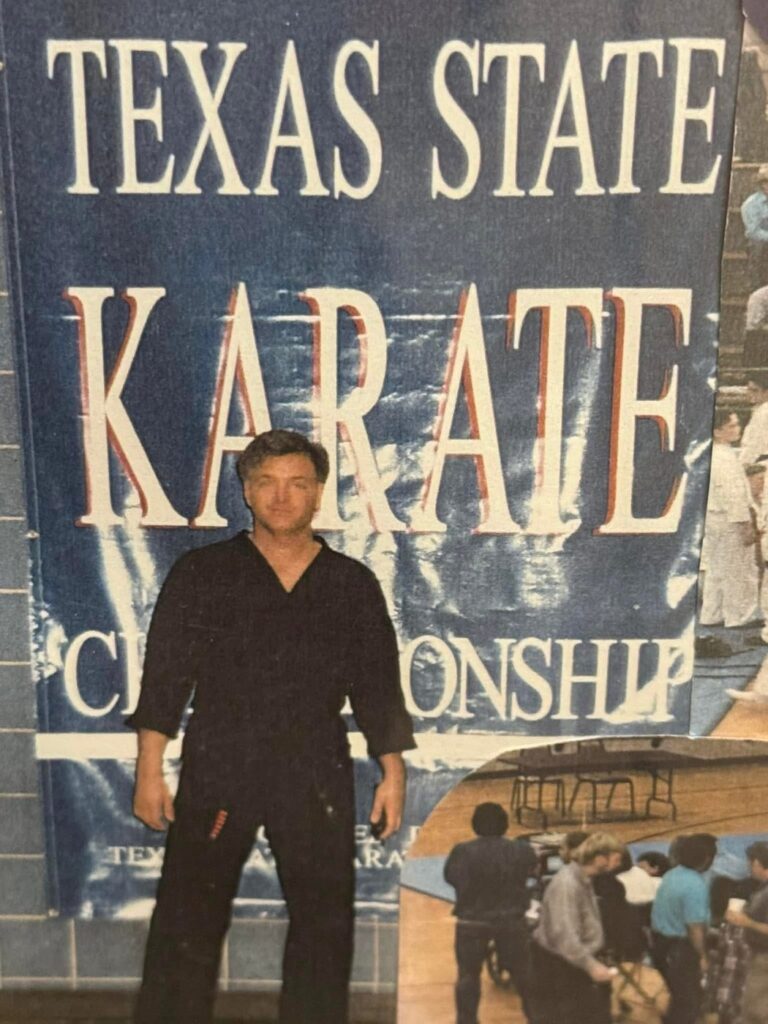
Then Ed and I choreographed the fight. That was a real challenge. The young actor who had to win the fight didn’t know any karate, so we had to make him look like he did. His opponent was one of Chuck’s Kick Drugs Out of America kids, and he was good. Our job was to make the student who knew nothing beat the student who knew something, believably, on camera.
Why did they tape over my patches?
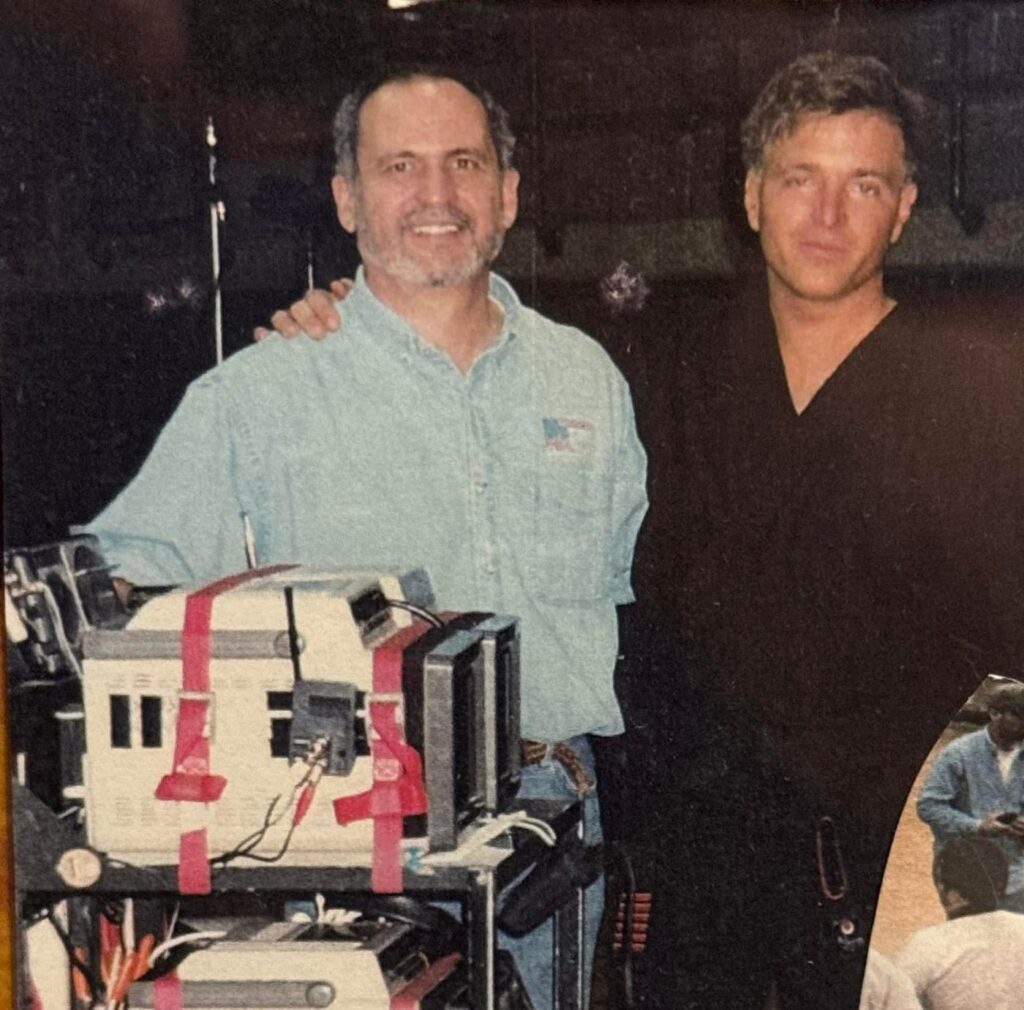
When it was time to shoot my center-referee scene, the first thing that happened was a crew member came over and started taping over every patch on my uniform. That meant the Mile High Karate logos and everything else I had on it.
“What are you doing?” I asked. “Why can’t I have the logos? The show has Chuck’s logos up there, and Kick Drugs Out of America.”
“You’re not going to win that fight,” he said. “Those are Chuck’s. CBS isn’t going to let you get away with that.”
So much for marketing lesson number one. Off came the logos.
Why does the camera only show my back?
So I’m running the match we choreographed, refereeing it the way a real center referee would. Then I hear the director, Michael Preece, and another man whispering beside me, and I catch the word “SAG.”
“What’s going on?” I asked.
The director looked at me. “You don’t by any chance have a SAG card, do you?”
“No. I don’t have a SAG card. I don’t want to be an actor.”
Here was the problem. A real center referee talks the whole match. Without membership in the Screen Actors Guild, the director told me, they could show my face or they could let me talk, but they couldn’t show my face and use my voice. Pat Johnson had a SAG card. I didn’t. So the whole scene was shot from behind me. On screen you see the back of a man in a black uniform running the fight.
I thought, “That’s okay. We can still make a big deal out of it.”
Did anyone in Colorado see the episode?
Back home, I found out when it would air, and we told every student in every Mile High Karate school: “Master Oliver is going to be on Walker, Texas Ranger this Saturday night.”
Saturday night came. We turned on the TV, and in Colorado Walker, Texas Ranger had been preempted for the high school basketball championships. It never aired in Colorado. A rerun probably showed later, but on the night we had promoted to every family in our schools, nobody in Colorado saw it.
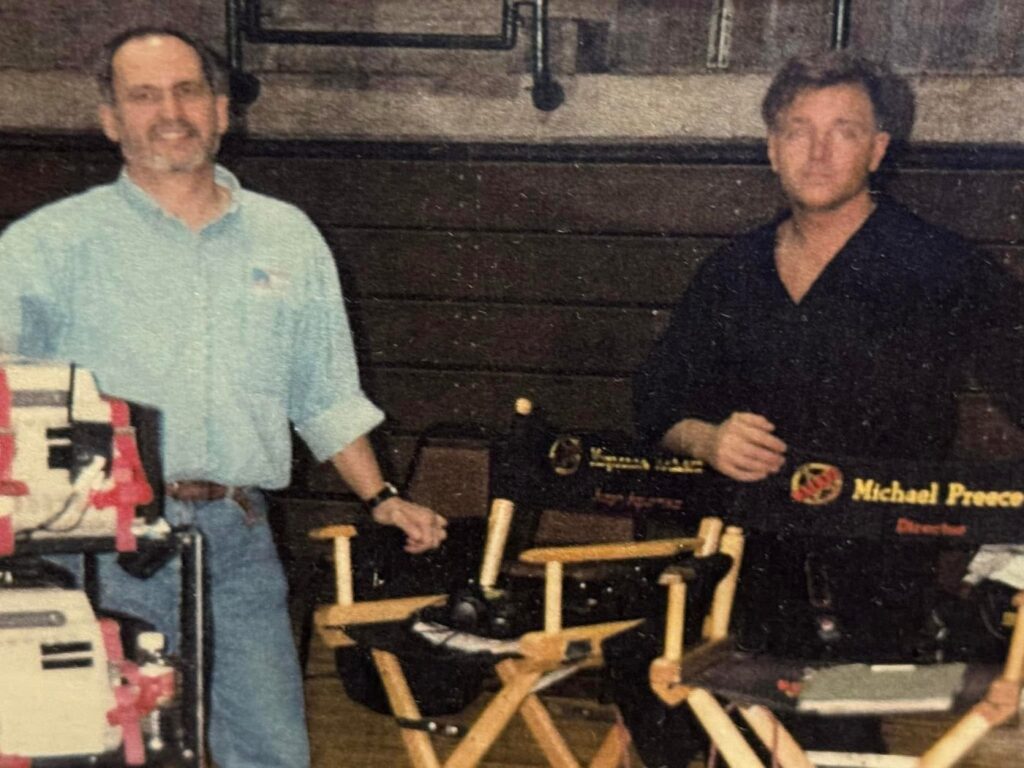
Which episode was it? By our best reading of the episode guides, it was “Undercover,” season 6, episode 18, first broadcast on CBS on Saturday, March 7, 1998. In that episode Trent trains Tommy Malloy and his top karate students for a state tournament. The date fits: it aired three months after the convention, during the Colorado high school basketball playoffs. IMDb credits Michael Preece as the director of “Undercover,” and one of my photographs from that day shows his director’s chair on the set, next to a Texas State Karate Championship banner in another. I appear without a screen credit, which you would expect for a man whose face never makes it on camera.
Did I get paid?
A couple of weeks later I opened the mail and found I’d been paid. There was a check for running the tournament as stunt coordinator, a check for choreographing the fight, and a check for the bit part, which I never expected to be paid for at all. It wasn’t much, but it was entertaining.
Someone told me afterward that they shot my back because they didn’t have enough makeup to make me look good enough for a close-up. I hadn’t heard that one. I’m sticking with the SAG explanation.
Was it worth it?
Yes, and not because of the screen time. My mother got to meet Chuck Norris. Howard Jackson, Chuck’s friend, associate and bodyguard, who has since passed away, was there with Chuck and the whole team. I spent time on the set of Chuck’s show, working alongside Ed Saenz and Chuck’s crew. And a fundraising idea I thought was brilliant did exactly what it was supposed to do: it got people raising money for kids. It just happened to backfire on the man who thought of it.
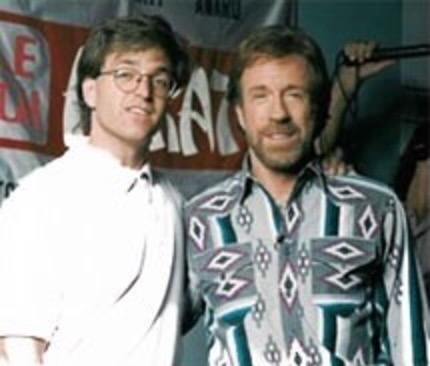
What a school owner should take from this
- Give people a reason to stretch. A signed belt for anyone over $500 and a once-in-a-lifetime prize for the top fundraiser moved school owners far more than “please give.”
- Charity is part of the job. The Kick Drugs Out of America drive put EFC schools in front of their communities for the right reasons, and it raised real money for kids.
- Your expertise travels. I came to play a referee and ended up running the set’s tournament, because years of running a real one meant I knew the answers. Whatever you do every week in your school is somebody else’s specialty.
- Read the fine print before you promote. Check the broadcast schedule in your own market before you tell every family in your schools to tune in.
Frequently asked questions
Was Stephen Oliver on Walker, Texas Ranger?
Yes. He worked as the center referee, tournament coordinator and fight choreographer for a karate tournament scene. He appears only from behind and without a screen credit, because he did not hold a Screen Actors Guild card.
How did Stephen Oliver get on Walker, Texas Ranger?
He proposed a guest spot on the show as the prize for the top fundraiser in the Educational Funding Company schools’ drive for Chuck Norris’s Kick Drugs Out of America Foundation, and then he raised the most himself. Chuck Norris’s December 8, 1997, letter thanks him for having “contributed the most this year.”
Which Walker, Texas Ranger episode was it?
By the best match to the episode guides, it was “Undercover,” season 6, episode 18, first aired on CBS on March 7, 1998. In that episode Trent Malloy trains Tommy Malloy and his karate students for a state tournament. IMDb credits Michael Preece as its director, and Stephen Oliver’s photographs from the set show Preece’s director’s chair and a Texas State Karate Championship banner.
Why is his face not shown?
A center referee talks throughout a match. Without a SAG card, the production could show his face or use his voice, but not both. The scene was shot from behind him.
What role did Pat Johnson play in The Karate Kid?
Pat Johnson played the center referee at the climactic tournament in The Karate Kid. The casting director described Stephen Oliver’s Walker role as “the Pat Johnson role.”
What is Kick Drugs Out of America called today?
Chuck Norris founded the Kick Drugs Out of America Foundation in 1990. It has operated as Kickstart Kids since 2003.
Sources, and what we could not confirm
This article is Stephen Oliver’s recollection. The fundraising figures are confirmed by Chuck Norris’s T.E.A.M. News, December 1997, and by Chuck Norris’s letter of December 8, 1997, both reproduced at StephenCOliver.com/chuck-norris. The episode is identified from published episode guides (Walker Fandom wiki, Season 6; the Legacy of Thunder fan episode guide; IMDb). Those guides describe the state-tournament storyline and the March 7, 1998, air date. IMDb lists Michael Preece as the episode’s director, which matches the director’s chair in Stephen Oliver’s set photographs. No screen credit for Stephen Oliver appears, as expected for an uncredited appearance. The set photographs are from Stephen Oliver’s personal collection; the people in them are identified as he supplied. The Colorado preemption, the SAG ruling on the set and the payments are from Stephen Oliver’s memory and are not independently documented. Kickstart Kids’ founding (1990) and renaming (2003): Wikipedia, “Kickstart Kids.”
Related reading
Grand Master Stephen Oliver, MBA, is a 10th Degree Black Belt and the Founder and CEO of Mile High Karate and Martial Arts Wealth Mastery, one of the martial arts industry’s leading coaching and consulting organizations for professional martial arts school owners, BJJ academies, and MMA gyms. A martial arts school owner since 1975 and business coach since 1985, Oliver has spent more than five decades building, operating, and advising successful martial arts schools. He also serves as CEO and Chairman of NAPMA (the National Association of Professional Martial Artists) and Publisher of Martial Arts Professional magazine. A Georgetown University cum laude graduate, he earned his Executive MBA through the Executive Program at the Daniels College of Business at the University of Denver. He was promoted to 10th Degree Black Belt in April 2026 and inducted into the Official Taekwondo Hall of Fame in August 2026. Learn more at MartialArtsWealth.com and StephenCOliver.com.