
State of the Industry 2026: How Many Martial Arts Schools Are There Really in the U.S.?

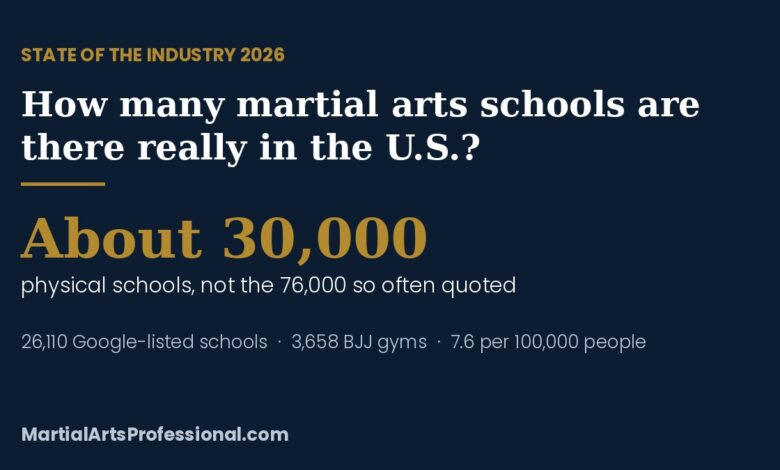
For years, articles, pitch decks and software websites have said there are about 76,000 martial arts schools in the United States. There aren’t. The 76,000 figure counts martial arts businesses, including thousands of independent instructors with no school of their own. When you count physical locations, meaning schools you can walk into, the number is about 30,000: somewhere between 26,000 and 35,000. This State of the Industry report shows where each number comes from and breaks the market down by style, by state, by size and by ownership.
A note from the publisher
I have owned martial arts schools since 1975 and coached school owners since 1985, so I have heard every version of “how big is this industry?” For most of that time the honest answer was “nobody really knows.” This year we set out to answer it with data rather than repetition. I am also the Founder and CEO of Martial Arts Wealth Mastery. Part of the style and school-size data in this report comes from Martial Arts Wealth Mastery’s own contact list, and it is labeled as such wherever it appears. It describes school owners who responded to our marketing, not the whole country.
— Grand Master Stephen Oliver, Publisher
The short answer
- About 30,000 physical martial arts schools operate in the U.S. (range: 26,000 to 35,000).
- 76,364 is IBISWorld’s 2026 count of martial arts businesses, including owners who have no employees. It is not a count of schools.
- 26,110 U.S. businesses are listed under Google’s “Martial arts school” category, the best single count of mapped locations.
- About 3,658 BJJ gyms are listed in the largest BJJ directory. No reliable national count of MMA gyms exists.
- 7.6 schools per 100,000 people nationally, about one school for every 13,000 residents. New Hampshire is the most saturated state, D.C. and Alabama the least.
- Roughly 3% of locations belong to the six major brands we checked. The industry is overwhelmingly independent and small.
Where does the “76,000 martial arts schools” figure come from?
It traces to IBISWorld’s industry report Martial Arts Studios in the US, which puts the 2026 count at 76,364 businesses, up 6.0% from 2025 and growing about 11.7% a year since 2021. Software vendors and industry blogs repeat it, usually as “schools” or “studios.” That is where the meaning changes.
Three details in IBISWorld’s own figures show it is counting something other than storefronts:
- Employees per business. IBISWorld reports 132,246 people employed across the industry, about 1.7 per business. A school with its own floor, front desk and instructors runs well above that. An average under two only works if most of the “businesses” are one person.
- Owners with no employees. IBISWorld describes the industry as one in which many studios operate as nonemployers. These are sole proprietors with no payroll: an instructor teaching at a YMCA, a church hall, a park district or a fitness club, or a part-time program filed as a side business. Each one is a business. None of them is a school you can walk into.
- The growth rate. An 11.7% yearly rise means the count grew by roughly 74% in five years. No location dataset we found shows physical schools growing anywhere near that fast. Fast growth in tax filings is what you would expect as more independent and part-time instructors register as businesses.
The U.S. Census Bureau sets a hard ceiling. In 2023, County Business Patterns counted 20,916 locations with paid employees in NAICS 611620, Sports and Recreation Instruction. That code covers martial arts plus swimming, golf, tennis, gymnastics, sports camps and other coaching. Even if every one of those 20,916 were a martial arts school, at least 72% of IBISWorld’s 76,364 (55,448 businesses) would still have to be operations with no payroll.
How to quote it accurately
“There are about 76,000 martial arts businesses in the United States, including independent instructors. About 30,000 of them are physical schools.”
Two other figures circulate and should be retired. “50,000 martial arts schools” is a blog estimate with no published method. “Over 10,000 BJJ gyms” applies a 19.8% share to that 50,000 and does not reach 10,000 even on its own arithmetic.
So how many martial arts schools are there in the U.S.?
No single source counts martial arts schools as physical places, so we compared independent sources against each other.
| Source | What it counts | Figure | As of |
|---|---|---|---|
| IBISWorld | Martial arts studio businesses, including those with no employees | 76,364 | 2026 |
| Google business listings (via SmartScraper) | Businesses in the “Martial arts school” category | 26,110 | Apr 1, 2026 |
| Google business listings (via SmartScraper) | Style categories: karate, kickboxing, taekwondo, jujitsu, kung fu | 15,566 combined | Apr 1, 2026 |
| Let’s Roll BJJ directory | BJJ gyms listed in the U.S. | 3,658 | Oct 2026 |
| U.S. Census, County Business Patterns | Locations with a payroll in all sports and recreation instruction | 20,916 | 2023 |
| U.S. Census, population estimates | State populations, used for per-capita rates | 341.8 million | Jul 1, 2025 |
| xMap and ScrapeHero | Locations of six major brands | about 980 | 2025–2026 |
How the estimate is built. The 26,110 “Martial arts school” listings are the floor for mapped locations. Listings under specific style categories add up to 15,566 more, but some schools appear in both groups, and the data does not show how many. That puts the combined ceiling at about 41,700 listings. Listings also run high: closed schools that were never removed, duplicates, and classes held inside YMCAs, recreation centers, churches and fitness gyms all appear. After allowing for that, roughly 26,000 to 35,000 real, dedicated locations remain, with about 30,000 as the midpoint.
Which martial arts styles have the most schools?
Most schools list themselves only under the general “Martial arts school” category: 26,110 of them, more than all the named-style categories combined. Among schools that do pick a style category, karate leads.
| Google category | U.S. listings | Share of named-style listings |
|---|---|---|
| Karate school | 5,435 | 34.9% |
| Kickboxing school | 3,357 | 21.6% |
| Taekwondo school | 3,156 | 20.3% |
| Jujitsu school | 2,622 | 16.8% |
| Kung fu school | 996 | 6.4% |
| Total, named styles | 15,566 | 100% |
Striking programs (karate, taekwondo, kung fu and kickboxing) make up 83% of named-style listings. A school can be listed in more than one category, so these counts overlap with each other and with the general category.
How many BJJ gyms are there in the U.S.?
The Let’s Roll directory lists 3,658 BJJ gyms across all 50 states and D.C. California (618), Texas (323) and Florida (310) hold 34% of them. Google’s “Jujitsu school” category (2,622) is smaller, because many BJJ academies list themselves as a “Martial arts school” or a “Gym.” A fair working range for U.S. BJJ locations is 3,000 to 4,500, or roughly 10% to 15% of all schools. Many of them also run MMA, Muay Thai or kids’ programs.
How many MMA gyms are there?
No dataset gives a reliable national count. Most MMA gyms are listed as gyms, boxing gyms, kickboxing schools or BJJ academies, so they are spread across the categories above. Branded MMA chains are small: xMap lists 107 UFC Gym locations in the U.S., 53 of them marked closed.
What school owners tell us about their styles
In Martial Arts Wealth Mastery’s contact list, 1,263 school owners and instructors chose at least one style. They could choose more than one.
| Style | Selected by | Share of 1,263 |
|---|---|---|
| Others | 340 | 26.9% |
| Tae Kwon Do / Tang Soo Do | 287 | 22.7% |
| Japanese styles | 204 | 16.2% |
| BJJ | 123 | 9.7% |
| MMA | 116 | 9.2% |
| Chinese styles (Kung Fu, Wing Chun) | 100 | 7.9% |
| Krav Maga | 53 | 4.2% |
| Boxing | 40 | 3.2% |
| Judo | 40 | 3.2% |
| Muay Thai | 33 | 2.6% |
This is one organization’s audience, not a random sample, so it is not the national mix. It points the same way as the listings: traditional striking arts are still the largest group of schools, and BJJ and MMA are a strong but smaller segment.
Which states have the most martial arts schools?
California, Texas, Florida and New York have the most schools: 9,777 between them, or 37% of the national total. Measured against population, the picture changes. Small Northeastern states and Hawaii are the most saturated, while much of the South and the Plains is the least.
- Most schools per person: New Hampshire (13.9 per 100,000), Hawaii (11.9), Connecticut (10.7), New Jersey and Rhode Island (10.6 each), Massachusetts (10.4) and Alaska (10.2).
- Fewest schools per person: D.C. (4.0), Alabama, West Virginia and South Dakota (4.5 each), Iowa and Mississippi (5.0 each).
- Large markets below the national average: Ohio, Michigan and Indiana (5.4 each), Georgia and Tennessee (6.1 each). Texas sits at 7.2, under the national 7.6, despite having the second-highest count.
The full table below ranks every state by the number of “Martial arts school” listings. Style categories overlap with the general one, so the columns cannot be added together.
| Rank | State | “Martial arts school” listings | Per 100,000 residents | Karate school listings | BJJ gyms (Let’s Roll) |
|---|---|---|---|---|---|
| 1 | California | 3,793 | 9.6 | 634 | 618 |
| 2 | Texas | 2,278 | 7.2 | 468 | 323 |
| 3 | Florida | 1,991 | 8.5 | 457 | 310 |
| 4 | New York | 1,715 | 8.6 | 423 | 172 |
| 5 | New Jersey | 1,015 | 10.6 | 270 | 126 |
| 6 | Pennsylvania | 952 | 7.3 | 276 | 101 |
| 7 | Illinois | 944 | 7.4 | 153 | 109 |
| 8 | North Carolina | 818 | 7.3 | 183 | 115 |
| 9 | Virginia | 748 | 8.4 | 153 | 102 |
| 10 | Massachusetts | 746 | 10.4 | 174 | 94 |
| 11 | Georgia | 693 | 6.1 | 182 | 77 |
| 12 | Ohio | 648 | 5.4 | 137 | 63 |
| 13 | Washington | 621 | 7.8 | 78 | 86 |
| 14 | Colorado | 584 | 9.7 | 137 | 92 |
| 15 | Arizona | 558 | 7.3 | 112 | 130 |
| 16 | Maryland | 549 | 8.8 | 128 | 66 |
| 17 | Michigan | 545 | 5.4 | 149 | 65 |
| 18 | Tennessee | 449 | 6.1 | 93 | 61 |
| 19 | Missouri | 401 | 6.4 | 75 | 62 |
| 20 | Wisconsin | 395 | 6.6 | 78 | 43 |
| 21 | Connecticut | 393 | 10.7 | 105 | 41 |
| 22 | Indiana | 375 | 5.4 | 68 | 50 |
| 23 | Oregon | 372 | 8.7 | 54 | 57 |
| 24 | South Carolina | 336 | 6.0 | 85 | 58 |
| 25 | Minnesota | 326 | 5.6 | 56 | 32 |
| 26 | Utah | 291 | 8.2 | 71 | 45 |
| 27 | Oklahoma | 269 | 6.5 | 27 | 63 |
| 28 | Nevada | 266 | 8.1 | 39 | 62 |
| 29 | Louisiana | 251 | 5.4 | 53 | 39 |
| 30 | Alabama | 236 | 4.5 | 56 | 31 |
| 31 | Kentucky | 234 | 5.1 | 54 | 27 |
| 32 | Kansas | 200 | 6.7 | 40 | 25 |
| 33 | New Hampshire | 197 | 13.9 | 40 | 24 |
| 34 | Arkansas | 174 | 5.6 | 27 | 20 |
| 35 | Idaho | 172 | 8.5 | 25 | 28 |
| 36 | Hawaii | 170 | 11.9 | 26 | 19 |
| 37 | New Mexico | 167 | 7.9 | 30 | 30 |
| 38 | Iowa | 162 | 5.0 | 17 | 30 |
| 39 | Mississippi | 147 | 5.0 | 20 | 21 |
| 40 | Nebraska | 126 | 6.2 | 24 | 9 |
| 41 | Rhode Island | 118 | 10.6 | 46 | 15 |
| 42 | Maine | 109 | 7.7 | 27 | 16 |
| 43 | Montana | 106 | 9.3 | 11 | 16 |
| 44 | Delaware | 88 | 8.3 | 26 | 17 |
| 45 | West Virginia | 80 | 4.5 | 13 | 19 |
| 46 | Alaska | 75 | 10.2 | 12 | 3 |
| 47 | Vermont | 63 | 9.8 | 7 | 9 |
| 48 | North Dakota | 50 | 6.3 | 4 | 12 |
| 49 | Wyoming | 44 | 7.5 | 3 | 13 |
| 50 | South Dakota | 42 | 4.5 | 6 | 8 |
| 51 | District of Columbia | 28 | 4.0 | 3 | 4 |
| United States | 26,110 | 7.6 | 5,435 | 3,658 |
Sources: SmartScraper U.S. category reports (Google business listings), April 1, 2026; Let’s Roll BJJ directory, October 2026; U.S. Census Bureau Vintage 2025 population estimates.
How big is the typical martial arts school?
Small. In Census data for 2022, 11,518 of the 19,658 sports-instruction locations with a payroll (59%) had fewer than five employees. Self-reported student counts from 5,548 contacts in Martial Arts Wealth Mastery’s list point the same way:
| Active students (self-reported) | Contacts | Share of 5,548 |
|---|---|---|
| Under 50 | 3,587 | 64.7% |
| 51–100 | 980 | 17.7% |
| 101–150 | 346 | 6.2% |
| 151–200 | 184 | 3.3% |
| Over 200 | 451 | 8.1% |
This list includes start-ups, part-time programs and some people who are not owners. Even so, more than 80% report 100 students or fewer.
How much of the industry is franchised?
Very little. The six brands we checked account for about 980 open U.S. locations:
| Brand | Open U.S. locations | Source and date |
|---|---|---|
| ATA Martial Arts | 605 | ScrapeHero, June 2025 |
| Premier Martial Arts | 190 | xMap, July 2026 |
| Gracie Barra | 59 (of 62 listed) | xMap, July 2026 |
| UFC Gym | 54 (of 107 listed) | xMap, January 2026 |
| Champions Martial Arts | 50 (of 56 listed) | xMap, July 2026 |
| Tiger-Rock Martial Arts | 19 (of 22 listed) | xMap, July 2026 |
That is roughly 3% of 30,000 locations. Counting smaller franchise systems and affiliate networks would raise the share somewhat, and location trackers can miss sites. Still, the great majority of America’s martial arts schools are independent, owner-operated businesses.
What a school owner should take from this
- Your market is less crowded than the headline suggests. At the national rate there is one school for about every 13,000 residents. In Alabama, West Virginia, South Dakota, Mississippi and Iowa it is about one for every 20,000 or more.
- Your real competition is the local school, not the national total. Most competitors are independent and have fewer than 100 students. A school that runs professional systems for enrollment, retention and billing stands out quickly.
- Program-based schools are still the core of the industry. Karate, taekwondo and kickboxing listings outnumber jujitsu listings by more than four to one.
- Use the right number. If you pitch an investor, a landlord or a lender, “about 30,000 schools” is defensible. “76,000 schools” is not, and a well-informed listener will know it.
Frequently asked questions
How many martial arts schools are there in the United States?
About 30,000 physical locations, within a range of roughly 26,000 to 35,000. Google business listings show 26,110 U.S. businesses in the “Martial arts school” category as of April 2026, plus about 15,600 more listings under specific style categories, some of which are the same schools.
Are there really 76,000 martial arts schools in the U.S.?
No. The 76,364 figure is IBISWorld’s 2026 count of martial arts studio businesses, which includes owners with no employees, such as instructors teaching in YMCAs, gyms and community centers. It is a count of businesses, not of physical schools.
Why is the 76,000 number so much higher than the number of schools?
Because it counts businesses rather than locations. IBISWorld reports about 1.7 employees per business, and Census data shows only 20,916 locations with a payroll across all sports and recreation instruction in 2023. At least 72% of the 76,364 must therefore be businesses with no payroll.
How many BJJ gyms are there in the United States?
The Let’s Roll directory lists 3,658 BJJ gyms across all 50 states and D.C. as of October 2026. A fair working range is 3,000 to 4,500, since many BJJ academies are listed under general martial arts or gym categories.
How many MMA gyms are there in the U.S.?
No reliable national count exists. Most MMA gyms are listed as gyms, boxing gyms, kickboxing schools or BJJ academies, so they are spread across those categories.
Which martial arts style has the most schools?
Among U.S. schools that list a specific style on Google, karate leads with 5,435 listings, followed by kickboxing (3,357), taekwondo (3,156), jujitsu (2,622) and kung fu (996). Most schools, 26,110, list only the general “Martial arts school” category.
Which state has the most martial arts schools?
California, with 3,793 “Martial arts school” listings, followed by Texas (2,278), Florida (1,991) and New York (1,715). Per person, New Hampshire leads with 13.9 schools per 100,000 residents.
How many martial arts schools are there per person in the U.S.?
About 7.6 per 100,000 people, or roughly one school for every 13,000 residents, based on 26,110 listings and the Census Bureau’s 2025 population estimate of 341.8 million.
How much of the martial arts industry is franchised?
Very little. The six major brands checked for this report, ATA Martial Arts, Premier Martial Arts, Gracie Barra, UFC Gym, Champions Martial Arts and Tiger-Rock Martial Arts, account for about 980 open U.S. locations, roughly 3% of all schools.
How big is the average martial arts school?
Small. In 2022 Census data, 59% of sports-instruction locations with a payroll had fewer than five employees, and more than 80% of 5,548 school contacts in one industry list reported 100 or fewer active students.
Sources, and what we could not confirm
Business counts: IBISWorld, Martial Arts Studios in the US, number of businesses (76,364 in 2026) and employment (132,246 in 2026). Mapped locations: SmartScraper (Rentech Digital) U.S. category reports for “Martial arts school,” “Karate school,” “Taekwondo school,” “Kung fu school,” “Jujitsu school” and “Kickboxing school,” all as of April 1, 2026. BJJ: Let’s Roll BJJ gym directory, United States, October 2026. Government data: U.S. Census Bureau, County Business Patterns 2022 and 2023, NAICS 611620; U.S. Census Bureau, Vintage 2025 state population estimates. Brands: xMap brand location reports for Premier Martial Arts, Gracie Barra, UFC Gym, Champions Martial Arts and Tiger-Rock Martial Arts; ScrapeHero location report for ATA Martial Arts. Owner data: Martial Arts Wealth Mastery’s contact list (style and student-count fields, October 11, 2026), a self-selected group of school owners and instructors.
Not established: how many schools appear in both the general and the style categories (SmartScraper does not publish its method or deduplication); how many listings are closed or are classes inside other facilities; how IBISWorld’s 76,364 splits between employers and nonemployers; and a national count of MMA gyms. The Census figures cover all sports and recreation instruction, not martial arts alone, and are used here only as a ceiling.
Disclosure: the publisher of this magazine is Founder and CEO of Martial Arts Wealth Mastery, whose contact list supplies the owner data above. No contact’s personal information is published.
Corrections: if you hold better data, such as an association membership count, a software platform’s active-school count or a state licensing list, please write to the editor. We will update this report and note the change.
Related reading
- The Definitive History of the Martial Arts School Business in North America
- The History of the Martial Arts School Business in the United States
- Martial Arts Business News
- BJJ Corner
- MMA & Combat Sports Gyms
About the author
Grand Master Stephen Oliver, MBA, is a 10th Degree Black Belt and the Founder and CEO of Mile High Karate and Martial Arts Wealth Mastery, one of the martial arts industry’s leading coaching and consulting organizations for professional martial arts school owners, BJJ academies, and MMA gyms. A martial arts school owner since 1975 and business coach since 1985, Oliver has spent more than five decades building, operating, and advising successful martial arts schools. He also serves as CEO and Chairman of NAPMA (the National Association of Professional Martial Artists) and Publisher of Martial Arts Professional magazine. A Georgetown University cum laude graduate, he earned his Executive MBA through the Executive Program at the Daniels College of Business at the University of Denver. He was promoted to 10th Degree Black Belt in April 2026 and inducted into the Official Taekwondo Hall of Fame in August 2026. Learn more at MartialArtsWealth.com and StephenCOliver.com.