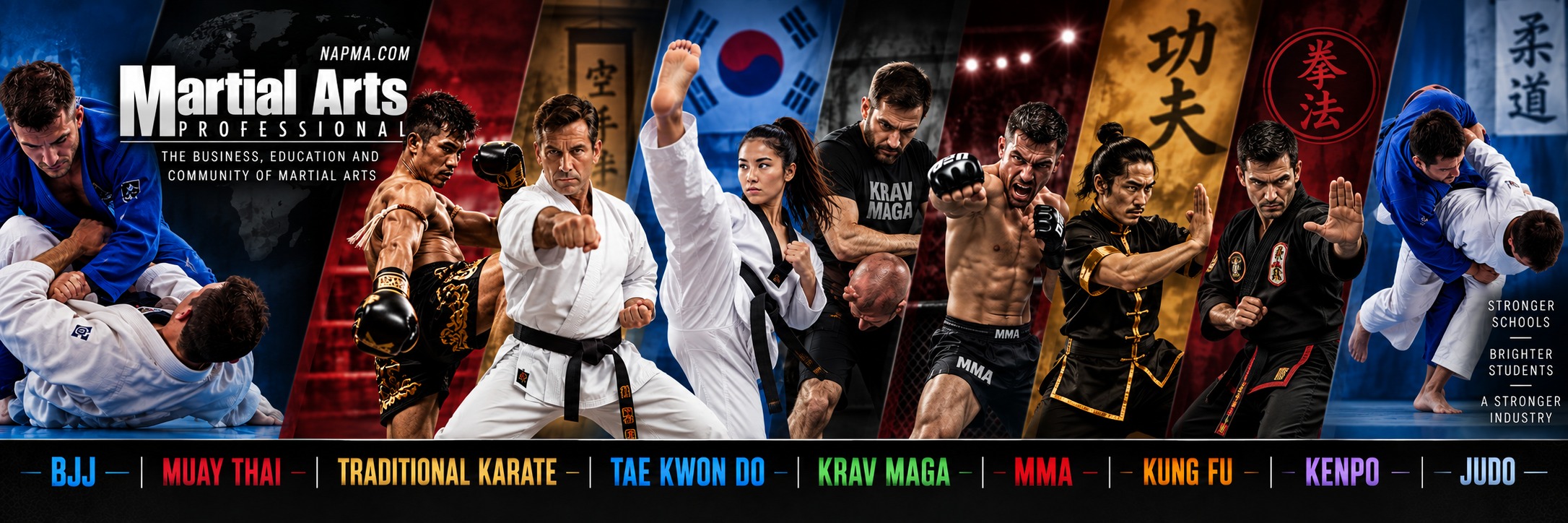
American Karate Pioneers: In Memoriam
Karate reached the United States in the late 1940s and 1950s, carried home by servicemen who had trained in Japan, Okinawa and Korea and by teachers from Hawaii. Within two decades it had its own tournaments, associations and commercial schools. These profiles follow the people who built American karate as a sport and as a business.
Browse by tradition: American Karate · Taekwondo and Korean Martial Arts · Brazilian Jiu-Jitsu · Muay Thai · Wing Chun and Chinese Martial Arts · Japanese Karate and Shotokan · Okinawan Karate · Judo · Business Pioneers · Martial Arts on Screen · All profiles
The profiles
Robert Trias
1923 – 1989
American karate pioneer who opened a karate school in Phoenix in 1946, founded the United States Karate Association in 1948 and developed Shuri-ryu karate.
Ed Parker
1931 – 1990
Hawaiian-born martial artist who developed American Kenpo Karate, built one of the first commercial karate school chains in the United States and founded the Long Beach International Karate Championships in 1964.
Peter Urban
1934 – 2004
American karate teacher who opened one of the first Goju-ryu schools in the United States in 1959 and founded USA Goju.
Richard Kim
1917 – 2001
Hawaii-born karate teacher and author of The Weaponless Warriors, based in San Francisco.
Allen Steen
1940 – 2025
The first American-trained black belt under Jhoon Rhee, founder of the Texas Karate Institute and the American Karate Black Belt Association, and promoter of the U.S. Karate Championships in Dallas.
J. Pat Burleson
1936 – 2021
Winner of the first U.S. National Karate Championships in 1964, founder of the World Martial Arts Ranking Association, and an originator of the intermediate belt-goal ranking system used across the martial arts school industry.
Chuck Norris
1940 – 2026
American martial artist and actor who won the Professional Middleweight Karate Championship in 1968, founded the Chuck Norris System and the United Fighting Arts Federation, and created the KickStart Kids character-education programme.
Mike Anderson
c. 1942 – 2026
American promoter and publisher who created the Top Ten Nationals and Professional Karate magazine’s national ratings, produced the 1974 World Professional Karate Championships that gave rise to the PKA, and co-founded what became WAKO.
Tony Thompson
1950 – 2025
Co-founder, with Ernie Reyes Sr., of the West Coast World Martial Arts Association, one of the earliest American affiliate-school networks, sustained over a 57-year partnership.
Orned “Chicken” Gabriel
1950 – 2025
San Diego instructor who opened his school in 1967, co-founded the United Karate Federation and produced 25 black belts including four-time world champion Steve Anderson.
Carol Middleton
1948 – 2026
Founder and director of the D.C. Self-Defense Karate Association for fifty years, a co-founder of the National Women's Martial Arts Federation and first president of IMPACT International.
Manny Saavedra
d. 2024
Founder of the World Sansei Goju-Ryu Karate-do Organization in Miami in 1979, from roots in Peter Urban's USA Goju lineage.
Gary Alexander
1938 – 2025
Isshinryu pioneer known as The Hammer, a bare-knuckle era competitor who ran a New Jersey dojo and promoted East Coast tournaments for decades.
Walter “Toby” Cooling
1944 – 2022
Founder of the Order of Isshin-Ryu in 1971, promoted in Okinawa by Isshin-Ryu founder Tatsuo Shimabuku, who told him to return to America and teach.
Hidetaka Nishiyama
1928 – 2008
Japanese Shotokan karate master who moved to Los Angeles in 1961 and founded the AAKF and the ITKF.
Takayuki Kubota
1934 – 2024
Founder of Gosoku-Ryu karate and the International Karate Association, and inventor of the Kubotan, developed for female LAPD officers and trademarked in 1978.
Gary Lee Cox
d. 2025
Former U.S. Army Special Forces soldier and Utah martial arts instructor whose family record describes more than fifty years operating his own studio.
Bernard Kerik
1955 – 2025
Police Commissioner of the City of New York from 2000 to 2001, in office on 11 September 2001, and a lifelong martial artist who taught defensive tactics to U.S. Special Forces.
Every profile in this section follows the In Memoriam research standard: deaths confirmed before anything is written, every claim sourced, conflicts between sources printed, and promotional claims labelled as such.