Great Achievement: The Edge of Growth: Keep The Students Who Are About To Quit!

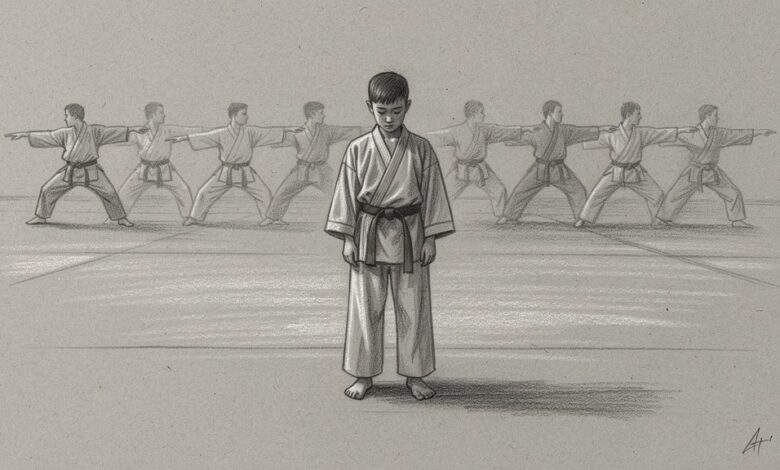
Students don’t quit when they’re winning. They quit the week it gets hard, which means your dropout number and your curriculum are the same conversation.
Go pull your last twenty dropouts and look at where each one sat in the curriculum when they left. I’ll tell you what you’ll find, because it’s the same in every school I’ve ever looked at. They didn’t leave after a good week. They left the week something got hard.
Students don’t quit when they’re winning. They quit at the EDGE OF GROWTH.
That’s not a motivational line, it’s an operational one. It means your retention problem and your curriculum are the same problem, and it means the moment you’re losing them is a moment you can see coming.
The letter on the office wall
We have a letter called Great Achievement. It’s on the wall in my office, and the staff read it until the philosophy is second nature, because it sets how we talk with families at enrollment, at renewal, and any time a parent is working to motivate their child.
Great achievements and anything of significance comes with challenges.
100 percent of the time, to accomplish something great or significant like becoming a CEO, a doctor, lawyer, or engineer or… a Black Belt, we encounter times where we don’t want to continue – and this happens right when we are on the edge of growth.
As a parent, if you base your actions on what your kids want to do, they won’t accomplish anything great or of significance. They’ll stop on these edges of growth. They’d rather choose to eat ice cream, watch TV, play video games or simply switch to another activity when they brush against a little challenge.
You may think Karate is about what they want, but it is about what you want for them to accomplish and achieve!!
This is the most important time in their lives. During this time, parents’ (and mentors’) job is not to push them but to teach them how to push themselves through challenges. If they don’t learn this as a child, they will not gain this ability. When they are an adult, they will always give up when it gets tough.
The line that does the most work in that letter is the one about the parent’s job. Not to push them. To teach them how to push themselves. Those are different jobs and most parents have never had anybody separate them out loud.
What the research supports, and what it doesn’t
There’s a whole popular literature about perseverance now, and I want to give you the honest version rather than the conference version.
Angela Duckworth and her colleagues introduced grit, defined as perseverance and passion for long-term goals, and reported that it predicted success beyond IQ and conscientiousness (Duckworth et al., 2007). That’s the version everybody quotes at seminars.
Here’s the part that usually gets left out. Marcus Credé and colleagues later ran a meta-analysis across 584 effect sizes and 66,807 people, and it came back more modest (Credé et al., 2017). Grit’s two-part structure wasn’t confirmed. Grit correlated only moderately with performance and retention. It correlated VERY strongly with plain conscientiousness, which we’ve been able to measure for decades.
Read that carefully before you throw the whole idea out, because one piece survived and it happens to be ours. The perseverance-of-effort half had significantly stronger validity than the consistency-of-interest half. Sticking with a hard thing held up. Never changing what you’re interested in did not.
That distinction is worth money to you. We are not in the business of telling an eleven-year-old they have to love karate forever. We’re in the business of teaching them to keep going through the part that’s hard right now, and that’s the half the evidence actually supports.
How you frame the hard part changes what happens next
Lisa Blackwell, Kali Trzesniewski and Carol Dweck followed 373 seventh graders across a school transition and found that the students who believed ability was something you build climbed, while the ones who believed it was fixed went flat (Blackwell et al., 2007). Same transition, same difficulty – different read on what the difficulty meant.
Then they taught the malleable view to a second group and watched motivation improve against a control.
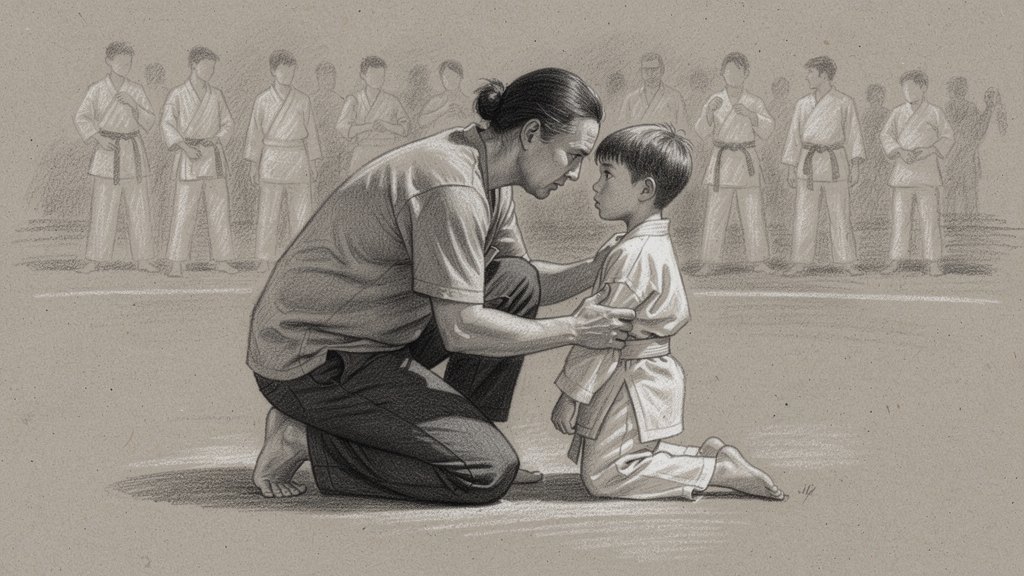
Apply that to a nine-year-old stuck on a form. If the difficulty means “I’m not a karate kid,” they’re done. If the difficulty means “this is the part where it gets built,” they stay. YOU pick which of those two sentences the student hears, and you pick it in about five seconds at the edge of the mat.
What to say at the desk
When a parent tells you their child wants to quit, they’re usually asking permission. Give them the frame instead. (If it has already gone past this and they’re asking to cancel, that’s a different conversation and I’ve written it up separately in The Cancellation Conversation.)
Tell them what you’re seeing, specifically, and name the edge: this is the week it got hard, and that’s not a sign they picked wrong. Tell them the letter’s line, that the job isn’t to push the kid but to teach the kid to push themselves. Then give them something to do this week that isn’t a lecture (the smallest possible next rep, and a time to do it).
Something I’d watch out for. Don’t promise the child will love it again by the end of the week, because you don’t know that, and one broken promise at this moment costs you the whole relationship. You can promise what happens if they get through the edge, because you’ve watched it happen hundreds of times.
What to do this week
Take your last twenty dropouts and mark where each one was in the curriculum. New stripe? First sparring cycle? The form that’s twice as long as the last one? You’re looking for a cluster, and there almost always is one.
That cluster is a schedule. It tells you the week to make the call, the week to put your best instructor on the floor, and the week to hand the parent the letter before they ask for a refund instead of after.
Find the cluster, then go stand in it (that week, on that floor, in person)!
Common questions
Why do students quit martial arts?
Usually at the point the material gets hard rather than after a bad experience. Mapping recent dropouts against where they sat in the curriculum tends to reveal a cluster at a specific difficulty step, which turns retention into something you can schedule around.
Is it right for a parent to push a child who wants to quit?
The distinction that matters is between pushing the child and teaching the child to push themselves. Most parents have never had those separated for them, and the second one is the skill that carries into adulthood.
Is grit real, or is it overstated?
Both, in parts. The original work reported grit predicting success beyond IQ and conscientiousness. A later meta-analysis of 584 effect sizes found the structure unconfirmed and the correlation with performance only moderate, with grit overlapping conscientiousness heavily. The perseverance-of-effort component held up better than consistency of interest.
Does what a student believes about ability affect whether they continue?
In a study of 373 seventh graders, those who believed ability was malleable improved over two years while those who believed it fixed stayed flat, and teaching the malleable view improved motivation against a control group.
What do you say to a parent whose child wants to stop?
Name the edge specifically, separate pushing from teaching a student to push themselves, and give one small, timed action for the week. Avoid promising the child will enjoy it again by a particular day, which is a promise nobody can keep.
References
Blackwell, L. S., Trzesniewski, K. H., & Dweck, C. S. (2007). Implicit theories of intelligence predict achievement across an adolescent transition: A longitudinal study and an intervention. Child Development, 78(1), 246–263. https://doi.org/10.1111/j.1467-8624.2007.00995.x
Credé, M., Tynan, M. C., & Harms, P. D. (2017). Much ado about grit: A meta-analytic synthesis of the grit literature. Journal of Personality and Social Psychology, 113(3), 492–511. https://doi.org/10.1037/pspp0000102
Duckworth, A. L., Peterson, C., Matthews, M. D., & Kelly, D. R. (2007). Grit: Perseverance and passion for long-term goals. Journal of Personality and Social Psychology, 92(6), 1087–1101. https://doi.org/10.1037/0022-3514.92.6.1087
A version of this article first appeared at mastermoody.com.