
Qualifying the Struggling Student for Leadership: Better Results And More Enrollments!

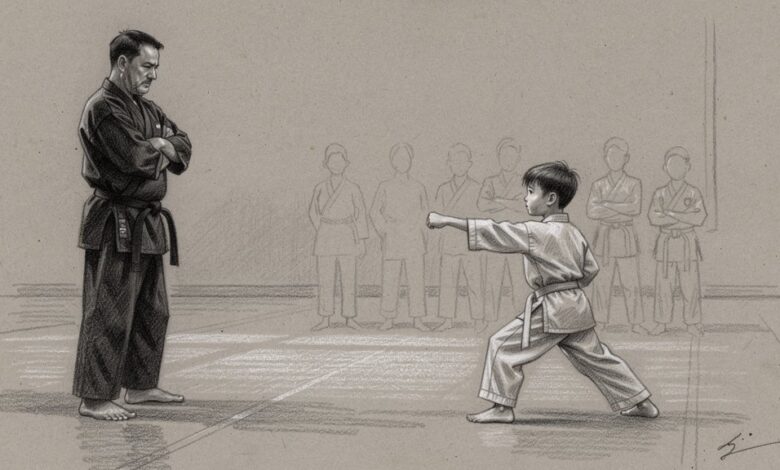
The student who forgets their uniform and gets in trouble at school is the one the program was built for. Here’s how to qualify them, and what to say to the parents.
Every school has this student. You’d put them in Leadership tomorrow and you know it, and you haven’t brought it up, because last week they forgot their uniform twice and a parent apologized for their behavior on the way out the door. Recommending the upgrade feels like asking a parent for more money for a kid who isn’t holding up their end.
Notice what you just said, though. If you can say they’d be good in Leadership, that’s the qualification. You just made it.
The reason it feels like a money grab is that you’re weighing the wrong evidence.
Three things qualify a student, and talent is not one of them
We qualify on three things, and only three.
Are they showing up? (Not perfectly – consistently.)
On the floor, in class. NOT at home. Are they good when they’re with you? If you’d put them in Leadership, you already know they are.
Are the parents in this with you?
That’s the whole list. Not talent. Not whether they remembered their gear. Not whether they had a rough week at school. A nine-year-old who forgets things and gets in trouble is exactly who we built the program for!
All three of those are things you can see on your own floor. Behavior at school and behavior at home reach you secondhand, from a parent who is usually frustrated at the moment they report it. You can’t verify either one, and neither one is the test.
The student who struggles has the most to gain
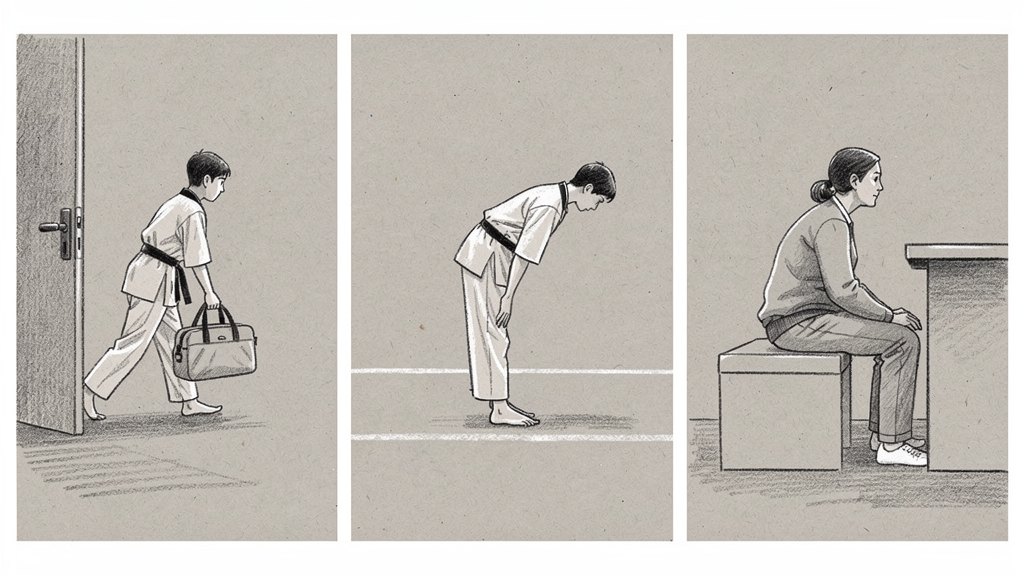
Adele Diamond and Kathleen Lee reviewed the interventions shown to improve executive function in children four to twelve, which is the cluster of focus, self-control and follow-through you are actually selling (Diamond & Lee, 2011). Martial arts is on their list by name, next to aerobics, yoga and mindfulness. Two of their findings land directly on the kid at your front counter.
The first: every program that worked involved repeated practice and progressively increased the challenge. That’s a belt curriculum, running in your school every week. You already own it, and you didn’t have to buy a thing!
The second: children with worse executive functions benefit MOST.
That’s their sentence, not my reading of it. The student who forgets and misbehaves has more room to gain than your tidiest White Belt. If you wait for them to settle down before you recommend it, you’re keeping them out of the program that settles them down.
Growth is the metric, not exclusion
At my school the staff live by the KarateBuilt Charter, and every one of them carries it on a metal card in their wallet:
The middle sentence is the one that does the work. We measure results based not on who we exclude but on students’ constant growth. The forgetting and the misbehaving aren’t the reason to hold a student back. They’re the reason to move them forward.
There’s a reason to take that seriously well past the belt. Terrie Moffitt and colleagues followed 1,000 children from birth to age 32 and found that childhood self-control predicted their physical health, their personal finances, their substance dependence and their criminal record, along a gradient (Moffitt et al., 2011). Every step up the scale was worth something. They separated the effect from intelligence and from social class, then checked it against 500 sibling pairs, and inside the same family the sibling with less self-control still came out worse.
Be careful how far you carry that one. It’s a pattern across a population over three decades, not a promise about one nine-year-old in your 5:15 class (correlation, and they say so). What it does tell you is that the thing you teach sits underneath all four of those outcomes.
Run the parent conversation in three frames

Past. Where they were the day they walked in your doors, and what the parents told you they wanted for them. Go back to your notes from the intro – they told you something specific, and they’ve probably forgotten they said it.
Present. Who they are on the floor today, and what has already improved in the weeks they’ve been training. They may still be misbehaving at home. Parents can almost always name two or three things that have gotten better when you ask them straight out, and they will rarely volunteer it on their own.
Future. Have them picture it. What if this keeps going all the way to Black Belt, then to 2nd Degree Black Belt, and into adulthood? How much difference would that make? Then turn it around and have them picture the other one. Ask them whether they know an adult who never built follow-through, or focus, or discipline. Everybody does! Everybody can also see what it cost that person. Now the parent is holding both sides at once.
I’ve written about the mechanics of this conversation in more detail in Past, Present, Future: Moving Customers Off Price, which is the same three frames aimed at a different decision.
Transfer to school and home is a separate job
Most of us assume this part happens by itself. It doesn’t.
Nicholas Holt and colleagues synthesized 63 qualitative studies into a model of how youth sport actually produces life-skill outcomes (Holt et al., 2017). Their model lists life-skill building activities and transfer activities as two separate things, and it lists them separately on purpose. The second doesn’t come free with the first.
A student can have beautiful discipline on your floor and none of it at the dinner table, and that’s not a failure of your program. It means nobody assigned the transfer, which is a job somebody has to do on purpose.
The same model names parental involvement as part of the climate that produces any outcome at all. That’s a reason to care whether the parents are in it, separate from whether they’re paying for it. The parents do part of the work themselves. That’s why they’re on the list.
Make the transfer explicit, and assign it like any other requirement. “This week you’re packing your own uniform for both classes, and next time I see you, you’re telling me whether you did it.” That’s a transfer activity. Withholding the recommendation is the failure here, not making it.
What to do this week
Pull your roster and count how many students qualify on those three things, attendance, attitude on the floor, and parent support. Then count how many you’ve actually recommended for Leadership or BBC.
That gap is almost always the same student, the one who’d be great in the program and keeps having a rough week.
If those two numbers aren’t within a few of each other, you’ve got students sitting in that gap right now. Go get them!
Common questions
What qualifies a student for a Leadership or BBC program?
Attendance, attitude in class, and parent support. Talent isn’t a qualifier and neither is conduct outside your school. The first two you observe yourself; the third you confirm in conversation.
Is it a money grab to recommend an upgrade for a student who keeps misbehaving?
It’s the opposite, if growth is your metric. A review of executive-function interventions reports the largest gains in the children who start with the weakest executive function, so the struggling student has the most to gain from the program rather than the least.
How do you raise Leadership with parents without sounding like a sales pitch?
Use three frames. Where the student started and what the parents said they wanted, who the student is on the floor now and what has already improved, and what continuing looks like against what stopping looks like. The parents supply most of the evidence themselves.
Does martial arts training actually change behavior at school and at home?
Not automatically. Models of youth development separate the activities that build a skill from the activities that carry it into another setting. Transfer has to be assigned and followed up, the same as any curriculum requirement.
What if the parents are not supportive?
Then one of the three qualifiers is missing and the conversation is with the parents, not about the upgrade. Parental involvement shows up in the research as part of what makes any outcome possible, so it’s worth treating as a condition rather than a formality.
References
Diamond, A., & Lee, K. (2011). Interventions shown to aid executive function development in children 4 to 12 years old. Science, 333(6045), 959–964. https://doi.org/10.1126/science.1204529
Holt, N. L., Neely, K. C., Slater, L. G., Camiré, M., Côté, J., Fraser-Thomas, J., MacDonald, D., Strachan, L., & Tamminen, K. A. (2017). A grounded theory of positive youth development through sport based on results from a qualitative meta-study. International Review of Sport and Exercise Psychology, 10(1), 1–49. https://doi.org/10.1080/1750984X.2016.1180704
Moffitt, T. E., Arseneault, L., Belsky, D., Dickson, N., Hancox, R. J., Harrington, H., Houts, R., Poulton, R., Roberts, B. W., Ross, S., Sears, M. R., Thomson, W. M., & Caspi, A. (2011). A gradient of childhood self-control predicts health, wealth, and public safety. Proceedings of the National Academy of Sciences, 108(7), 2693–2698. https://doi.org/10.1073/pnas.1010076108
A version of this article first appeared at mastermoody.com.