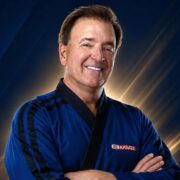

Jhoon Rhee — The Way of Truth, Beauty, Love and Profits
World-renowned 10th Degree Black Belt, known as the Father of American Tae Kwon Do. Appointed to the National Council on Vocational Education (1984–1988) by President Ronald Reagan and as Special Advisor to the President’s Council on Physical Fitness & Sports (1988–1991) by President George H. W. Bush. Martial arts instructor to Muhammad Ali, Jack Anderson, George Allen Sr., Bob Livingston, Tony Robbins, Jack Valenti and over 300 U.S. Senators and House Representatives. Creator of National Teacher Appreciation Day; received the American Immigrants Achievement Award on 19 March 1999 and NAPMA’s Lifetime Achievement Award on 10 June 1999. In January 2000 he was the only Korean American named among 203 most recognized American immigrants by the National Immigrant Forum and the U.S. INS — a list that included Albert Einstein and Alexander Graham Bell.
Listen to the interview
This interview was conducted for Martial Arts Professional, the trade magazine the National Association of Professional Martial Artists has published since 1996, and appeared in the magazine’s interview series. It is republished here as part of the magazine’s archive. The original recording date is not stated in the surviving archive record.
Browse the full interview archive
Full transcript
Transcript generated from the original recording and lightly edited for readability; minor errors may remain.
Okay, NAPMA members, welcome to our show. Today, we have with us my good friend and my mentor, Grandmaster Jhoon Rhee. Grandmaster Rhee, welcome to the Sounds of Success. Well, thank you for your invitation. My pleasure. I’ve been wanting to do this interview for many, many years, and I have to say we’ve had some interesting guests on this show. Zig Ziglar, Tony Robbins, we had the senior vice president of Dell Computers and Jean-Claude Van Damme, and just all kinds of people, but I have to say that I’ve never been more excited about an interview than this one today because you are, as far as I’m concerned, one of the most iconic martial artists in history. So thanks for your time today, Grandmaster Rhee. We really appreciate it. Thank you very much for your flattering me. Well, definitely it’s well deserved. My first question to you is this, sir.
Read the full transcript
You’ve been studying martial arts now for over 60 years. You opened up your first school in 1962 in Washington, D.C. What’s the biggest change you’ve seen take place in the martial arts industry since you’ve been in America?
Well, when I first came, you know, it was sin to make money in martial arts, just like in communism ideology, that in communism, that profit-making is a sin. As a result, nobody really wanted to make money, and in a result, they all became poor, and now all the communist countries are dismantling. And by the same token, martial arts industry had the same, you know, thought, which was wrong information, brainwashed in the wrong way, and I wanted to break that thought. And so we really went in, and commercial, and television, and newspaper. I mean, just we went in a full swing, just like any other business.
So the biggest change you’ve seen, I guess, in your career is that the commercialism that you once helped catalyze just really caught on nowadays, it seems. Well, as you know, without money, that we cannot do anything. That’s why even churches, they have to make money before they can flourish, you know, spreading their words. And in fact, in 1964, when Black Belt had a conference that Bruce Lee and I were invited as a special guest, and I gave speech there, you know, in fact, that I just bought a house, I told them in my speech, and Jack Dutcher, who was one of my head instructors, and he said, the master read, don’t buy that house. If you do that, people in neighborhoods are going to tell you must be Chinese houseboy. And sure enough, one day I was, you know, alone, more, and sure enough, I was mowing the lawn, a guy passing by and whistling and so I stopped my, hey, boy, how much do you charge me? For an hour, I said, nothing. So I get to, I get to share the master bedroom with the mother who owns that house. And he just, you know, thought he was funny, he just drove away. It’s so true, you know, we must make money to be spreading
Better service and receive the respect, martial artist. Yeah, well, there’s no doubt about it. You can do a whole lot more with profits than you can with losses. If you could look into a crystal ball, what do you think the martial arts industry will be like in 25 years from today? What do you see in your mind’s eye? Well, let me tell you that last 40 years that I have been saying that I’m going to live up to 136, because I saw a lady in Russia, a former Soviet Union, a lady who lived 135 and I said, if she can, I will do one more. Ever since then, my goal has been 136. And you know, when I got out of my surgery, everybody thought I’m going to die because I got a stroke. And I was the only one who never had the sense of a theater I’m going to die. I never thought I was going to die. And then when I’m up, I’m back, I’m really busy in my activities, my wife and everybody thought I was going to die. And I told them, you know, because I said for the last 40 years that I was going to live 136, everybody in my buddies listening for 40 years, they begin to believe they all reported to me,
[05:06] Yes, so we are going to live up to 136. I didn’t really feel that I’m going to die. Well, mind over matter, I sure hope you pull that off. And as I’ve told you many times, I would like to be one of the first people to be invited to your 100th birthday.
I’m looking forward to that day already. You managed to grow from one school to nine schools at a time when martial arts was not nearly as understood or even accepted as it is today. And that’s quite an amazing feat. Talk to us about the transition from running a single school yourself to managing a whole chain of schools. What were some of the challenges you had to overcome to make this work? Yes, I really made it happen in the really first 10 years. I studied in 1962. By the time 1972, I had about nine schools. And I think, first of all, you must believe in what you’re doing is a positive thing for the community. And you just must really work very, very hard. For example, 1967, I know that time I was giving Junior National Championship annually. And we had 8,000 audience in 1967, of course. Bruce Lee was my special guest and his name really helped. But I had to let the people know that Bruce Lee is coming. And so I walked for four hours for three months to really put my poster in every barbershop.
And so everybody has to have about three or four haircuts in three months. And they all had to watch about three or four times. And I was really shocked to really have so many people coming to watch that time. And Bruce Lee brought Robert Cobb that time. I spy a TV series and Ed Parker came. And so we had a lot of personalities really appearing in the event. And you just have to have promotion just like any other business. That you must bring some known personalities because they are the ones who attract audience. And I’m going to talk to you a little bit more about PR as we move forward in this interview. But a lot of the NAPMA members, they want to go from having one school to having two or three or four schools. Is there any advice that you could give to them about multi-school operations versus having just a single school? Well, I believe that first of all, they must really think in a service first of them making money. If you really sincerely try to serve, when they pay $1, you want to pay back $2 value in service and make everybody happy.
[08:22] And so, you know, really pouring money in advertising, television and newspaper is really very, very, very expensive. But once your service is good now, word of mouth. Word of mouth will bring the people in. And that doesn’t cost any. That comes only from your really your vested interest in serving people. That’s exactly right. Customer service is king. And in order to give customer service, you have to have a servant. And I know that many of the NAPMA members think that way. Servant, leadership, and oftentimes that’s far more powerful than, as you said, running a newspaper ad or a commercial on television. Those are some great points. Hard work, belief in what you’re doing, and customer service. And in 1968, we started a television commercial. And, you know, at that time, for a couple of years, we did maybe a couple of stations. But then 1970 to 1980, for 10 years, I was able to afford all the, you know, finance to pay the commercial that we did, you know, one spot a day in all five stations. At that time, there was not too many stations like we do now. We had the channel five, seven, four, nine, and the channel 20, UHF. And every station carrying my commercial five times a day for 10 years. Can you imagine how many that is? And everybody recognized my face
That time. Now that there’s many, you know, all people, senior citizens now, they all remember my face and my name. And I still remember seeing some of your commercials, albeit on video, the ones with Jhoon Rhee, your son, and Kimi-ri. My daughter, my daughter first day, nobody bothers me. And then my son follows nobody bothers me either. And, you know, I really thought, you know, I was going to say that that was my idea. I was kind of afraid made some guys in the downtown pick me up. So I made my children say that, you know, it’s a cuter than really arrogant. No, that’s the brilliance behind it. You know, the kids were so cute in their uniforms. And, you know, they definitely aligned with the audience. I’m sure you were trying to attract to the school anyway. So that commercial really won the first place in Hall Metropolitan area with the award because that really make people remember. Yes. Yes. No doubt. You know, in the sixties and seventies, there was even more backlash against commercialism in the martial arts than there is today. How did you deal with all the criticism from people who saw themselves as quote unquote real martial artists back then and who didn’t necessarily approve of commercial martial arts? Well, I really didn’t care. I really only care what I believe in. You know,
I will tell them then time will come to prove that I was right. Sure enough. I was right. Everybody’s in really involved in commercialism today in martial arts. Without it, you cannot survive. And same thing, you know, I really believe that someday that martial art will be remaining as a, you know, the performing art martial ballet. Right now we have, you know, martial art fighting because we cannot trust one another. You know, James Madison said, if all men or angels in the government would be necessary. I follow if all men or angels do we need Tae Kwon Do fight. And then I say, if all men or angels, you know, I’m not saying anything, I’m just asking questions and let the audience have their own answer. Do we need the correct education or 10 commandments? And this, that’s why I came up the idea that slowly we must change martial arts. Because I see next hundred years, we are going to really eliminate martial art fighting because we are going to build that, totally, trustable society among people next hundred years. I see. Yeah. And as I wrote about in my book, criticism sometimes is the price of success and you were criticized. but I think people, now are recognizing that you were a visionary and, many of the things that you stood for 30 and 40 years ago are coming true
[13:25] Or have already come true today. Well, thank you. Very interesting. I’m proud of that. I’m sure you are. you and Bruce Lee talked about the business of martial arts from time to time. in fact, I’ve seen in your book that he was sending you ads from Chuck Norris and others. Can you share with us how you and Bruce Lee, thought about the business of martial arts in the business of martial arts schools in the sixties and seventies? You know, Bruce Lee, did not believe in really having chain of his schools. He just, he had still some old thought, not business way, but, I was really very, you know, much business minded in early ages that at that time, almost no martial artists really, really spoke out loud. You know, they may believe in business like I did, but they didn’t, they are talk out a tough speak up, but, I didn’t care. I, as long as I believe in what I’m doing is right.
That’s all counts, but, time will solve that who is right and who is wrong. And so will be, will be, you know, shown in the time. if you really do, not promoting without really cheating or deceiving in the public. Yes. Yes. Yes. So if I understand you correct, it’s, and please correct me if I’m wrong here, but it sounds like you were, aiming more towards commercialism, but Bruce Lee was not. That’s right. I understand. That’s why he didn’t have, he had much bigger name than I did, but he didn’t have any chain. -huh. I see. Except just few loyal students that found out him. That makes sense. What are the two or three biggest realizations that you had that helped you create both a highly successful commercial school operation and that allowed you to consistently produce many, and I mean many high quality black belts, including world formed champions like Charlie Lee and John Chung and fighting champions such as Jeff Smith and many, many others. Well, I believe it in, believing, I believe in basics, you know, really perfect basics. Once you have a good basic, for example, you know, one good punching, good job, good front kick, good round kick, good side kick.
[16:02] What else are there? If you do those really perfect, then, all this complicated forms are others, you know, combination of these five or six basics in speed and accuracy and, fighting the same way. And, you just, must really, with practice, the good basics and, the basics of everything, you know, there is a, all, the famous book, you know, Robert Fulgham, remember wrote, all I know is, that everything I learned in kindergarten, that one basic in human society that we are violating, is, you know, really cheating. And that really is the only crime that I can see of a human society. There are only a few basics in golf, you know, those, you know, Tigerwood making so much, you know, money and success. How many basics in golf? One swing and putting, just two basics, right? And so when it comes down to, you know, all fields that only had less than half a dozen basics, so stay with the basic, then you are going to be successful. And that’s the, I think that’s the result that I had, because of my emphasis in basics, we had a good form, performers, good, you know, fighting champions, and you just must, love your basic as you love your students.
Beautifully put. And I concur. In fact, the NAPMA materials are indicative of that. Some people may feel they’re redundant, but in reality, it’s just a constant, reminder of the basics, sales, marketing, customer service, upgrades, renewals, character education for children. And each month the materials come to our members and they’re not meant to be redundant. They’re just a reminder to do the basics because those are the most important things you could ever work on, whether you’re talking about business or fighting. goodness. You know, you talked about redundant. Let me tell you that my success is staying with the basics. So, the speech that I gave at the, you know, all over the world and you and everything is that it was same thing I have been giving for the last 40 years. I have been really saying and thinking and living by basic principles. And so my speech doesn’t change the event to another.
And so those who heard me for 40 years ago, they are so surprised that I’m still talking the same thing they heard the 40 years ago. Yeah, no doubt. So you have to be redundant to make things really, stick it to the, yeah. And it’s very hard to master the basics. I mean, you can become good at them, but it seems to me like, really mastering the basics is a lifelong journey, you know? So yeah. So, you know, when people ask you, Hey, Rob, you, I heard that before. I know you did, but did you do it? You just asked that.
That’s a writer downer. I’ve got to definitely make a note of that. Yeah. Whenever they say, Hey, I heard that 40 years ago. I know that, but have you lived it? you may give me the same answer, but I’m going to ask you my next question anyway. you’ve been responsible for some of the most successful school operators in the world. That includes Allen Steen and Pat Burleson in the early days and Stephen Oliver, Jeff Smith, Larry Carnahan, Pat Worley, John Worley, and many, many others nowadays. Michael Coles also. Michael Coles is a DC guy. He is, he is really successful here in Washington DC. He used to work for me now. He has his own. Yes. They just go, you know, branch out. Just like when children grow up, they really go out their own way from their parents. Well, I usually resent that, but I don’t anymore. That’s right. That’s right. They have to leave the nest at some point.
[20:25] I remember when you and I were at, Allen Steen’s birthday party a number of years ago in Texas and, Mr. Steen had that big family tree, on display and it was stunning to me. there was his name and your name. And then underneath that, there was just this massive tree of some of the biggest names that, that is, I guess have ever been in, in American martial arts that are from your lineage. So I have to ask you, what did these people learn under your mentorship that led them to such huge successes?
Well, really, as my, student creed, recited, you know, we are here to really develop confidence through strength in my body, honest in my heart, knowledge in my mind, you know, that’s it. You have to have that. That really, I think is a well-organized in my seven quarters of a champion. You must really, really develop your physical qualities for us from there. You learn how to develop the human qualities from there. You can develop your business, a man’s qualities. Okay. And we’re going to talk about the seven qualities of a champion later in the interview. So, so I guess what you’re saying is that many of these people became so successful either as fighters or, weapons and forms champions or business owners, because of the seven qualities of a champion that you taught them. I understand that that seven quarters of a champion that really gives me the, you know, what’s the universal purpose of life that you saw and all that. I mean, that really solved all my questions about life problems.
I see. We’ll touch about more on that in here in just a moment, because it’s just so critical. You’ve been conducting speeches all over the world for many years now and at a very hectic pace, I might add. I mean, you’ve done, seminars in Morocco and Russia and China and Japan and Kazakhstan. You’ve done them for the United Nations and the state department. I mean, the list is truly huge. If I may be so direct, sir, this is very challenging work. Why are you doing it? Well, you know, I have a vision that, why, you know, the mankind is suffering when I will create this so loving and unconditional love of a creator and made us and put us in, in such a, you know, tribulation and, predicament and why? And there is a reason. And so, I really, really searched my philosophy, how we can really help humanity.
And I think I have really solutions to, all the problems that we have that, I found only one problem, the seeding. And it’s not that we, that we don’t really honor God is really, he’s punishing us. We are punishing ourselves by cheating one another. So if all the cheating is gone, if all men or angels, no government necessary is really so right. And so, that I have some, you know, really big vision, bigger than anybody that ever conceived that I said, always said, I said, you can reach as far as our thoughts can reach. Then I was, you know, I found I am contradicting myself. How come you don’t you think a little bigger thought? Then I said, okay, well, the biggest thought that I can, I can conceive is to buy whole earth. Then I said, it’s going to be a lot of problem. Then what would be next, you know, best goal that I can conceive making everybody happy with every breath of life. And I’ve been loved by all 6 billion people. When we were loved by 6 billion people, you’ll be the happiest person in the whole wide world. Very interesting. You talked about cheating, deception. I guess we could extend that to the category of fraud, which is prolific these days. I myself have been a victim
[24:41] Of this recently. I don’t mind saying, though I won’t reveal any further details about that. But when somebody does cheat you, rip you off, how, what’s your advice for dealing with that?
Well, I really, I am very, really, quick decision makers and I’m not very careful sometimes, but when it comes to money, I have some experience that, I co-signed for some people and I’m, and I ended up paying that. And then sometimes it was maybe up to a hundred thousand, two hundred thousand dollars. But now I said, you know, I’m going to goody and when you do business, you just can’t help, but once in a while that you have, you know, forced into, that is deceiving here and there. This world is more than now without, you know, really deceiving once in a while. You cannot survive. And so, I said, you know, not to really, deceive anybody. I’m going to stay away from business. I’m giving just nothing but speeches. I don’t do any business. Very interesting. Very interesting. Stephen Oliver mentioned to me recently that when it comes to PR, you are the best he’s ever seen in the martial arts world. please talk to the NAPMA members about the importance of generating PR for their schools and maybe give them a few ideas that they can run with immediately after listening to this interview. Well, you know, no, Jesus was the best salesman ever lived. That’s right. The greatest salesman in the world.
Salesman means, the person who are able to really persuade your ideas to others. And so, I really think that to be real good, this salesman, you have to really believe in what you are selling first. And, you know, you must to be really, you must to be saying that, whatever you’re selling is going to be good for our, buyers. You almost believe that. And then, you must really, you know, to become a good salesperson, you must really, really constantly selling and with a sincerely, and there’s no other way, you know, when you first become a salesperson, you may sell one out of five, try. And when you keep doing now two and three, four, you’re batting average become 90%. And once you reach that, you are going to be the good salesperson. Again, use the purpose of selling is to serve like Jesus did.
I see. In your case specifically, you were extremely high profile. I mean, even in, at this time, I can’t say there’s another martial artist that has affiliated with president, Bush senior and Ronald Reagan and Bill Clinton and, hundreds of, congressional men and women. And, you were the teacher for Bruce Lee and Muhammad Ali and, Tony Robbins. And you know, you were on television with commercials and you’ve been in the list is just huge. I guess, you know, for the average martial arts school owner that does nothing in the area of PR, they have a school and they have the build it and they will come mentality. I think that stuff only works in the movies. You really worked it though. You were on TV. you were in front of stadiums of people doing demonstrations constantly. You became a major name, not only in the martial arts world, but in your own community.
[28:59] How did you do that? I mean, did somebody advise you to do that or did that just come naturally?
Oh, no, that’s just naturally. And that’s really my sincerity to change the world without really, getting credibility from this, you know, the world opinion leaders, unless they really, testify that how good guys you are, you’re not going anywhere. And so, you know, actually that I taught to members of Congress for 43 years now, three mornings a week, then takwon do. There were two reasons. One is that, I want to pay back what America had done for Korea during the Korean war. And secondly, and one day I’m going to be in confront with the whole public that maybe not very popular issues that, you know, if I just, you know, talk sweet words only, with the establishment of society, they’re not going to make any change. You may have to really confront with the world society saying that what you knew thought is the difference is. And then, that time when I get, I may get in trouble, then that time who knows maybe white house and Congress may testify that June is not bad guy.
Well, I know, president Bush senior gave you a glowing endorsement on video, which is, if you’re going to get an endorsement from somebody who better than the president of the United States. Congratulations. Well, you know, I really, when the Korean television wanted to do a documentary on my life, I just said, well, my TV personnel, the crew wants to visit you just for a minute. Tell you what you believe in what I have done. Boy, he really did a much better than I expected. I was so grateful. I didn’t, I didn’t spend the money to travel there. And he just in four days, three, four days, he just sent it back to me. That’s absolutely amazing. I’ll tell you one of the things that we teach our NAPMA members is, is the value and importance of social proof and getting testimonials from community leaders and their students about the benefits of training and all this kind of stuff. I have to say, you’ve probably got the best one of all time directly from the president. Yeah. You know, that, that, that, that, that piece really, I sent to every