
The professional martial arts school, with its introductory lesson, enrollment conference, monthly tuition, belt-rank curriculum, children’s program and weekly numbers, was built in the United States between 1956 and the mid-1990s by a small, connected group of people. This is the history of that business: who built it, where each of its systems came from, and how the knowledge passed from Jhoon Rhee’s Texas classes and Washington, D.C. institute, through Allen Steen, J. Pat Burleson, Nick Cokinos’s Educational Funding Company and Grand Master Jeff Smith, to the trade associations and coaching organizations that school owners use today. Where the record is thin or disputed, we say so.
Disclosure
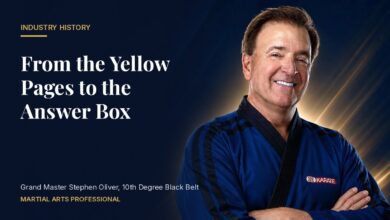
This history is published by Martial Arts Professional, the trade journal of NAPMA, the National Association of Professional Martial Artists. Our publisher, Grand Master Stephen Oliver, is CEO and Chairman of NAPMA and appears in this history: he trained and worked within the Jhoon Rhee Institute, served on the Board of Directors of Educational Funding Company from April 1987 through 2001, and has coached school owners since 1985. Grand Master Jeff Smith, also a subject here, is Chief of Instruction for Martial Arts Wealth Mastery. Where a passage rests on Stephen Oliver’s first-hand recollection rather than a published record, it is labeled as his recollection.
The short version
- Origins (1956–1962): Jhoon Rhee arrived in Texas in 1956 and taught the classes that produced Allen Steen, his first American-trained black belt (1962), and J. Pat Burleson. Rhee opened the Jhoon Rhee Institute in Washington, D.C. on June 28, 1962.
- The business model came from dance studios. Arthur Murray and Fred Astaire studios had already built the introductory lesson, the enrollment conference, prepaid and financed programs and weekly statistics. Burleson learned the Fred Astaire sales system in the mid-1960s and passed it to Rhee and Ed Parker; Nick Cokinos, an Arthur Murray and Linkletter–Totten dance-studio operator, brought the same model into the Rhee organization from 1967.
- The first chain: Allen Steen’s Texas Karate Institute grew to nine company-owned schools and dozens of affiliates and pioneered separating teaching staff from sales staff.
- Billing and business education: Cokinos founded Educational Funding Company (EFC) in 1967–68. It combined third-party tuition billing with business training and by the early 1990s was reported to serve more than 700 schools.
- The operators who spread it: Grand Master Jeff Smith helped Cokinos build the Rhee schools’ systems and ran Rhee’s operations for fifteen years; Stephen Oliver, trained in the same institute, founded Mile High Karate in 1983, sat on EFC’s first Board of Directors (1987–2001) and taught EFC’s systems nationally.
- The association era: John Graden founded NAPMA in 1993 and Martial Arts Professional in 1996. Supplier-led consulting (Century’s MAIA, 2001) and franchise systems followed. Stephen Oliver acquired NAPMA in August 2007.
What is the “martial arts school business,” and when did it begin?
Martial arts were taught in the United States long before anyone made a living from them. Judo clubs, Japanese-American community dojos and military combatives programs date from the early twentieth century. What did not exist until the late 1950s was the commercial martial arts school: a storefront open to the public, staffed by paid instructors, selling a structured program of lessons for a monthly or prepaid fee, and run as a business that could support a family and open a second location.
That model has a specific history. It took shape in three places at almost the same time: Texas, where Jhoon Rhee’s college classes produced the first generation of Texas black belts; Washington, D.C., where Rhee built the Jhoon Rhee Institute from 1962; and California, where Ed Parker, the Tracy brothers and the Chuck Norris studios built the first large Kenpo and karate chains. Chicago, with its own early schools and tournaments, was a fourth important center, but the business systems that became standard spread mainly through the Texas–Washington lineage described here.
The industry went through four broad eras:
- Pioneers (1956–1966): first commercial schools, first tournaments, first black belts trained entirely in America.
- Systematization (1964–1975): dance-studio sales and enrollment methods adopted; the first chains; third-party tuition billing; safety equipment that kept students training.
- Professionalization (1975–1993): EFC teaches business to hundreds of schools; multi-school operators emerge nationally; the EFC Board becomes a working laboratory of top operators.
- Associations, suppliers and coaching (1993–present): NAPMA, trade magazines, supplier-backed consulting, licensing and franchise systems, and dedicated coaching organizations.
Where did the business model come from?
From ballroom dancing. By the 1950s the franchised dance-studio chains had solved the problem every martial arts school would face: how to sell something intangible and slow to master, to adults and children who could quit at any time. Arthur Murray had begun building a chain of studios by about 1920, and the company describes itself as one of the oldest franchised businesses in America. Fred Astaire Dance Studios was co-founded in 1947 and franchised from 1950. A smaller network, the Linkletter–Totten Dance Studios, used the broadcaster Art Linkletter’s name.
Their system had every element a modern martial arts school owner will recognize:
- advertising that generated inquiries, booked into a free or low-cost introductory lesson;
- a structured enrollment conference after that lesson, offering a course of lessons paid in advance or financed;
- written agreements with a total program price, a down payment and installments;
- progress levels (Bronze, Silver and Gold at Fred Astaire) that gave students goals and gave the studio a reason to offer the next program;
- instructors trained to teach and to sell, with management progression for the best of them;
- children’s divisions, and in some studios a service that collected children from school and drove them to lessons;
- a short list of numbers, reviewed every week, and multi-location management.
Two people carried that system into martial arts, independently and from different sides of the dance industry: J. Pat Burleson in Texas, through Fred Astaire licensees, and Nick Cokinos in Washington, through Arthur Murray and Linkletter–Totten. Both channels ran into the Jhoon Rhee organization. The longer account of this transmission is our feature Where Martial Arts School Business Systems Came From: The Dance-Studio Lineage.
Who was Jhoon Rhee, and why does the industry start with him?
Grand Master Jhoon Rhee (January 7, 1932 – April 30, 2018), known as the “Father of American Taekwondo,” is the root of the lineage. Born in Asan, Korea, he trained in the Chung Do Kwan and arrived in the United States in 1956 through a South Korean military training program at Gary Air Force Base in San Marcos, Texas, with, by his own account, $46. He enrolled at Southwest Texas State College in 1958 and transferred to the University of Texas at Austin in 1960 to study engineering; a 1975 first-person interview says he never completed the degree.
In Texas he advertised his classes as “karate,” the word Americans knew, and adopted “taekwondo” after General Choi Hong-hi’s visit in 1960. A demonstration in which he broke boards in mid-air drew about 180 students to one class; six earned black belts. The first was Allen Steen.
In the summer of 1962 Rhee went to Washington, D.C. for a teaching job at a school that turned out to have six students and could not pay him. He opened his own studio instead, at 2035 K Street NW, on June 28, 1962, with 12 students on the first day and more than 125 by August. By 1970 the Jhoon Rhee Institute had grown from one school to eight, and by the mid-1980s it ran 11 studios across the Washington area with more than 10,000 students and about 25 black-belt instructors.
Rhee’s commercial inventions answered problems school owners still have:
- Targeted outreach before advertising (1962): letters to ambassadors and embassies promoting character education, plus two small ads in the Washington Post sports section.
- The Congressional Taekwondo Club (from May 6, 1965): free classes three mornings a week in the Rayburn Building gym for 45 years, after Congressman James Cleveland of New Hampshire was mugged. More than 350 members of Congress trained; 19 earned black belts.
- The report-card rule: students had to earn A’s or B’s in school to be eligible for black belt, the root of the industry’s character-education and academic-incentive programs.
- Safety equipment as a retention product: after a student, Pat Worley, suffered a broken cheekbone in 1969, Rhee developed foam Safe-T gear, built Rheemax, Inc. to manufacture it, and reached roughly 90 percent of American instructors. Allen Steen’s championships of February 1974 are the first tournament documented to require it. Jeff Smith’s summary was that it reduced “the injury but also the student drop-outs.”
- Musical forms: forms choreographed to classical music, the foundation of today’s musical-forms divisions.
- Television: the first taekwondo master to advertise on television. The “Nobody bothers me” commercial, with his children Chun and Meme and a 1978 jingle by Nils Lofgren, ran in Washington for about twenty years; Rhee said it increased business by 20 percent.
- Instructor equity: Rhee gave Jeff Smith company stock, which Smith later exchanged for ownership of two schools, an instructor-retention mechanism most schools still lack.
Rhee received NAPMA’s Lifetime Achievement Award on June 10, 1999. Our full profile is Grand Master Jhoon Rhee.
Who was Allen Steen, and what did he build?
Grand Master Allen R. Steen (March 30, 1940 – December 30, 2025) was Jhoon Rhee’s first American-trained black belt, promoted in 1962, and the builder of what Martial Arts Professional has called the first real chain of martial arts schools in America. He saw Rhee’s demonstration as a University of Texas student, and when Rhee left for Washington in 1962, Steen took over the Texas students and opened a school near Southern Methodist University in Dallas, first under Rhee’s name and later as the Texas Karate Institute. He and Burleson took their schools independent of Rhee for commercial control, without a feud; the relationship held, and Rhee’s safety gear debuted at Steen’s tournament a decade later. Steen’s principle was that the person who signs the lease should control the pricing.
As a competitor he is remembered for July 31, 1966, at Ed Parker’s International Karate Championships in Long Beach, when he beat Joe Lewis in the heavyweight final and Chuck Norris for the grand championship on the same evening. He retired from competition at about 27 to run the business.
As a businessman he built:
- nine company-owned Texas Karate Institute schools, with 37 affiliated schools reported by his student Skipper Mullins, and interests in other schools in the Southwest and Europe;
- the Southwest Karate Black Belt Association (1964, per the association), renamed the American Karate Black Belt Association in 1972;
- the U.S. Karate Championships in Dallas, open to all styles; the 1973 event drew about 9,000 spectators and black belts from 41 states and was televised on ABC’s Wide World of Sports;
- video in training around 1970, and in 1971 a martial arts supply import business with Tom Thompson.
His operating innovations, recorded by the American Karate Black Belt Association, are still standard: separating the instructional staff from the marketing staff, using program directors as the sales team, and establishing separate programs with separate payment schedules. His schools were among the first with wall-to-wall mats, glassed-in offices and saunas. By 1970 Black Belt was profiling him as a pioneer of “big business karate.” Around the turn of the 1980s he moved into the oil business and handed his schools to his students. His obituary states that his business practices “became the example for other school owners, tournament promoters and teachers worldwide.” Full profile: Grand Master Allen Steen.
How did J. Pat Burleson bring the dance-studio sales system into karate?
Grand Master J. Pat Burleson (April 27, 1936 – October 31, 2021) began training in 1957 while serving in the U.S. Navy in Japan, returned to Fort Worth, Texas in 1959, taught in his family’s garage, and in 1960 rented his first building for $45 a month, making his one of the first karate schools in the United States. Through Steen he met Jhoon Rhee and trained in the Rhee lineage; he was promoted to black belt in 1963, a few months after Steen. In 1964 he won the black belt division of the first National Karate Championships, which Rhee hosted in Washington, D.C., becoming America’s first national karate champion. He ended his life holding the senior American rank under Rhee.
His place in business history rests on his own account, given to this journal in 2009. In the mid-1960s, local businessmen who held the Fred Astaire Dance System license for his part of Texas took private lessons at his school, went into business with him and taught him their sales and enrollment system. “The number of new students and dollars in the bank just exploded,” he said. He then taught the system to Jhoon Rhee and to Ed Parker, and from Parker it reached Al Tracy and the Tracy schools; he said he also taught it to Chuck Norris, Bob Wall and Joe Lewis. He was candid that he ran his own schools mostly on the front end, leads and enrollments, and neglected the back end that keeps students training. The full interview is in our archive: The Father of the Modern Martial Arts School Business Model.
Burleson received NAPMA’s Lifetime Achievement Award in 2009. Full profile: Grand Master J. Pat Burleson.
What happened in California: Parker, the Tracys and the Norris schools?
Ed Parker (1931–1990) opened what is generally described as the first karate school in the western United States in Provo, Utah, in 1954 and was teaching in Pasadena, California by 1956. His International Karate Championships at Long Beach, first held in 1964, became the most important tournament of the era; Jhoon Rhee and Bruce Lee met there in 1964. Parker is identified as one of the instructors who developed sales systems suited to martial arts in the 1960s. Profile: Ed Parker.
The Tracy brothers, Kenpo students of Parker, opened their first school in San Francisco in the early 1960s and built the largest karate chain of its time, with an estimated 70 studios at its 1969–1973 peak. Historians of the period record that the Tracys used a sales system adapted from commercial dance studios and put new instructors through business indoctrination courses, and that they hired Joe Lewis as a figurehead for franchise recruitment.
Chuck Norris opened his first studio in Torrance in 1962. Bob Wall and Joe Lewis opened the Sherman Oaks Karate Studio in 1966; in 1968 Lewis sold his share to Norris. By the early 1970s the Norris studios had grown to six Southern California locations. Bob Wall was known as an astute businessman who helped Norris, Rhee and others adopt sound practices and who documented a sales system that many professional studios used. Norris gave up running the chain as his film career grew. Norris, who learned American karate from Pat Burleson and whose great rival in 1966 was Allen Steen, was posthumously inducted into the Martial Arts Professional Lifetime Achievement Awards in 2026. Profile: Chuck Norris.
Competition also became a business in this period. In 1968 Jim Harrison of Kansas City promoted the first World Professional Karate Championships, paying the winner, Joe Lewis, a nominal purse; the professional full-contact circuit that followed, including the Professional Karate Association (PKA), gave schools champion instructors to market.
Who was Nick Cokinos, and what was Educational Funding Company?
Nicholas P. Cokinos (1921–2014) is the most consequential figure in this history who never earned a black belt. He attended West Point and then Georgetown University (one EFC page says George Washington University) and built his career in the professional dance-school industry, first with Arthur Murray and then as a leader in the Linkletter–Totten Dance Studios, eventually operating seven studios around Washington.
In 1967 he began working with the Jhoon Rhee organization as it grew from one school to eight. With Jeff Smith, Rhee’s champion and rising operator, he built and ran the business systems of the Rhee schools. Smith’s account is that Cokinos “helped Grandmaster Rhee initiate the business systems, although they had a falling out a few years later.” No source records the terms of their arrangement or the cause of the split.
Out of that work came Educational Funding Company of Chevy Chase, Maryland. EFC gives its founding as 1967 on one page and 1968 on another; its UK arm reconciles them as 1967 for the Rhee work and 1968 for opening its services to martial arts schools generally. EFC’s central innovation was not billing alone but the bundling of third-party tuition billing and collection with business education. Stephen Oliver’s description is that EFC was “an educational organization disguised as a billing company.”
What EFC taught became the vocabulary of the profession:
- Know your numbers, every week: inquiries, appointments booked, appointments shown, enrollments, retention, payroll as a percentage of revenue, rent and actual profit, decades before the industry used the term “KPI.”
- Named enrollment and renewal systems, among them the Seven and a Half Magic Questions, the Extension Conference (the documented ancestor of the long-term renewal agreement), the ABC Theory and the Half Moon Theory.
- A professional-school philosophy: owners should run businesses, make money, own their buildings, build assets and operate with integrity.
By the early 1990s, published reports described EFC as handling the finances of more than 700 martial arts schools; an EFC executive page describes the company at its peak as serving about a quarter of a million students and processing more than $200 million a year. EFC expanded internationally from 1993, and EFC UK, launched in 1997 in Swindon, pioneered managed Direct Debit fee collection for British schools. Today EFC reports having served more than 5,000 schools in seven countries. These figures are EFC’s own and are not independently audited.
NAPMA and Martial Arts Professional posthumously inducted Cokinos into the Lifetime Achievement Awards in 2015, “for his pioneering role in professionalizing martial arts school management.” His son John Cokinos is EFC’s Chairman. Full profile: Nick Cokinos.
What was the EFC Board of Directors, and why did it matter?
EFC’s lasting advantage was the operators it gathered. Cokinos built a board of high-performing school owners, many running several locations, and used it as a working laboratory: what is working, what is not, what the numbers say, and how to teach it to everyone else. In Stephen Oliver’s words, “That was not an honorary board where everybody showed up, had lunch and congratulated each other.”
The board was formally constituted in April 1987. A letter from Nicholas Cokinos, Chairman of the Board, dated April 22, 1987, confirms that nine members were voted from 17 nominees for the 1987–88 fiscal year: Dennis Brown, David Deaton, Keith Hafner, Steve LaVallee, Will Maier, Jim Mather, Stephen Oliver, Greg Silva and Don Southerton. Several went on to shape the next era. Greg Silva built United Professionals, a consultancy that served hundreds of schools, and in 1989 developed the Universal Curriculum, an early vendor-delivered rotating children’s curriculum; his student Frank Silverman became executive director of MAIA in 2001.
For roughly two decades EFC’s conventions, seminars and board were, in Stephen Oliver’s recollection, almost the only place a school owner could get high-level business training.
What was Grand Master Jeff Smith’s role?
Grand Master Jeff Smith is the link between the champion era and the business era. He earned his black belt in Texas in the Rhee lineage (1966 in most accounts; some say 1969), came to Washington as an instructor, and served the Jhoon Rhee Institute for fifteen years, from 1970 to 1985, rising to Senior Vice President and running training and operations across Rhee’s network of schools (reported as 10 to 12 locations). Rhee’s stock grant, later exchanged for ownership of two schools, made him an owner-operator as well as an executive. It was Smith who worked alongside Nick Cokinos to develop and implement the Rhee schools’ business systems.
At the same time he was one of the great fighters of American kickboxing. On September 14, 1974, he beat Wally Slocki at the Los Angeles Sports Arena for the PKA World Light-Heavyweight title, and on October 1, 1975, he beat Karriem Allah on the closed-circuit card of Ali–Frazier’s “Thrilla in Manila.” He held the PKA title until 1980; his professional record is reported as 32–1 with 16 knockouts, though sources and Smith’s own recollection differ slightly. He was promoted to 10th Degree Black Belt at the Battle of Atlanta in June 2016 and received NAPMA’s Lifetime Achievement Award in 2008.
His career shows the professional model the industry was building: a world champion who was also a manager, trainer of instructors and school owner. Today he is Chief of Instruction for Martial Arts Wealth Mastery and co-author, with Stephen Oliver, of Extraordinary Teaching. Profile: Grand Master Jeff Smith; more at MasterJeffSmith.com.
How did Stephen Oliver and Mile High Karate carry the lineage west?
Stephen Oliver’s career runs through every stage of this history. He began training in Tulsa, Oklahoma in 1969 under Bob Olinghouse and Gran Moulder, black belts teaching in the Jhoon Rhee Institute system, began teaching in 1974 and opened his own school in 1975, at age 15. He trained at the JRI headquarters in Washington in 1976 and earned his 1st Degree Black Belt from Jhoon Rhee in 1978, with one of the highest scores recorded on the Jhoon Rhee Black Belt Exam. While at Georgetown University (A.B. cum laude, 1982) he served as a head instructor and then branch manager for the Jhoon Rhee Institute, working under Jhoon Rhee, Nick Cokinos, Jeff Smith and general manager Ned Muffley. He described that as his real business education: “I wasn’t getting an MBA in martial arts business from a university. I was getting it from Jhoon Rhee, Nick Cokinos, Jeff Smith and Ned Muffley.”
On August 6, 1983, with $10,000, he founded Mile High Karate in Lakewood, Colorado, bringing the Jhoon Rhee system to the Rocky Mountain region. The first school passed 150 students within 90 days. Applying the Institute’s branch-school model and EFC’s systems, he opened five schools in 18 months and by age 25 had more than 2,500 active students and over $1,700,000 in annual revenue (approximately $5,200,000 in today’s dollars); the organization then grew to six locations and more than 3,500 students. From 1989 to 1999 the Mile High Karate Classic held NASKA World Tour status, and Oliver served on the NASKA Board and as its national sanctioning director. Mile High Karate began international franchising in 2000 and has promoted well over 1,000 black belts. Grand Master Jhoon Rhee promoted him through 6th Degree (1994).
Oliver began coaching other school owners in 1985. He was one of the nine members of EFC’s first Board of Directors in April 1987 and served until 2001, keynoting EFC conventions and teaching its systems in seminars across North America. In 2000 he founded the coaching organization that began as Stephen Oliver’s Inner Circle and was later rebranded Martial Arts Wealth Mastery; in 2002 he launched NAPMA Squared, later called Maximum Impact, an advanced program for professional schools. He received NAPMA’s Lifetime Achievement Award in 2003 and an EFC Lifetime Achievement Award. In August 2007 he acquired NAPMA and became its CEO and Chairman and Publisher of Martial Arts Professional. He was promoted to 10th Degree Black Belt in April 2026 and inducted into the Official Taekwondo Hall of Fame in August 2026. Full biography: Grand Master Stephen Oliver.
How did John Graden and NAPMA open the association era?
By the early 1990s, business knowledge in the industry was still passed mostly in person, through EFC events, a handful of operators and word of mouth. John Graden, a Tampa Bay, Florida school owner and black belt under Joe Lewis who had competed and coached on U.S. kickboxing teams, changed the delivery model. He founded the National Association of Professional Martial Artists (NAPMA) in 1993, a membership association that sold business education, marketing materials and support to school owners nationally, and grew it past 2,000 members.
In 1996 NAPMA launched Martial Arts Professional, the industry’s trade journal (Volume 1, Number 1 was the Winter 1996 issue; it was monthly by July 1996). Graden also founded the American Council on Martial Arts (1997), an instructor-certification program, and later the Martial Arts Teachers’ Association (2004), and wrote Black Belt Management and The Truth About the Martial Arts Business. He sold NAPMA and the magazine to Century Martial Arts in the mid-2000s. Stephen Oliver’s recollection: Graden was an EFC member school owner who learned much of his early business model from EFC’s teaching, including seminars given by Oliver and Jeff Smith; Graden in turn credited Oliver with the industry’s first how-to manual on marketing a school on the internet, in 1999. Profile: John Graden, founder of NAPMA.
What came after: suppliers, consultants and franchises
From the late 1990s the business side of the industry multiplied:
- Century Martial Arts, founded by Mike Dillard in Oklahoma City in 1976 as an equipment supplier, created the Martial Arts Industry Association (MAIA) as its consulting arm in 2001 with Frank Silverman as executive director, and held the first MA SuperShow in Las Vegas in 2002. Century acquired NAPMA in 2005.
- Stephen Oliver acquired NAPMA from Century in August 2007 and has led it since, with Martial Arts Professional as its journal.
- Licensing and franchise systems grew out of the same body of methods. Premier Martial Arts, founded in Knoxville, Tennessee in 2004 by Barry Vanover, is the best-known example of franchising schools to owners who were not martial artists.
- Coaching organizations led by working operators, including Martial Arts Wealth Mastery, continued the EFC tradition of peer groups built around real numbers.
- Software replaced much of what EFC once did by hand. Online billing, CRM and lead management made the tools cheap, but the methods they run (the introductory lesson, the enrollment conference, renewal conferences and weekly statistics) are the same ones this lineage built.
Where did each part of today’s school business model come from?
| Practice | Origin | How it entered martial arts |
|---|---|---|
| Introductory lesson and enrollment conference | Arthur Murray and Fred Astaire dance studios | Burleson (Fred Astaire licensees, mid-1960s) to Rhee, Parker and the Tracys; Cokinos into the Rhee schools from 1967 |
| Prepaid or financed programs; tuition agreements | Dance-studio contracts (total price, down payment, installments) | Rhee organization and EFC, late 1960s |
| Third-party tuition billing and collection | Dance-studio financing | Nick Cokinos, Educational Funding Company, 1967–68 |
| Renewal / extension conference | Dance-studio program upgrades | EFC’s Extension Conference |
| Weekly key numbers (inquiries, appointments, shows, enrollments, retention) | Dance-studio management | Cokinos and EFC; later the EFC Board |
| Separate teaching and sales staff; program directors | Texas karate | Allen Steen, Texas Karate Institute |
| Chains and multi-location management | Dance-studio chains | Steen (Texas), Rhee (Washington), the Tracys and Norris (California) |
| Character education and report-card requirements | Jhoon Rhee | Jhoon Rhee Institute |
| Safety sparring gear (retention) | Jhoon Rhee, 1969–74 | Safe-T gear; first required at Steen’s championships, 1974 |
| Television advertising | Jhoon Rhee | “Nobody bothers me” commercial, Washington, D.C. |
| Rotating children’s curriculum | Stephen Oliver | Greg Silva’s Universal Curriculum, 1989 |
| Rotating curriculum | Bill Clark, ATA (American Taekwondo Association) | ATA member schools |
| Trade association, trade journal, instructor certification | Professional associations in other industries | John Graden: NAPMA 1993, Martial Arts Professional 1996, ACMA 1997 |
The lineage at a glance
Dance studios (Arthur Murray c. 1920; Fred Astaire 1947)
→ J. Pat Burleson (Fred Astaire licensees, mid-1960s) → Jhoon Rhee; Ed Parker → the Tracy schools; Norris, Wall and Lewis
→ Nick Cokinos (Arthur Murray; Linkletter–Totten) → the Jhoon Rhee organization, 1967 → Educational Funding Company, 1967–68
Jhoon Rhee (Texas 1956; Washington, D.C. 1962) → Allen Steen (first American-trained black belt, 1962; Texas Karate Institute) and J. Pat Burleson (1963; first national champion, 1964)
Jhoon Rhee Institute → Jeff Smith (SVP 1970–85; built the business systems with Cokinos) and Stephen Oliver (JRI branch manager; Mile High Karate, 1983)
EFC → EFC Board of Directors, April 1987 (Oliver, Silva, Hafner and others) → national dissemination of EFC systems, 1987–2001
EFC-trained owners → John Graden → NAPMA (1993) and Martial Arts Professional (1996) → Century (2005) → Stephen Oliver (2007–present)
Greg Silva → Frank Silverman → MAIA (2001)
Timeline of record
| Date | Event |
|---|---|
| c. 1920 | Arthur Murray begins building a chain of dance studios, later franchised |
| 1947 | Fred Astaire Dance Studios co-founded; franchised from 1950 |
| 1954 | Ed Parker opens a karate school in Provo, Utah; teaching in Pasadena by 1956 |
| 1956 | Jhoon Rhee arrives in Texas |
| 1958–59 | Rhee’s college classes in Texas; Allen Steen begins training |
| 1959–60 | Pat Burleson returns to Fort Worth; rents his first school for $45 a month (1960) |
| 1962 | Steen becomes Rhee’s first American-trained black belt and opens his Dallas school; Rhee opens his Washington studio (June 28); Chuck Norris opens in Torrance |
| 1963 | Burleson promoted to black belt |
| 1964 | Burleson wins the first National Karate Championships, hosted by Rhee; Parker’s first International Karate Championships; Southwest Karate Black Belt Association formed |
| May 6, 1965 | Congressional Taekwondo Club begins |
| Mid-1960s | Fred Astaire licensees teach Burleson their sales system; he passes it to Rhee and Parker |
| July 31, 1966 | Steen beats Joe Lewis and Chuck Norris at Long Beach |
| 1966 | Bob Wall and Joe Lewis open the Sherman Oaks Karate Studio |
| 1967 | Nick Cokinos begins working with the Jhoon Rhee organization; EFC’s stated founding year |
| 1968 | EFC serves martial arts schools generally; first World Professional Karate Championships (Kansas City); Norris buys Lewis’s share of Sherman Oaks |
| 1969–73 | Tracy schools peak at an estimated 70 studios |
| 1970 | Jhoon Rhee Institute reaches eight schools; Jeff Smith joins as an instructor and executive |
| 1973 | Steen’s U.S. Karate Championships televised on ABC |
| 1974 | Safe-T gear in production; first required at Steen’s February championships; Jeff Smith wins the PKA World Light-Heavyweight title (September 14) |
| 1975 | Stephen Oliver opens his first school, in Tulsa, at 15 |
| 1976 | Century Martial Arts founded |
| 1978 | Oliver earns 1st Degree Black Belt from Jhoon Rhee; “Nobody bothers me” jingle recorded |
| Early 1980s | Oliver serves as JRI head instructor and branch manager while at Georgetown |
| August 6, 1983 | Mile High Karate founded in Lakewood, Colorado |
| Mid-1980s | Jhoon Rhee Institute peaks at 11 studios and 10,000+ students |
| 1985 | Oliver begins coaching school owners; Jeff Smith completes 15 years at the JRI |
| April 1987 | EFC’s first Board of Directors elected: nine members from 17 nominees |
| 1989 | Greg Silva’s Universal Curriculum; Mile High Karate Classic begins its NASKA World Tour decade (1989–99) |
| Early 1990s | EFC reported to handle the finances of 700+ schools |
| 1993 | John Graden founds NAPMA; EFC expands internationally |
| 1996 | Martial Arts Professional launched (Winter 1996 issue) |
| 1997 | ACMA certification founded; EFC UK launched |
| 1999 | Jhoon Rhee receives NAPMA’s Lifetime Achievement Award |
| 2000 | Oliver founds Stephen Oliver’s Inner Circle (later Martial Arts Wealth Mastery); Mile High Karate begins international franchising |
| 2001 | Century creates MAIA; Oliver’s EFC Board service ends |
| 2002 | First MA SuperShow; Oliver launches NAPMA Squared (Maximum Impact) |
| 2004 | Premier Martial Arts founded in Knoxville |
| 2005 | Century acquires NAPMA |
| August 2007 | Stephen Oliver acquires NAPMA; becomes CEO and Chairman and Publisher of Martial Arts Professional |
| 2014 | Nick Cokinos dies |
| 2015 | Cokinos posthumously receives NAPMA’s Lifetime Achievement Award |
| April 30, 2018 | Jhoon Rhee dies in Arlington, Virginia |
| October 31, 2021 | J. Pat Burleson dies |
| December 30, 2025 | Allen Steen dies |
| 2026 | Stephen Oliver promoted to 10th Degree (April) and inducted into the Official Taekwondo Hall of Fame (August) |
What a school owner should take from this
Your systems have a design logic. The introductory lesson, enrollment conference and program agreement were built for a product sold to people who can quit at any time. Understand why each piece exists before you drop it.
The front end was never the whole system. Burleson admitted he ran on leads and enrollments and neglected retention. EFC’s Extension Conference and Rhee’s safety gear were both retention tools. Most schools still fail at the back end.
Know your numbers weekly. Cokinos was teaching inquiries, appointments, shows, enrollments and payroll percentage in the 1960s. Benchmark against your own trailing numbers first.
Separate teaching from selling. Allen Steen’s program-director model is sixty years old and still the most common missing role in a growing school.
Learn from operators who are still operating. Every advance in this history came from people running schools and comparing real results with each other.
Frequently asked questions
Who started the martial arts school business in the United States?
No single person, but the lineage that produced today’s professional school model begins with Grand Master Jhoon Rhee, who began teaching in Texas after arriving in 1956 and opened the Jhoon Rhee Institute in Washington, D.C. on June 28, 1962, and with his first Texas black belts, Allen Steen and J. Pat Burleson. Its business methods came largely from the dance-studio industry, through Burleson and Nick Cokinos.
Where did martial arts school business systems come from?
From franchised ballroom-dance studios such as Arthur Murray and Fred Astaire, which had developed the introductory lesson, enrollment conference, prepaid programs and weekly statistics by the 1950s. Pat Burleson learned the Fred Astaire system in the mid-1960s and passed it to Jhoon Rhee and Ed Parker; Nick Cokinos brought Arthur Murray and Linkletter–Totten methods into the Rhee organization from 1967.
Who built the first chain of martial arts schools?
Allen Steen’s Texas Karate Institute, with nine company-owned schools and dozens of affiliates, is generally described as the first real chain in America. The Tracy brothers’ Kenpo chain in California reached an estimated 70 studios between 1969 and 1973, and the Jhoon Rhee Institute reached 11 studios in the Washington area.
What was Educational Funding Company (EFC)?
A tuition-billing and business-education company founded by Nick Cokinos in 1967–68, based in Chevy Chase, Maryland. It collected tuition for schools and taught owners enrollment, renewal, retention and financial management. By the early 1990s it was reported to serve more than 700 schools.
Who invented third-party tuition billing for martial arts schools?
Third-party billing for martial arts schools was worked out in and around the Jhoon Rhee Institute in the late 1960s and institutionalized by Nick Cokinos’s Educational Funding Company. EFC describes itself as the first provider; no independent history has adjudicated the claim.
Who served on EFC’s first Board of Directors?
Nine school owners elected in April 1987 for the 1987–88 fiscal year: Dennis Brown, David Deaton, Keith Hafner, Steve LaVallee, Will Maier, Jim Mather, Stephen Oliver, Greg Silva and Don Southerton, with Nicholas Cokinos as Chairman.
What did Jeff Smith contribute to the martial arts business?
Grand Master Jeff Smith helped Nick Cokinos develop and implement the Jhoon Rhee schools’ business systems and served the Jhoon Rhee Institute from 1970 to 1985, rising to Senior Vice President, while also holding the PKA World Light-Heavyweight title from 1974 to 1980. He is Chief of Instruction for Martial Arts Wealth Mastery.
Who founded NAPMA and Martial Arts Professional magazine?
John Graden founded the National Association of Professional Martial Artists in 1993, and NAPMA launched Martial Arts Professional in 1996. Century Martial Arts acquired NAPMA in 2005, and Stephen Oliver acquired it in August 2007; he is CEO and Chairman of NAPMA and Publisher of the magazine.
What is Stephen Oliver’s place in this history?
Grand Master Stephen Oliver trained in the Jhoon Rhee system from 1969, earned his black belt from Jhoon Rhee in 1978, served as a Jhoon Rhee Institute branch manager, founded Mile High Karate in 1983, sat on EFC’s first Board of Directors from 1987 to 2001, and has coached school owners since 1985. He founded the organization now called Martial Arts Wealth Mastery in 2000 and has led NAPMA since 2007.
Who was the first U.S. national karate champion?
J. Pat Burleson, who won the black belt division of the first National Karate Championships, hosted by Jhoon Rhee in Washington, D.C., in 1964.
Was Allen Steen or Pat Burleson Jhoon Rhee’s first American black belt?
Most sources, including Steen’s obituary and Burleson’s own biography pages, place Allen Steen first, in 1962, with Burleson following in 1963. The formulation that holds under every source is that Steen was Rhee’s first American-trained black belt.
Sources, and what we could not confirm
Principal sources: Martial Arts Professional profiles of Jhoon Rhee, Allen Steen, J. Pat Burleson, Nick Cokinos, Ed Parker and Chuck Norris, and their underlying sources (the Washington Post, the Smithsonian, the Restland Funeral Home obituary of Allen Steen, the Burleson funeral home record, the American Karate Black Belt Association, USAdojo, Black Belt); Pat Burleson’s 2009 interview with Stephen Oliver, republished in our archive; a letter from Nicholas Cokinos, Chairman of the Board, Educational Funding Co., to Stephen Oliver, April 22, 1987 (publisher’s collection); EFC company materials in the U.S. and U.K.; NAPMA’s published history; the NAPMA Lifetime Achievement Award record; USAdojo’s biography of John Graden; published histories of the Tracy and Norris schools; National Karate’s institutional history; and Stephen Oliver’s biographical record.
Where accounts differ: EFC gives its founding as both 1967 and 1968; we follow EFC UK’s reading (1967 for the Rhee work, 1968 for serving schools generally). One reference names Burleson rather than Steen as Rhee’s first U.S. black belt, and sources differ on whether Rhee or Steen promoted Burleson. Steen’s demonstration is dated 1958 or 1959. Some secondary sources date NAPMA to 1994 and the magazine to 1995; NAPMA’s own records give 1993 and Winter 1996. Graden’s biography dates the sale of NAPMA to 2004; we follow our records, which date Century’s ownership from 2005. Jeff Smith’s black belt is dated 1966 or 1969, his JRI remit is given as 10 or 12 locations, and his fight record varies between sources. Some biographies date Stephen Oliver’s EFC Board service from 1985, when his coaching began; the board itself was constituted in April 1987. One secondary source says Pat Burleson founded the “American Karate System”; that organization was founded by Ernest H. Lieb in 1972, and we have not repeated the claim.
Presented as recollection, not record: that EFC was, for most of the 1980s, almost the only source of high-level business training; that John Graden learned much of his early business model from EFC seminars given by Stephen Oliver and Jeff Smith; the attribution of the rotating children’s curriculum to Stephen Oliver and, separately, to Bill Clark of the ATA; and the characterizations of Rhee, Cokinos, Smith and Muffley attributed to Oliver.
Not established: the terms of the Rhee–Cokinos arrangement and the cause of their falling out; the exact date Burleson learned the Fred Astaire system; how widely dance-studio methods spread through the Kenpo schools beyond Parker and the Tracys; EFC’s student and revenue figures, which are EFC’s own and unaudited; and the death date of Nick Cokinos beyond the year, which rests on this publication.
Not included: ratings or rankings of individual consultants and coaching firms. This is a history of the business, not a buyer’s guide.
Related reading
- Grand Master Jhoon Rhee (1932–2018)
- Grand Master Allen Steen (1940–2025)
- Grand Master J. Pat Burleson (1936–2021)
- Nick Cokinos (1921–2014), founder of Educational Funding Company
- Nick Cokinos: The Man Who Helped Turn Martial Arts Into a Profession
- Pat Burleson: The Father of the Modern Martial Arts School Business Model
- Grand Master Jeff Smith
- John Graden, founder of NAPMA
- Grand Master Stephen Oliver: biography
- Ed Parker and Chuck Norris
- The NAPMA Martial Arts Professional Lifetime Achievement Awards
- In Memoriam: the people who built the martial arts industry
About the publisher
Grand Master Stephen Oliver, MBA, is a 10th Degree Black Belt and the Founder and CEO of Mile High Karate and Martial Arts Wealth Mastery, one of the martial arts industry’s leading coaching and consulting organizations for professional martial arts school owners, BJJ academies, and MMA gyms. A martial arts school owner since 1975 and business coach since 1985, Oliver has spent more than five decades building, operating, and advising successful martial arts schools. He also serves as CEO and Chairman of NAPMA (the National Association of Professional Martial Artists) and Publisher of Martial Arts Professional magazine. A Georgetown University cum laude graduate, he earned his Executive MBA through the Executive Program at the Daniels College of Business at the University of Denver. He was promoted to 10th Degree Black Belt in April 2026 and inducted into the Official Taekwondo Hall of Fame in August 2026. Learn more at MartialArtsWealth.com and StephenCOliver.com.