
Ned Muffley, 1930-2025: The Navy Band Conductor Who Brought Order to Martial Arts
Ned Elwood Muffley commanded the United States Navy Band, and then spent the rest of his working life bringing the same order to an industry that had almost none. He died on 17 October 2025 in Bethesda, Maryland, nine days short of his ninety-fifth birthday. Most martial arts school owners have never heard his name. A great many of them run their schools inside systems he helped build.
Disclosure. Stephen Oliver, the publisher of this magazine, was a friend of Ned Muffley’s for more than forty years, worked alongside him at the Jhoon Rhee Institute in Washington, D.C., and later served on the board of the Educational Funding Company from its first elected board in April 1987 through 2001. The tribute published below is his, written in his own voice and identified as such. The reported sections of this profile are sourced to the published record, and the places where that record is thin or disagrees with itself are named at the end.
- Full name
- Ned Elwood Muffley
- Born
- 26 October 1930, Lebanon, Pennsylvania, to Elwood Muffley and Grace Gorton (née Huff)
- Died
- 17 October 2025, Bethesda, Maryland, aged 94
- Service
- United States Navy, 30 years; United States Naval Academy, class of 1952; served during the Korean and Vietnam wars; stationed in Alaska
- Rank
- Commander, U.S. Navy (Retired)
- Known for
- Leader and Conductor of the United States Navy Band, 1973–1978; General Manager, Educational Funding Company, Bethesda, Maryland
- Interment
- Arlington National Cemetery. No service, at the family’s request
Thirty years in uniform
Muffley was born in Lebanon, Pennsylvania, in 1930, and entered the United States Naval Academy, graduating with the class of 1952. His thirty-year career spanned the Korean and Vietnam wars and included a posting to Alaska.
That is a conventional naval career, and it is worth pausing on how unconventional its destination was. Career line officers do not, as a rule, end up conducting orchestras. The United States Navy Band, established in 1925 and based at the Washington Navy Yard, is the service’s official musical organization — the ensemble that plays presidential inaugurations, state funerals and national ceremonies. Its leadership is a command billet and a musical one at the same time, and the roster of those who have held it since 1925 runs to only fifteen tenures.
The Navy Band, 1973–1978
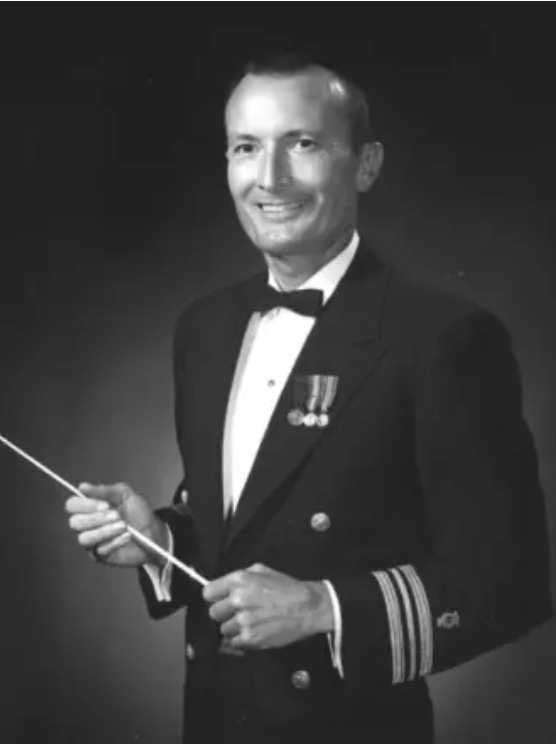
Commander Ned Muffley is the fifth name on that list. He succeeded Commander Donald W. Stauffer and was succeeded by Commander William J. Phillips, leading the band for five years.
His family’s published obituary records one detail from those years that deserves to outlive him: he was, in their words, “the first Conductor of the Navy Band that promoted the hiring of women.” In the mid-1970s that was not a gesture. It was a decision with professional consequences for the man who made it, taken inside one of the most tradition-bound organisations in American public life.
It also says something about how he would later operate in a completely different field. The instinct to widen a closed room, and to do it without a speech about widening it, is the same instinct his martial arts colleagues would describe for the next forty years.
The second career
Muffley retired from the Navy in the early 1980s and moved into an industry that, at that moment, barely qualified as one.
American commercial martial arts in 1982 was a collection of gifted instructors running businesses by instinct. There were no standard enrollment systems, no accepted way to structure tuition, no professional finance infrastructure, and very little reason for a bank or a parent to treat a karate school as a serious concern. The people trying to change that were clustered around one organisation in Washington, D.C. — the Jhoon Rhee Institute, then the largest and most systematised martial arts operation in the country.
By Stephen Oliver’s first-hand account, Muffley was hired into the Jhoon Rhee Institute as its General Manager by Jeff Smith, then the Institute’s Vice President and Head Instructor, and worked alongside Smith, president Nick Cokinos and Jhoon Rhee himself. We have not found a contemporaneous document confirming that appointment, and say so plainly; it rests on the testimony of people who were in the building.
What is on the public record is where he spent the decades that followed. Muffley became General Manager of the Educational Funding Company of Bethesda, Maryland — the tuition-billing and financial-services firm built by Nick Cokinos that, more than any single school or style, industrialised the business side of American martial arts. EFC handled the money. Handling the money is how a hobby becomes a profession.
His family’s obituary says simply that he spent decades there and that colleagues remembered a man who “brought joy and leadership to every role he held.”
What a school owner should take from Ned Muffley
There is a particular kind of contribution that never gets a trophy, and this is the clearest example of it in our industry’s history.
Muffley did not found a style. He did not win a world title. He never appeared on a magazine cover. What he did was arrive in a chaotic field carrying thirty years of institutional discipline — the assumption that an organisation has a mission, that a mission requires systems, and that systems require somebody unglamorous enough to maintain them — and hand that discipline to people who had never been taught it.
If your school has a written enrollment process, a tuition structure that survives staff turnover, and a way of talking to parents that a bank would recognise as businesslike, you are operating inside a framework that people like Ned Muffley assembled. The practical lesson is narrower and more useful than a tribute: the person who makes your organisation run is usually not the person on the poster, and schools that cannot tell the difference tend to lose them.
A tribute from Grand Master Stephen Oliver
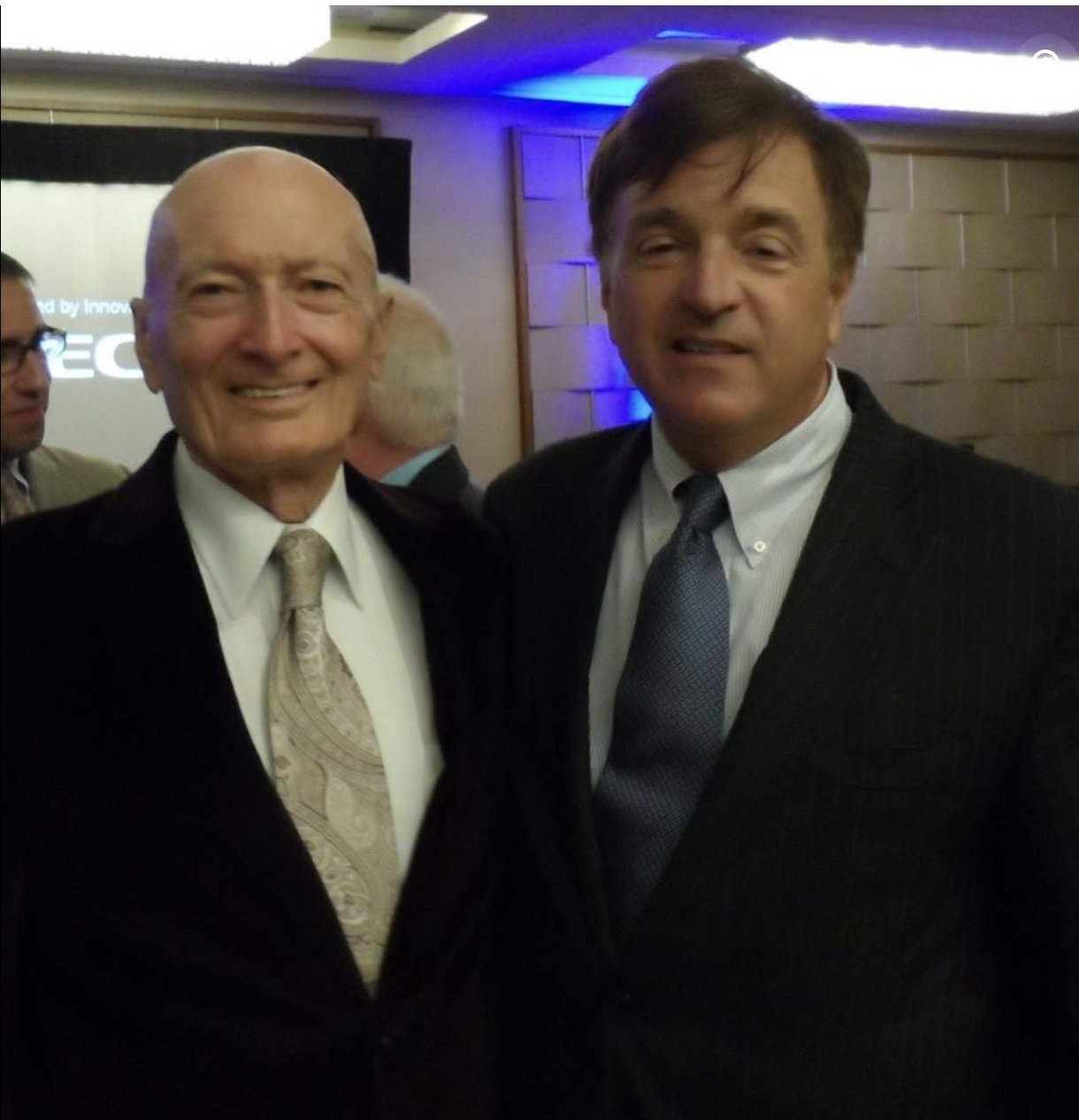
Some friendships define seasons of your life. Others quietly shape everything that comes after. My friendship with Commander Ned Muffley was both.
We met in the early 1980s at the Jhoon Rhee Institute in Washington, D.C. — that incredible era when Jhoon Rhee, Jeff Smith, Nick Cokinos, and a handful of us were working to build something bigger than a martial arts school. We were building a movement. At the heart of it all was Ned.
He had recently retired from a distinguished career in the U.S. Navy, having served as Commander and Leader of the United States Navy Band — one of the most elite musical organizations in the world. He carried himself with that same precision, discipline, and quiet authority that comes from decades of command experience. But beneath that military bearing was a warm, thoughtful, dryly humorous man with a sharp intellect and a deeper heart. From the first time we talked, we clicked.
Ned stepped into the martial arts world at a time when most of us were still trying to figure out how to bridge the gap between passion and professionalism. The martial arts business — as an industry — was still in its infancy. At the Jhoon Rhee Institute, he teamed up with Jeff Smith, Nick Cokinos, and of course Grand Master Jhoon Rhee himself. Together, that core group brought order, structure, and credibility to what was, at the time, a collection of talented but often chaotic schools and instructors.
Ned’s military background gave him a unique perspective — he didn’t see schools as “businesses” or “dojos.” He saw them as organizations with a mission. He taught all of us, through example rather than lecture, that excellence in teaching required excellence in leadership, systems, and execution.
Over the decades, Ned and I became close friends. We worked side by side on projects, brainstormed over dinners, and spent countless hours swapping ideas about leadership, teaching, and the balance between integrity and ambition. He was the kind of friend who never needed fanfare. He wasn’t loud or self-promotional. He was the quiet professional — the one who made everyone else better just by being there.
We could spend hours talking about the smallest details — how to run a staff meeting, how to structure tuition, how to handle a parent conversation — and he’d always bring a clarity that cut through the noise. More than once, I’d walk away from a conversation thinking, well, that was obvious — why didn’t I see it until Ned said it? That was his gift: to make complex things simple, without making you feel small in the process. He had that rare combination of sharp intellect and genuine humility. And a wicked sense of humor when you least expected it.
When the Educational Funding Company was established, Ned was again instrumental in setting the tone and structure. Alongside Nick and Jeff, he helped turn martial arts from a sideline passion into a sustainable, professional industry. His fingerprints are on everything from how schools manage their finances to how they communicate professionalism to parents. If your martial arts school today operates with clear systems, structure, and a respect for the business side of teaching — whether you know it or not — you’re living in the world that Ned helped design.
Commander Muffley was a man of character — calm, dependable, consistent, and loyal to the bone. You could always count on him to tell you what you needed to hear, not what you wanted to hear. He brought integrity to every room he entered. He had no patience for arrogance or ego — just quiet confidence and competence.
We shared more than work; we shared life. Over four decades, our friendship endured careers, relocations, and all the ups and downs that come with trying to build something meaningful. And through it all, Ned remained the same: steady, loyal, and dedicated to excellence.
The martial arts industry owes him more than most will ever realize. Many of us who were fortunate enough to be there during that foundational era — the Jhoon Rhee Institute, the early EFC days — know that the systems, professionalism, and credibility our field enjoys today didn’t just appear. They were built, and Ned was one of the builders.
For me personally, the loss runs deeper. Ned wasn’t just a colleague or a mentor — he was one of my closest friends. A man whose loyalty, intellect, and friendship helped shape the person and professional I became.
Fair winds and following seas, Commander. You served your country with honor, your colleagues with grace, and your friends with unwavering loyalty. You’ll be missed — but your example will never be forgotten.
— Grand Master Stephen Oliver
Publisher, Martial Arts Professional; Founder, Martial Arts Wealth Mastery
Friend and colleague of Commander Ned Muffley since 1980
Survivors
Commander Muffley is survived by his wife of thirty years, Jeannette Muffley; his sons Adam and Tye; his daughters Lynn Klimczak and Debra Bernhardt; his adopted daughter Mariah Sim; seven grandchildren; and eight great-grandchildren. He was preceded in death by his son Rick Muffley and his sister Kathryn Hanstein.
He was interred at Arlington National Cemetery. At the family’s request there was no service.
Sources, and what we could not confirm
Primary sources: the published obituary of Ned Elwood Muffley, carried by Legacy.com and placed by Going Home Cremation & Funeral Care by Value Choice, P.A., of Rockville, Maryland, for the dates and places of birth and death, his parents’ names, the Naval Academy class of 1952, the thirty years of service, the Korean and Vietnam war service, the Alaska posting, the Navy Band conductorship, the Educational Funding Company career, the survivors and the Arlington interment; and the United States Navy Band’s own roster of leaders for his tenure and rank.
A date conflict we have printed rather than smoothed over. The family’s obituary says he became the Navy Band’s conductor in 1972. The Navy Band’s own list of leaders records Commander Ned Muffley as serving from 1973 to 1978. We have followed the band’s roster for the tenure dates and noted the family’s date here.
Not independently documented. That Ned Muffley served as General Manager of the Jhoon Rhee Institute, and that he was hired into that role by Jeff Smith, rests on Stephen Oliver’s first-hand account as a colleague present at the time. We found no contemporaneous record of the appointment and have labelled it as testimony rather than record. His exact title and start date at the Educational Funding Company are likewise not established; a professional profile lists him as General Manager and the obituary says only that he spent decades there.
The women-in-the-band claim — that he was the first conductor of the Navy Band to promote the hiring of women — is the family’s own wording in the published obituary. We have quoted it as theirs. We were not able to independently verify the chronology of women’s entry into the band against it, and would welcome a correction from anyone who can document it.
One editorial change to the tribute. Grand Master Oliver’s original text described Commander Muffley as “finishing” his naval career as Leader of the Navy Band. Because his band tenure ended in 1978 and his thirty years of service ran to roughly 1982, that phrase has been changed to “having served as.” Nothing else in his text was altered.
Photographs are from the publisher’s own collection and the subjects are identified as supplied. Photographers and copyright holders have not been established. We are glad to add a credit or remove an image on request.
Cause of death was not made public by the family and is not reported here.
Corrections. See our editorial policy. If you knew Ned Muffley and can add to or correct this record, we want to hear from you.