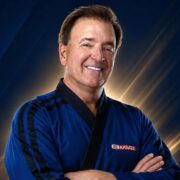

Tony Robbins — Leadership from Inside Out
A Jhoon Rhee Black Belt, Anthony Robbins spent decades as one of the most widely known figures in peak-performance coaching, working with athletes, executives and heads of state. In this interview he returns to the martial arts audience he came from and talks about leadership as an inside-out discipline: state, standards, and the decisions that separate an instructor who runs a school from one who builds an organisation.
Listen to the interview
This interview was conducted for Martial Arts Professional, the trade magazine the National Association of Professional Martial Artists has published since 1996, and appeared in the magazine’s interview series. It is republished here as part of the magazine’s archive. The original recording date is not stated in the surviving archive record.
Browse the full interview archive
Full transcript
Transcript generated from the original recording and lightly edited for readability; minor errors may remain.
Today we have with us an extraordinary guest. He is considered to be the greatest personal development expert of all time. He is the chairman of six companies. He is a strategic advisor to world leaders and his teachings have impacted the lives of an estimated 50 million people. I’m also proud to tell you that he is a martial artist and the recipient of NAPMA’s 2003 Lifetime Achievement Award. He is the one and only Anthony Robbins. Tony, welcome to our show. Thanks for having me on, Rob. My pleasure. Let’s go ahead and begin if we can with a little bit of a historical perspective. After the Karate Kid movie, there was a tremendous interest in personal development. However, most instructors didn’t have the tools to integrate this type of material into their classrooms. That is until you began providing those tools.
Today, you have thousands of long distance disciples in the martial arts industry and the NAPMA organization feels that you’ve influenced more instructors than anyone in the area of personal development. In fact, you even earned your black belt. Tell us a little bit about that experience. Well, first of all, I appreciate your compliment very much. I feel really grateful to be able to serve so many people and especially people in the martial arts community because that’s a major discipline in my own life. But how it came about for me is I was always interested in martial arts as a young child. I was five foot one, even my sophomore year in high school. And I could get beat up quite a bit. And now six, seven, I grew 10 inches in a year, and I took a martial art that was a bit bigger.
Read the full transcript
But Jhoon Rhee was the reason I got involved specifically in Taekwondo. I was actually interested in the keto at the time, because I loved the beauty of the art and the concept of aligning with your opponent and not necessarily having to harm them in order to change their perspective but he is such a beautiful fool and his life is so about a life-affirming approach as opposed to a life-taking approach that the privilege to be able to work with him was enormous and he saw my capacities and he saw how I was influencing people and he said I just think that this is an art that you would totally love and he said I’m willing to work with you he said your modeling ability is very strong because I was doing things right, modeled things in the United States Army I took a training program that they’d, a pistol shooting program that they’d worked on literally for 30 years and changed it, increased it by more than 50%, took it from literally a four-day program to a one-day program and tripled the number of people that qualified to the highest level of expert.
So I’ve done a lot of modeling in that area. And he said, I think you could really develop your black belt. I’d love to see you develop it in a very short period of time. And I said, well, I’d love to be able to do it in a year. And his eyes got really big. And I said, I’m not trying to find a shortcut to it. I just, I would love to live in total immersion with you. So, Master Reed gave me an extraordinary privilege. We came very close friends and he traveled with me and I traveled with him and I literally did my training every single day and I got to learn from him, you know, one of the best that has ever existed. Master Reed, you know, even trained Bruce Lee for portions of his training.
So he’s an amazing soul and frankly, it was one of the greatest gifts of my life. The only thing, and hindsight that I learned by it is by jamming it in so much, I injured myself several times, as you might guess, and I went from a position in my youth where I was trying to do everything in a shorter period of time, and I think that in hindsight there’s great benefit in taking your time so that some of the greater subtleties you take in. So while I did experience and achieve my plaque belt, I learned a lot also about the process of making sure I really enjoy myself rather than just the rigor of the discipline of just getting it done. And I approach things differently in my life today as a result of it. Very interesting.
Now I understand for a while there you were incorporating martial arts concepts such as board breaking and breathing techniques and so forth into your seminars. How and why did you do this?
Well I still do actually in some of my programs because I think there are fundamental tools for life as well as for martial artists. And I did it because I wanted to demonstrate to people specific tools and techniques for taking control of their mental and emotional focus, for changing their state literally in an instant. And using your body as a way to change your mental and emotional state is the single most powerful and the fastest factor you can access. So as a demonstration of it, I would do originally woodboard breaking and then brick breaking and then brick breaking with my ad and so forth and so on. But I actually still do one demonstration in our events and I have one set of events where we teach you know amateurs board breaking as a metaphor for breaking through their limitations and fears And we teach young people how to do this with all over people young kids in the seven eight nine ten year old range Because as you probably know I use fire walking as a metaphor as well as skydiving We have a variety of techniques where we put people directly on the line and we give them breakthrough experiences So the wood breaking is a fantastic tool for getting people to experience experienced that and many people have gone on to become involved in martial arts as a result of their exposure because they love that state and that psyche that comes from the discipline of martial arts.
[05:11] Well that is fantastic. Now off the top of your head, how many people per year would you guess are exposed to martial arts related concepts through your programs?
Well in live seminars it depends on the year but you probably average about 100,000 people a year that get exposed and then you know obviously I’ve had you know, millions of people, I guess 50 million people have gone through my programs or my tapes and books over the period of the year. So depends on what program they’ve seen, but probably a hundred thousand year on average, just in live programs. That is amazing. And I’ve never been real strong in math, but if my math is correct, that means you’ve probably exposed millions of people to martial arts related techniques and concepts. And we thank you so very much for all that exposure. In fact, you’ve climbed to the top of your profession. Did you ever visualize yourself reaching this level?
Well actually I did, I visualized beyond it as I still have. I think that it’s critical to see yourself. Now, not all of it the way it is. When I was younger I would set goals where I’d say, okay I want to do this exact thing and I’d point to this exact spot in the future. And I approached things slightly different today. Now it’s more like I pick the direction, the mountain I’m heading towards, knowing that as I get closer to the mountain I will have more choices. I may want to go over it, around it, through it. There may be a pathway, there are all kinds of choices about how to go about it, but if you keep moving in the direction of the goal consistently of what you visualized, you’ll achieve it or you’ll achieve something greater.
But very early in my life, when I was 16 or 17 years old, I kind of laid out my life in a 10 year chunks where I said in my 20s I wanted to master the ability to literally help any individual change anything they’d want to change and have the ability to do that if I was truly committed to it. And while you constantly make new decisions, I certainly did that in my 20s, and I said that in my 30s at that time, I projected forward that I’d be able to do that with groups of people simultaneously, as opposed to people one-on-one. I actually was ahead of schedule and did that in my 20s, obviously. And then I said in my 40s, I’d do that with organizations. I did that in my 30s. I said in my 50s, I would do it with governments.
I’m actually doing that now. I just got back from Venezuela, where I worked there with Jimmy Carter, President Carter’s group, as well as the Organization of American States. to negotiate a peace process there between Chavez and the anti-Chavez forces that are threatening to take the country to civil war. And I’m working in a variety of countries now in this capacity. So I’ve had an opportunity to step into that level in my early 40s here. And then I said in my 60s, my entire life is a spiritual path, but it would probably take more of a religious forum specifically that time where I would share with people what I believe in that area. At this stage of my life, I feel I’m… the learning and not here to tell people what to believe in that area. So those elements of how I would live my life I have known literally since 16 and 17 and I seem to be on target or slightly ahead of the schedule for what I want to accomplish.
Tony, that’s simply fascinating. Thanks for sharing. Now let’s shift gears for a moment and talk a little bit about the martial arts business. Martial arts is a personality driven business and success or failure often hinges on the instructor’s charisma. [inaudible] Because the speaker is somebody who’s got a structure and a format and they’re trying to present something. I think you’ve got to be an effective communicator. To be an effective communicator, you’ve got to know your audience. That’s number one. Who is in this room today, in this class, in this hour?
[08:52] What do they need? What do they desire? What do they fear?
Because if you understand what’s really driving the people that are in the room, you’re going to be able to relate to their needs as opposed to just making a presentation that’s the same for everybody. And so it has a limited impact. I think the second piece is if you really know what they really need and want, then you’ve got to think about what are you most passionate about and you’ve got to reignite yourself before you go to communicate something. Otherwise, when you’re teaching the same fundamentals again and again and again, you can go on automatic pilot. And there’s nothing less engaging than a person who’s not there. Meaning they’re there physically, but their mind and body is checked out because they’re going on automatic pilot. So you’ve got to really stop and remind yourself. What do I love about this art?
What is my passion? It has to be an every time experience. And a way to do that is the same way that you would walking into, you know, onto the mat, into the ring, whatever your metaphor is. You don’t walk in without being in a peak state. You never walk in without being in a peak state to visit with your students. You never take your students for granted any more than you would an opponent. Because if you do it with an opponent, you pay it a price. If you do it with your students, you pay an even worse price. you lose your own sense of identity, your own sense of pride as a teacher and as a leader. I think it’s critical that the focus be beyond yourself, but the focus be on being in a peak state every time until it becomes your identity.
Then it’s not hard to have charisma from the front of the room because you’re not trying to have charisma, you’re trying to serve. That is absolutely brilliant. Tony, every night school owners have to get out there on the deck and meet or exceed the expectations of their students. I see a parallel here with you. It can’t be as easy as it looks to be Anthony Robbins. You’re an extremely busy person and you always have to perform at such an extremely high level. Can you tell the instructors listening to this program how you avoid burnout, how you avoid stress?
What’s your secret? I appreciate the compliment. I would say that two things. I don’t get burnout because I have such a passionate love for what I do. I love people. I love to serve. I love the diversity of always finding an answer in difficult situations. So I’m fed by what I do. The second thing I do though is I keep a balance. I used to work seven days a week, never take a break. And what I learned to do when I was in my late 20s, as I felt I was burning out even then, was I took a vacation. It wasn’t under the guise of vacation. I never would have done that. I went to Fiji, where I now have my home, where I live two and a half months out of the year and I own a resort there.
But at the time I just went there because I wanted to find some land that if all heck broke loose, I could take my family and have them live in an incredible environment. So, you know, I landed there, I literally could not turn it off. I never turned it off. And I would be running, I got an airplane, I flew from island to island, I got a sea plane, I was checking out everything, I had to have the very best island, I had to find the very best spot. And literally I didn’t break. I remember I went to one Fijian man the second day I was there, I said, what time is it?
And I’m talking at this tempo and this intensity. And he looked at me like I was crazy, and he looked up at the sky, and he said, daytime. He was serious. And I realized I was out of balance. So it took me probably two days for me to gear down, but once I’d been in that environment, I started to actually smell the flowers, notice the trees, taking the smiles of the people around me. And what came back out of that is I came back hungry to deliver at a different level. It wasn’t time lost. It wasn’t time off. It was such a recharging time that even though at the time I wasn’t economically at that level, I committed to buying the resort. knowing that I would need a place that if I didn’t do this, I’d probably get caught back up in my pattern.
[12:19] So I went for the first probably 17 years of owning the molly, my resort there in Fiji. I literally only went there one week out of the year and I kept building it, making it better, and then I got it, were sold out, and I couldn’t go to my own resort. And gradually I geared up and finally set a goal to balance my life by spending two months a year there, and I go there and I bring my friends and family and participate at this stage of my life. But I think the secret is staying in shape both physically and mentally. I mean, most people in the martial arts industry are physically fit, but they’re not all emotionally fit. And that’s what I believe is critical. Emotional fitness comes from not only having the drive and the desire, but having the ability to laugh, the ability to find the moment where you just have that total silence, not just the silence of the discipline of a meditation, but those times where you find the beauty in spontaneity and everything around you.
When you become a machine just trying to run your business, you do not serve your students and you do not live at the same level. When I came back from that first trip in Fiji, all the people around me were like, oh my god, go on more trips. Because I was so much easier to be around. I was a taskmaster before. Here I was getting everyone to do the same thing, but they wanted to do things. They were doing it at a higher level of quality. And it made a big difference, not only in my life, but in the life of the people I lead. Batteries once in a while. Without a doubt. Now at NAPMA, we’re all about learning and helping people grow. We provide top-quality monthly support materials to more than 2,000 schools worldwide.
And that’s critically important because in the martial arts, there are no educational prerequisites for opening a school. Can you elaborate a little on the importance of continual growth and improvement in the martial arts field or in any field for that matter?
It’s not only in any field, it’s in life. I believe there are six needs that have to be met by all human beings. They’re the needs of all humans. They’re not desires. We all have different backgrounds, we have different educations, we speak different languages, we have different religions, different philosophies of life, but there are certain things all human beings need. They need certainty. One of the poles of martial arts for many people is to increase their sense of certainty that in any environment they can really be in control of their life. We all need uncertainty. So the entering of battle, the concept of the variety, the stimulation of entering a different state of mind than our martial arts offers us, meets that need to the fullest level. We all need to feel significant or unique or special in some way.
And certainly martial arts provides a unique way of living, a unique higher level of discipline for life, a different structure than the average person will settle for. We all need connection and love and the martial arts allows you to connect with your spirit, it allows you to connect with higher spirit, it allows you to connect with other people. You know, I believe the highest level of martial arts is where you feel every aspect, obviously, of your opponent and your opponent you literally are at war. That power is an extraordinary power. There’s also the commodity and connection that we all feel in the dojo together as we’re learning or expanding. All these are needs that are met by martial arts and they’re fundamental needs that can be met by anything. You can meet these same needs by doing drugs.
You do drugs and you will feel comfortable and certain. You do drugs that will change your state and your variety. You do drugs, you’ll have experiences that feel bizarre and significant. You do drugs, you’ll feel connected. But drugs are an obtainable way to meet these needs, but they’re not sustainable because of their side effects. You do it with food. So I believe martial arts meets the four fundamental needs, but the ultimate needs, the primary needs of all human beings, are to grow and to contribute beyond yourself. Everyone finds a way to meet the first four needs, even if that’s a lie to themselves, even if that’s to hallucinate. We all do it. But very few people meet the final two needs, those the needs that create fulfillment. We must grow or we die. Those are the laws of the universe, they’re not Tony Robbins laws.
[16:00] And everything in the universe either contributes or it’s eventually eliminated. It’s nothing else by evolution. So the bottom line is, we have to live by a philosophy of can I, constant and never ending improvement, C-A-N-I. And that philosophy, what you’re… constantly driving yourself to grow is the only thing that will make you happy. Whenever you meet someone who’s built an enormous business, I have several friends that have sold their businesses for more than a billion dollars. I have one friend that’s worth five and a half billion dollars. And he always talks about the toughest times, the early days when he was scratching to survive. Because during those days he felt the most growth. After selling his companies, his companies were a source of certainty. When he did it, he knew those businesses. they were a variety for him because your business is always challenging you.
It was constant significance for him because he knew he had a unique place in it. He felt connected to the people. He had to grow to keep it going. He was always contributing. When he sold this business, he was happy for about four months. And then there’s only so many islands you can go to, so many beaches you can sit on, so many Mai Tai you can drink and you go crazy. He lost his vehicle for meeting all of his needs and now he’s back in business again. So I say to anyone in any field, you must be constantly scheduling a way to make yourself grow, scheduling it, not hoping it’s going to interrupt you, because good ideas don’t interrupt you. You’ve got to go after it, pursue it, schedule it, and it’s real. When you talk about stuff, it’s a dream.
When you plan it’s possible. When it’s in your schedule, it’s real, and you’ll have a different life. That was so well put. And thanks, by the way, for the glowing endorsement of martial arts. I’m sure the instructors out there really appreciate this. Now, sometimes in the martial arts, school owners feel like they just can’t grow. They can’t raise their tuition. They can’t break past 200 students, etc. What’s happening is they fall victim to the Pygmalion Principle by creating their own self-fulfilling prophecies. Please talk to us a little bit about how an instructor can break this mindset. Well, just so everybody knows that most people do know, but the Pygmalion, in fact, is based on a Greek myth. And the sculptor named Pygmalion sculpted the statue of a woman and he fell in love with it. And his love was so strong that he transformed the statue into a real woman.
It’s just a transformative effect that comes from expectation, and that’s what this principle’s about that you’re talking about. So whatever we expect, we tend to fulfill. The challenge, as you’ve said, is there aren’t many role models beyond, let’s say, a couple hundred students, and so most people think that’s the lid. But, you know, that was what they told Sam Walton. In fact, here’s a guy who comes up with this idea for Walmart. They all told him it was a stupid idea. He built it so strongly that by 1974, Everybody at Wall Street, I think at that time, if I remember correctly, he had something like 200 stores. They said that’s the most he can build. That’s the only size of a market for these inexpensive stores, you know, down south, et cetera, et cetera. And if you looked at that time, you had Sears that had thousands of stores, you had Kmart that had thousands of stores, and everybody said that’s the biggest it can be, because there was no role model for a store of that type being any larger in its scope than the ones that he had built.
Of course, what they didn’t understand was that he didn’t have the limitation of comparing himself to other people. They didn’t realize that his resources were unlimited because he didn’t have a Pygmalion effect. His view was, his vision was as large as the world. And so now you’ve got Kmart that’s bankrupt, and you’ve got, here we’ve got Walmart that is, I think, five times larger than Kmart and Sears put together. The largest and most successful store chain on Earth. So what you’ve got to do is find role models that are outside your own business because if you can’t find somebody with a bigger business, and my guest isn’t a martial arts business, there is somebody who’s open multiple locations, has bigger groups, and still does the level of quality that I know your instructors are committed to.
Because that’s the other thing that shows up. People say, yeah, well, I could have more students, I could do this and this, but I couldn’t do the same level of quality. That’s a lie. I used to have the same lie in my own business because I had my own form of martial arts. Mine was psychological. psychological and emotional arts, this emotional, psychological, and spiritual fitness. And it is a discipline that I teach. And I remember when I first started doing my Date with Destiny seminars, I’d do them with 35 people. Gradually, I got them to 60, and I said, I can’t do it more than 60 and give personal attention and get the same quality of effect. And I began to challenge myself. And I said, you know what?
[20:17] I said that about 30. I could do 100. And I had to change my strategy, but I found a way to deliver for 100 people better than I did, literally, when I was doing 35. next thing I knew I had it to a thousand, then two thousand. My largest event now, I have 20,000 people. I can tell you, I produced a quality of effect for 20,000 people in one day, in one session now, better than I did when I used to do it with 35. So it’s all about breaking down the myths in your head. And the best solution for this is get outside your business and find somebody, either find somebody in your business that’s dwarfing what everybody else does and model them, interview them, follow up with them. find out what their belief systems are, find out what their strategies are, or get outside the business and look at somebody who’s in another area and model that thought process.
Well, I truly enjoy that because we’re in the seminar business and you just gave me plenty of great ideas. Thank you so much. Now, I recently received a report from the SGMA indicating that there are close to 12 million people currently participating in martial arts related programs in the United States alone. Also, an estimated 60 to 70% of our industry is now comprised of children. Tony, how can martial arts instructors benefit from applying NLP as well as other technologies when teaching both children and adults?
Well, I teach a series of techniques. NLP is how I started my career in my 20s. I developed my own techniques for some time. I called neurosociative conditioning, which was just an expansion of what I’ve learned. And then I don’t put so much names or labels to it. I teach fundamental tools for what I call the psychology of human needs. If you understand the needs of any human being, you can drive them, motivate them, excite them, and move them to do anything. The secret is obviously getting people to do things for their reasons instead of for yours. So often, you’ll see people in the martial arts business who will use a motivation strategy that’s based on how they were motivated. They will be abusive or intense or harsh or mean because that’s what motivated them by their sensei.
But what you’ll discover is everyone is unique. And if you only try to motivate people with your style of motivation strategy, for example, you’re only going to drive a certain number of people, you’re going to lose everybody else, and you’re going to think they’re just weak or stupid, but in fact you’re the one who’s being weak and stupid because you’re inflexible. A great leader knows how to meet people where they are. Norman Swartz cost a great friend of mine, and he was commanding 800,000 men and women from all these countries during Desert Storm back in 1990-91, he had to be able to enter into every different world you can imagine. He knew how to talk to the guy that was the Ph.D. from Stanford, who is now in the Army, as well as the kids from the street and speak in their own language.
That’s a powerful leader. And I think studying various tools, whether it be Ericksonian patterns, whether it be NLP, whether it be my work, whether it be Gestalt, understanding various tools about how to meet people’s needs are critical. a particular way of approaching things now I call human needs psychology because I believe what dwarfs all the techniques is understanding the needs of these individuals. Some people move towards. You can yell and scream all you want. That doesn’t motivate them. But show them what’s possible. Give them a big enough carrot. They’ll go crazy. Some people say, well, it’s the carrot and the stick. Not true. Every person’s different. Some people don’t move without the stick. Some people move with a carrot. And there are many elements between. Refining your understanding of the drive behind all human beings will make you a more effective leader and make you a better trainer whether you’re working with adults or kids.
Now you’re at Black Belt we’ve established under Jhoon Rhee, and given your experience in training to Black Belt, what tools can an instructor use to anchor in success and be more effective in developing their students in a group session?
Give me an example from a different context. I’m also a helicopter pilot. I first went to fly a helicopter. Helicopter pilots have a unique ego. They’re different than other pilots. Pilots alone have an ego because, you know, they own the skies. You’re a unique person. You have this unique skill. But when your helicopter pilot, it’s even more because you don’t have to live by the rules that other people live by. You don’t have to live by VFR or IFR rules, for example. You can fly as long as it’s safe. And safe isn’t the judgment of the pilot. That’s why I take off the doors of my helicopter and I go screaming down literally a few inches above the waves as they crawl underneath me and do what I call helicopter surfing. The other surfers don’t like it too much but I enjoy it.
[24:35] Nobody complains you’re okay. So what the ego is for helicopter guys is that very few people, 85% of people that take helicopter lessons never get their license. 85% failure rate. Now they all brag about this. The reason is because the pilots themselves try to make it as hard as possible for people to learn. And I have one simple principle. It’s impossible to build on failure. You only build on success. So I believe, and success lead includes, but I also believe that a great instructor sets their people up to succeed early on because that gives them the sense of certainty they can continue to succeed. When I was with the United States Army, and I took this pistol shooting program that the Army had worked on for so many decades and turned it around, the way I did it was once I figured out the most important tools, I made sure the first time somebody shot a gun, literally, instead of shooting this.45 caliber pistol, which has a bit of a kick, and shooting it from 50 yards away, which is what they were starting these guys out at, 50 feet away, I brought the target literally five feet in front of the guy.
I didn’t let him ever fire the gun until he had rehearsed over and over again the exact perfect form and firing technique, literally, for two hours, so that by the time he ever had the gun, he had every technique Then, when he fired the gun, of course he succeeded. Bam! At first they thought it was stupid, but the ignition in their brain of, wow, I’ve succeeded, versus shooting bullets in the ceiling or in the floor, or missing the target completely for the first few times, it creates the initial belief system, the initial sense of certainty as whether people can succeed or not. So I believe, set people up to win. Many instructors think, set them up to fail so they stay humble and they’re more motivated. I disagree radically. There’s a time for that, but it’s not in the beginning.
So I show people what I call a success cycle. I designed these four boxes. The top left box, if you were drawing it on a piece of paper, you’d put a box to the top left, top right, bottom right, and bottom left. In the bottom left corner, you’d write the word belief, and then you draw an arrow up, because that shapes how much potential, which is what’s in the top left box, you’re going to tap. the potential human beings have is unlimited, but how much they tap is going to be based on their belief. Now if you go across from the top, from the top left to the top right, you start to have a thing called action. People’s actions are very limited when they think they have a limited potential. In other words, if you have limited belief, you’re going to use limited potential, you’re going to take limited action, why would you take action when you think you’re going to fail anyway?
The arrow drops down to the bottom right where you get results. When you have limited belief, you tap limited potential, you take limited action, you get limited results, which then, by the way, drops an arrow across and makes your belief even less. Now you take less potential, less action, worse results, and it becomes a self-fulfilling prophecy that takes you to spiral down. But if you can get someone to get a result in advance, to set them up to succeed, then they get a belief right to start that they can do this. Then they tap more potential, because they’re certain they have it. They take more action. They get better results when they take massive action. So it increases their belief and now they’re in the upward spiral. I believe that’s the secret to success. Set them up to win and reinforce them with power.
That is so cool. And NAPMA members, I highly recommend that you apply that to your next staff meeting with your crew. Now, Tony, here’s a challenge. In the martial arts, sometimes there’s a negative association with money or wealth. In fact, some school owners still charge 50, 60 bucks a month for their classes. They’re severely undervaluing their service. Yet I know many other guys out there grossing seven figures. How can school owners condition themselves for wealth and eliminate wealth wounds, as you would say?
[28:13] We hit the nail on the head. We all have psychological separation in our heads about what we think we deserve or worth, et cetera. And very often we’ve developed this duality between success and financial terms and success and serving those we care about. And the truth of the matter is that they can go together. Duality is what I believe makes somebody an ineffective martial artist. The more separation you see between the energy that’s available in the universe and yourself, the more you’re trying to effort and use just your body to produce results as opposed to your spirit. And anyone who’s a great martial artist knows there is no separation. You know, when I hit someone, the Earth hits them. The Earth and I are one. That’s the connection. That’s the power that comes through you. And so that seems…
Duality is showing up with people in their economics and that’s why they’re weak there just like a person would be weak if they thought all the resources they had to hit with was their own body. So you have to be able to see that it is incongruent to say that you’re abundant spiritually and yet not be able to demonstrate whatever you envision in a short order. My experience with this, I finally got in my early 20s because early on I did very well I wanted to do well. I grew up in a very poor family. I thought if I did well financially, people would be so happy. I could help everyone. I made a lot of money and a lot of my friends literally rejected me. Because I came back with a young kid. I was excited.
Hey guys, I go to my old friends and I say, listen, I’ve done really well. I want to take you on a surprise. Let’s go to Egypt and race camels between the pyramids. And they’d be like, easy for you. But I’m getting the love and connection. I got disrespect. I got frustration. I got rejection from it. So gradually I learned to adapt. And I didn’t do it consciously, I did it unconsciously, and I sabotaged everything financially. Because I wanted the connection, I wanted the partnership, I wanted to be one of the guys again. And as soon as everything tube, as soon as I destroyed it all, guys would come going and say, hey man, I know how you feel. But you know what, I got bored with that game because it got incongruent with me, because I started thinking, you know what, if I could be stronger physically, should I do something to be stronger?
My answer was yes. If I could be smarter, should I do something as smart?
The answer was obvious. If I could expand my intelligence, of course I should. If I have the capacity to give more, should I?
Of course. Then if I have the ability to earn more, should I?
Why not? Because the reality is there is no difference. So this is a, what you said, a term I use as wealth moon. This is a psychological limit. And any time a person has a limit, it’s a psychological limit. Stop. playing the game of Popper and saying, oh, this is because I serve so much. I can tell you, in my own business, I serve millions of people at deep and passionate levels, and the greatest gift of my life is not money. It’s every day of my life, literally, when I walk down the street virtually anywhere I go in the world. I’m in the middle of Africa on a trip just recently, and in the middle of Africa, I’m the plane who I’m stopped by people saying, oh my god, you changed my life. It happens to me at least half dozen to a dozen times a day, because I’ve done this for a quarter of a century, but it’s also because I’ve helped 50 million people.
So that doesn’t necessarily be the person’s goal, but I have benefited from that as a side note economically because I didn’t block it. It wasn’t my primary intent, but I didn’t block it. I didn’t see it as a limitation. I believe that I want to show people how to be abundant at all levels, mental, emotional, spiritual, and financial, and my own personal belief is… that if you were truly spiritually full and abundant you should have the capacity to take whatever you think about and demonstrate it in short order and economics is one of those areas. You know Tony, I was on your website recently and for those of you who haven’t seen it yet it’s of course www.tonyrobbies.com and I understand you work quite a bit with youth groups. Can you share with us some of the keys to positively influencing 21st century teens?
Well, you say 21st century teens can sound you know, like a catchphrase. But the truth of the matter is, the kids today have a completely different experience of life than most instructors have, because they’ve grown up in a world where the attention span in that child has been conditioned to be extremely limited. And MTV would have been the easiest description of that. But living in the world of the web, where they control everything, where at the moment they want something, they can get it, and the moment they’re bored, they’re out, has trained their nervous systems, to have a different mindset. Unless you as an instructor can be more captivating than your sensei ever was, you’re unlikely to capture the majority of these kids for the long term except those that either are pressure at home or have the inner desire.
[32:39] And if we’re going to expand our impact as martial artists, you must step into a different level with these kids. But I will tell you what, we’ll capture a kid more than anything, more than anything on Earth is the demonstration of prowess with humility. If a kid feels like you have that power, but you are humble, I.e., that means you care for them still. You’re not just showing them what’s possible, but you’re showing them what’s possible for them. You can capture any child at any age, and all adults are big kids anyway. I worked with Giving Idea. I have 22 kids I’ve mentored since the fifth grade. I met them in Houston, Texas. They live in a very, very difficult community. Most of them are from single-parent families, very, very poor. And I adopted them and basically said, listen, I’m going to put you through college if you stay in school capable of being average.
Because they said there’s no excuse for not being above average. I’ll help you mentor you and so forth. But that’s a standard anyone can hold. And you’ve got to give me 50 hours of community service each week. Now you say, well, why would they do that?
These are kids that want help. Because I wanted to change these kids’ identities. I don’t care. I don’t have a college education myself. I wanted them to have a reason to work harder, and I knew that if I could get them from trying to get help to being people that believe that they were to give help, it would turn them into leaders. I believe if you call kids to a higher level, if you give them more than just instruction, if you demonstrate prowess at a different level, I’m talking about leadership prowess, kids will be attracted to you. But if you talk one talk and you walk another, you have no hope of influencing the youth of today. And I think you’re a father of four?
Yes I am. Wow, fantastic. Now here’s the question I was most looking forward to your response to, Tony. NAPMA has recently launched the GOLD program. GOLD stands for Guidance on Leadership Development and the curriculum is designed to help instructors transform students into leaders through what’s known as a leadership team. Most schools do in fact implement a leadership team of some kind. What advice would you give to instructors in the area of leadership since they are all leaders in their schools and in their communities?
Well, I would say you don’t have to work on leadership. What you have to work on is your spiritual intent. What I mean by that is not in religious terms. I’m not telling people what to believe religiously, but here’s what I mean. Everything, you know, if I asked you what, if I gave you know, my favorite flower or plant and I said, look, I’m going to be gone for three months. I need you to take care of this. I want it to be perfect when I get back. What would you do?
Well, a lot of people would, you know, look at the thing and they dust off the plant. Maybe they water a bit. But the basis of that plan, whether it’s going to live or die, is the roots. Everything you see on the outside, everything you see above the ground comes from below the ground. Likewise, it’s true with leadership. When you see a great leader, what you see on the outside is merely a reflection of what’s really going on the inside in terms of their beliefs and their spiritual intent. All of us as human beings, and this is rampant in the martial arts industry because we attract people that want to conquer and overcome, all of us start with a fundamental way of looking at life which is egocentric. Egocentric doesn’t mean you’re just filled with ego, it just means you focus on yourself more than others.
It’s about meeting your own needs first. Every human being is wired that way at birth. So a baby, even up to the age of three or four, can’t distinguish between what you see and what they see. In other words, if I held up a piece of paper, one side of it’s blue and one side of it’s white, and I show it to a three-year-old and I go, this is blue, this is white, this is blue, this is white. I turn the page back and forth. Then I show them the blue page towards them and it bright towards me and I say, what am I looking at?
[36:13] They’ll say blue. They don’t even have the neurology. The part of their nervous system developed usually until three or four years old. But eventually, we grow out of egocentrism, most of us, and we go to ethnocentrism. That means we learned that to survive. We can’t just cry and whine and get our way. We’ve got to take care of other people. And ethnocentric means our central group. Maybe it’s our family, maybe it’s our mother or father, maybe it’s the kids in the street. Anyone we care about them, because if we don’t, we know they have the ability to take something from us, to give us pain or to give us pleasure. So we have to take care of them. So by demand, by necessity, most people become ethnocentric. So now they care about their group, or their little dojo, or their martial arts approach as opposed to any other martial arts approach.
Or their religion, their Christian, their Muslim, their Jew. but screw the rest of them. And of course, that mindset will limit who you can read as a leader. There is a level above that, and that’s world-centric, and very few people get there, but world-centric is when you start caring about everybody, whether they can affect you or not. You care about whites even though you’re black, or you care about blacks even if you’re white. You care about brown, you care about yellow, you care about anyone. It doesn’t matter. You don’t care about them because they have the ability to give you pain or pleasure. You care about them because you feel a connection to all that is. And there’s a final level above that which is really not just world-centric, but spirit-centric. Where you feel the tree, where you feel the butterfly, where you can feel the lizard, where you feel the dog, where all of that is connected to you.
Now these are all levels of spiritual development. If you’re intense, no matter where you are, it’s to only meet your own needs, egocentric. To have power over the people, for you to be the head of the dojo, for you to build this big practice, you’ll have very little power moved to you. because power moves to those who are serving at the highest level. If your intent is to be able to serve an ethnocenter group, a small group of people, you will receive much more power than just trying to serve yourself. If your intent is to serve the world, you will have a power, a flow of ideas, distinction, a level of physical energy, emotion, and spirit that no one around you will have to experience them, because spirit moves to that which serves the most. And if you are spirit-centric, you will not only be an unbelievable martial artist, but you will have no difficulty attracting people.
People will come to you. In my own life, I can tell you, my intent, I’m sure at one stage of my life, was purely egocentric, but fortunately, early in my life, not because I’m a good person, because maybe I’m just lucky I had the right people around me. I at least became ethnocentric. I love people. And I love to give and to serve them. It gives me joy to see them light up. I don’t have to do this. I don’t have to do this for money. I don’t have to work another day of my life. I do this because this is what my spirit is called to. This is what I’m made for. And so gradually I move from ethnocentric to world-centric. And I don’t know if I could say that I live in spirit-centric, where I feel the tree and the plants.
I think I would be a lie to say that I’m there. But I have my moments. I’d say my center of gravity is more world-centric. I feel people. And that’s why I serve millions of them. The ideas come true to me. I know things. Just like you know in the Ring of Times, you just know your opponent. You know where the next move is coming from before they even sink it. Those moments that all great martial arts have felt, you can feel every moment in your life when you’re looking to serve at a higher level. So you don’t have to work on leadership skills as much as you do your spiritual intent. If your intent is that high, you will seek out masters in the area of leadership. That’s what I’ve done throughout my life and that’s why I have those skills as well.
[inaudible] 8982NY which is silly but that’s the number everybody remembers. A lot of karate schools are something with KICK at the end 5425. So anyway the bottom line is the difference is I created personal power when I was literally 27 years old and it sold 30 million copies and was the most successful program of all time. What I did when I was 40 years old 39 40 years old is I thought you know I have lived so much of life I want to update this, even though the principles of the first program are so solid, they’re stand to test the time, I’ve made refined distinctions, and also, I wanted to give people the daily discipline that I did that actually changed my life way back when I was 17 and helped me to create all of this.[40:54] So Get the Edge is my most updated program, and what I do with it now is I give the first week of personal power, because those fundamentals are so critical. So it’s a program you can do literally in seven days, but realistically, I give people enough really for a month, and then they can go back to it again and again. And obviously, I highly recommend it. It’s the best work I’ve created so far that’s on CD or K. Wow. Now, are there any other projects you’re working on right now that you feel would benefit martial arts instructors?
In fact, one of your associates tells me you were up to about three o’clock in the morning last night working on a book. Yes, I’m actually working a book called Emotional Fitness because I believe we’ve all been sold to build goods that’s wrong. We also have a great life if we have a Great exercise, you know, regimen, whether it be martial arts or something else, if you have a great diet, and it’s a lie. Because it’s a two-legged stool we’ve all been sold. The people who really succeed in life are the people that have emotional fitness as well, because it’s that drive, it’s that faith, it’s that determination that makes the difference in whether or not you do your disciplines on a regular basis, whether you have that energy. We all know people that work out all the time, they got a perfect diet, and they’re exhausted.
That’s because They’re emotionally, psychologically stressed. They only have the emotional power to make their life work. So my view is developing those emotional, psychological, and spiritual muscles are as important, if not more important, than the others because of the driving force of whether you either create and or maintain or grow all the other muscles of life. But I’m involved in so many different projects, it’s hard to say. Right now, I’m literally in 720 prisons and I invite any martial artist that’s interested and would like to use their skills and work with me in some way to contact my foundation. We’re in eighteen hundred school systems now in nine countries. I’m in a hundred thousand health and human services agencies. You know, we feed more than a million people now in twenty countries between Thanksgiving and Christmas.
So we have a thing called the Baskerville Gate. So I’d love any martial artist who’s looking to expand their impact on their community to look at ways to step out of your own community because the beauty of our community and martial arts is the discipline and the focus and the commitment that we all have. It’s a different, we hold a higher standard for our lives. But also whenever you live in a community, you start to get stale. You start to think that’s all that life exists. And sometimes entering other communities is extremely important. Expand your vision and you bring that fresh perspective back. So I invite people to contact our foundation, look at some things we’re doing, or if you don’t have to do it with me, look at anything outside your current focus. and take it on.
Do something completely different. It will stimulate you to bring things back to your art that you would never think about doing the same disciplines daily. Wow. Well this CD is going to be going to over 2,000 martial arts schools who all have a bunch of staff members. So guys, step up to the plate, check out TonyRobbins.com and see if you can assist with Tony’s Foundation. They’re doing a great thing for millions of people. Now for those of you who have not yet heard, Anthony Robbins has been chosen to receive NAPMA’s prestigious Lifetime Achievement Award. The award will be presented on August 23rd at the 2003 NAPMA World Conference. At that time, Tony Robbins will accompany other LTA recipients such as the great Grand Master Jhoon Rhee, karate legend Joe Louis, Ernie Reyes Sr., Black Belt Magazine, and others.
[44:05] Tony, we understand that you have a prior commitment on that day and that you are unable to accept the award in person in our general session. However, I know that you’re working on something very special concerning your acceptance. Can you please tell our audience what they can look forward to at the conference?
And I think anybody who’s attending will find them to be quite valuable in the expansion of their true wealth and happiness. Not just financial, spiritual, emotional, psychological. I think the tools, although simple, will be things that people will want to apply in their personal lives as well as in the work that they’re doing within their own dojos or martial arts facilities. Tony, your teachings have had such a dramatic impact on our industry. You’ve actually helped to improve the interaction between the students. and the instructors you’ve helped make our industry more professional and by all means you’ve helped increase our retention on behalf of the entire industry and the NAPMA organization I want to thank you personally for all that you’ve done and for all that you do. Thank you, it’s a privilege to be part of this community and I spend my honor and my love and my respect for all those that participate in it.
The work that we all do together is one that makes all you beings that we have the privilege to influence. better human beings and I honor everyone within the area and I wish to give the honor back. I’m very grateful for the honor this thing bestowed upon me. Ladies and gentlemen, what can I say?
The incredible Anthony Robbins.