Charge One Fair Price, and Never Nickel-and-Dime: The Case for Professional Tuition

Every so often someone tells me my tuition recommendations are “ridiculously” high. Here is my answer, along with a story from a beachfront hotel in Fort Lauderdale. That stay taught me more about pricing than any seminar. The airlines of 2026 are now teaching the same lesson to the whole country.
Disclosure: I advise martial arts school owners on pricing through Martial Arts Wealth Mastery, and I am the Publisher of this magazine. The opinions here are mine. The figures for airlines, hotels and inflation come from the public sources listed at the end.
Are my tuition recommendations “ridiculously” high?
Every so often I hear a criticism of the fees I recommend to school owners, and of the fees at my own Mile High Karate schools. The word that comes up most is “ridiculous.” The fees are “ridiculously high,” “outrageous,” a “McDojo” price.
It’s an interesting complaint. Honestly, I find it a little crazy, because the facts point the other way. So let me set the record straight. I’ll start with a number almost nobody in our industry likes to look at.
Much of the martial arts industry has settled on a monthly tuition that is about the same as, or less than, what we charged at the Jhoon Rhee Institute in the Washington, D.C., area in the early 1980s. It’s also about what I charged when I was 23, opening schools from scratch in a city where I didn’t know a soul. The nominal price has barely moved in more than forty years. Everything else has.
What did tuition cost in 1980, in today’s dollars?
Inflation is the adjustment nobody makes. By the Consumer Price Index, a dollar in 1980 is worth roughly four dollars today; the CPI multiplier from 1980 to 2026 is about 4.05. Put the other way, today’s dollar buys about a quarter of what it bought then.
So a school charging $150 a month in 1980 was charging the equivalent of just over $600 a month in today’s money. A school charging $150 a month today is charging a quarter of that in real terms. Its owner gets the same number on the statement while paying today’s rent, today’s insurance, today’s wages and today’s price for everything else.
| Monthly tuition in 1980 | Same buying power in 2026 (CPI, about 4.05×) |
|---|---|
| $75 | About $304 |
| $100 | About $405 |
| $150 | About $608 |
| $200 | About $810 |
The schools that charge professional tuition today are not the outliers. They are the ones that kept pace. The industry average is what fell behind, and many owners are paying for it with their health, their families and their retirement.
What does professional tuition actually pay for?
Tuition isn’t a number you pull out of the air to see what the market will bear. It is the budget for the experience you promise a family. At a professional school, that budget pays for things parents can see and feel.
- Full-time, highly trained instructors. A teacher who does this as a career, not a sideline, has been trained to teach as well as perform. They know every student’s name, goal and family situation, and they’re there at 4:00 on a Tuesday because it’s their job, not a favor.
- A real instructor-development system. Teaching curriculum, leadership training, and the time and pay to grow assistants into professionals. Retention lives and dies here.
- A clean, safe, well-equipped facility. Quality mats, clean changing areas, a parent viewing area, good lighting, proper insurance and background-checked staff.
- A written curriculum and a structured path to Black Belt. A student knows where they stand, what comes next and why.
- Time for each student. Progress checks, parent conferences, and the follow-up call when a child misses two classes. These are the habits that keep a student training for years.
Low tuition doesn’t make any of this cheaper. It makes it impossible. A school charging 1980 prices in 2026 can’t pay a full-time professional staff, so it runs on part-time help, an exhausted owner and good intentions. Then, to keep the lights on, it starts doing something far more damaging than charging a fair price. It starts nickel-and-diming.
What happened at the Harbor Beach Marriott in Fort Lauderdale?
I came to the no-nickel-and-diming principle almost by accident.
Many years ago, more than thirty now, I spent some time in Fort Lauderdale at the Harbor Beach Marriott, the beachfront resort still operating today as the Fort Lauderdale Marriott Harbor Beach Resort & Spa. The trip was part study, part recreation and part business. I was meeting a friend who ran a school in the area, and Nick Cokinos, chairman of Educational Funding Company, who kept a penthouse condominium down the street.
I was in a very expensive beachfront room, about $550 a night, and that was three decades ago. Not long into the stay I started to notice the nickel-and-diming.
I dialed the phone from the room: 75 cents. I sat at the pool and ordered an iced tea: $4.75. When I asked for a refill, it was another $4.75 for another little plastic cup of tea. Then the room safe, then the parking (valet or self-park, it didn’t matter), and on, and on. Everywhere I turned there was another small charge. None of it was much money, but there was always just enough to annoy me.
Here’s the part that matters for your school. The price of the room never bothered me. I had already agreed to pay $550 a night. If they’d charged me $600 and included the calls, the tea and the parking, I wouldn’t have thought twice. I’d probably have gone home and recommended the place to friends.
What wore on me was the constant drumbeat of another $5 or $10 every time I turned around. Each one was trivial. Together they changed how I felt about the whole place. I stopped feeling like a guest and started feeling like a mark. I began keeping score, and a customer who keeps score is a customer looking for the exit.
Look at the economics from the hotel’s side. It collected a few extra dollars in tea, phone calls and parking from a guest who would happily have paid fifty dollars more a night for a clean, single price. It traded goodwill for change. It’s one of the worst trades in business, and I’ve seen martial arts school owners make it every week for forty years.
What is the airline industry teaching your customers in 2026?
If you want to see nickel-and-diming as a national business model, get on an airplane.
Ancillary fees (bags, seats, boarding priority, change fees and the rest) have grown into a huge share of what airlines earn. The airline consultancy IdeaWorksCompany estimated that airlines worldwide would bring in a record $157 billion in ancillary revenue in 2025. That’s about 15.7 percent of all airline revenue, up from 9.1 percent in 2016. In the United States alone, the Bureau of Transportation Statistics reports that U.S. airlines collected $7.4 billion in baggage fees and another $1.1 billion in reservation change fees in 2025.
And it keeps creeping up. Between late March and early April 2026, the big carriers raised checked-bag fees again. United’s first checked bag went to $50 ($45 if you prepay online) and the second to $60. Delta’s went to $45 and $55 for tickets bought on or after April 8. JetBlue went to $39 and $59 off-peak, and $49 and $69 at peak times.
The most telling case is Southwest. For decades its brand was the opposite of nickel-and-diming: “Bags fly free,” open seating, no change fees. Customers loved it, and it became a big part of why people flew Southwest. Then, for tickets bought on or after May 28, 2025, Southwest started charging for checked bags: $35 for the first and $45 for the second. On January 27, 2026, it ended its famous open seating and moved to assigned seats with paid tiers. Whatever the financial logic, the airline gave up the thing that made it different and joined everybody else.
There was an attempt to make airlines show these fees up front. In 2024 the U.S. Department of Transportation issued a rule requiring airlines to disclose bag and change fees when they first show a fare. The airlines sued, and on February 3, 2026, the U.S. Court of Appeals for the Fifth Circuit vacated the rule. As I write this, the advertised fare is still not the price.
Hotels went the other way. The Federal Trade Commission’s rule on unfair or deceptive fees took effect on May 12, 2025, and covers short-term lodging and live-event tickets. It doesn’t ban resort fees, but it requires the total price, mandatory fees included, to be the price a customer sees first. The hotel industry built a business on the add-on, and federal regulators had to step in to make it show customers the real number.
Why does this matter to a martial arts school? Because the parents walking into your school have spent years being nickel-and-dimed by airlines, hotels, ticket sellers, rental car counters and streaming services. They are primed to resent it. When they meet another surprise fee at your front desk, they don’t think of it as your fee. They file it with every other one they’ve ever been hit with. You have just made yourself one more company trying to squeeze them.
That is also your opportunity. When a family has been trained to expect a catch, a school that says “this is the price, and it includes everything” stands out right away.
What did “board-breaking day” teach me?
On a different trip, my associates and I visited a martial arts school, also in Fort Lauderdale. In the middle of a children’s class, every child suddenly ran out to the waiting area to beg their parents for a few dollars.
It was “board-breaking day,” at $2.00 a board.
Afterward the owner took us into the back room where he cut the boards. He walked us through the economics, and he was proud of how well these extra sales did.
Here’s what I saw:
- Three disappointed children with no parent there to pay, who couldn’t take part while their classmates broke boards.
- A couple of frustrated mothers at the front desk asking whether they could put the boards on a credit card.
- A class that stopped being a class. For those minutes the lesson wasn’t courage, focus or technique. It was money.
The owner saw an extra couple of thousand dollars from boards. I saw five families who were now considerably more likely to drop out after that one class, and several more who were less likely to stay. A child’s retention is worth thousands of dollars over the years it takes to reach Black Belt and beyond. Trading that for a two-dollar board is the Harbor Beach iced tea all over again, with a child crying in the lobby.
Kids running to Mom to beg for money in the middle of class was a new low in my experience. But the thinking behind it is common in our industry.
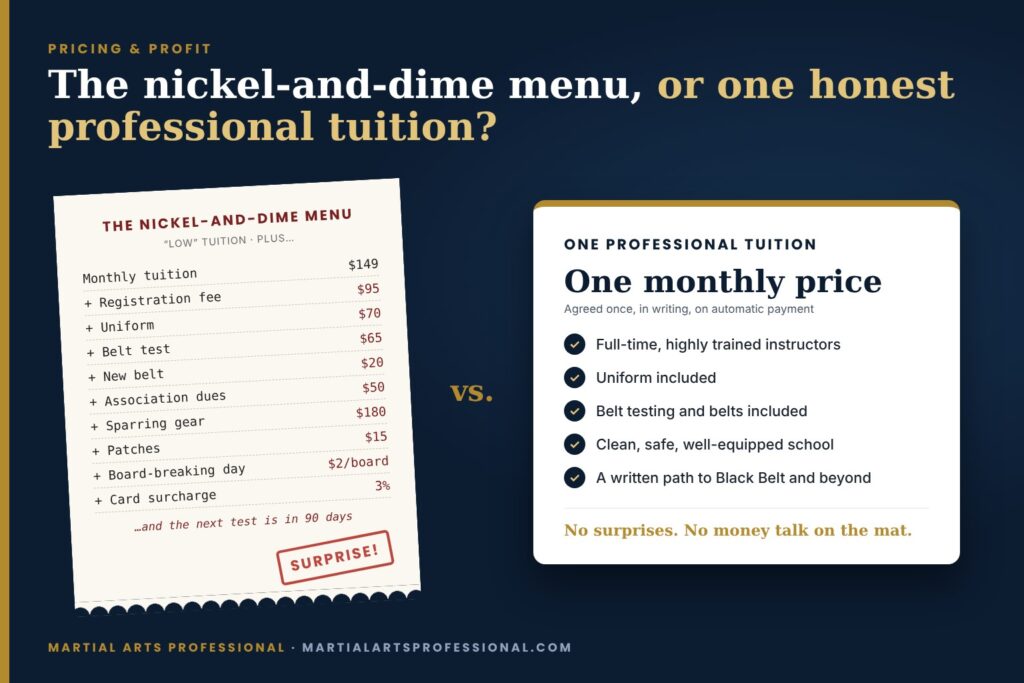
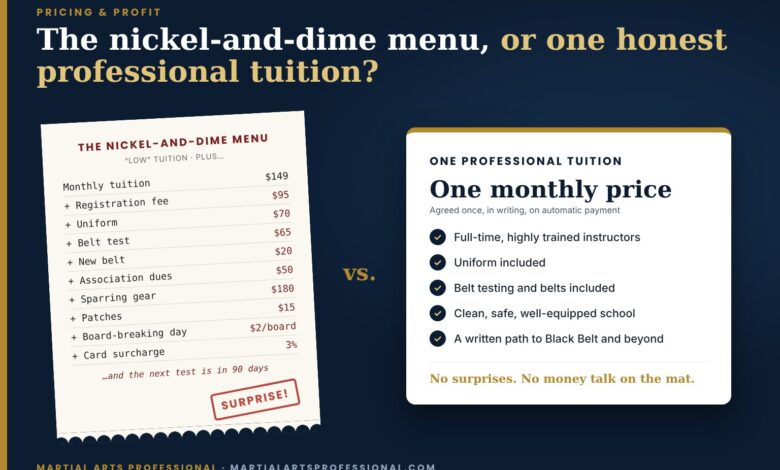
What do martial arts schools typically tack on?
Look at the fee schedules many schools publish, and the list beyond monthly tuition often looks like this:
- A registration, enrollment or “initiation” fee.
- A uniform, and then a different uniform for testing or for a higher program.
- Belt testing fees every few months, often tens of dollars for each color-belt test and several hundred for a Black Belt test.
- Annual association or federation dues.
- Sparring gear, often required within weeks of starting.
- Weapons, patches, manuals, “annual maintenance” fees, late fees and card-processing surcharges.
Each fee can be defended on its own. Together they create the experience I had at the Harbor Beach Marriott: one more charge, one more conversation about money, one more withdrawal. Most of them land at exactly the wrong moments, during the first few months when a new family is deciding whether this school is for them, and at belt tests, which should be celebrations.
Why is one all-inclusive tuition better?
After Fort Lauderdale I decided we were much better off including everything in the tuition and never dinging our students again and again. That’s the way I recommend now.
The late Stephen Covey, one of my favorite authors, called it the Emotional Bank Account. Every interaction with another person is either a deposit or a withdrawal. Every time you hit a family with an unexpected fee, however small, you make a withdrawal. It’s hard enough to retain students without irritating them several times a year.
I would much rather make one sale, or perhaps two: the enrollment, and later an upgrade to a leadership program the family chooses with full information. After that, I don’t want to ask for money or discuss it again. That one decision does several things:
- It protects the student-teacher relationship. When the instructor never has to be a bill collector, the instructor can just be a teacher.
- It removes the nickel-and-dime reflex. Families stop keeping score, because there’s nothing to score.
- It keeps everyone focused on class. Belt tests become celebrations instead of invoices, and children never learn that their progress depends on whether Mom brought her wallet.
- It makes the price honest. The number a family hears at enrollment is the number they pay. That’s what the FTC now requires of hotels, and it’s simply good practice for us.
It’s also why I want tuition on automatic monthly payments. I don’t want an instructor asking for, or reminding a parent about, tuition as the family walks in for class. Money should be handled once, clearly and in writing, and then it should disappear from the training floor.
Isn’t “all-inclusive” just a higher price in disguise?
No. It’s a higher headline price and a more honest total price. That distinction is the whole argument.
A school advertising $149 a month, plus a registration fee, plus a uniform, plus a testing fee every few months, plus dues and gear, isn’t a $149-a-month school. Add up a family’s real first-year cost and the gap between the advertised number and the actual number is often hundreds of dollars. That gap is exactly what consumers have learned to resent from the airlines.
A school charging a professional tuition that includes the uniform, testing, belts and the other routine costs of training is telling the family the truth up front. The family can compare it fairly, decide once, and then stop thinking about money and start thinking about training.
That’s the real answer to the “outrageous fees” criticism. Outrageous is the price you didn’t know about until you were already committed: the tea refill, the bag fee, the two-dollar board. A clear, all-inclusive, professional tuition is the opposite of that.
How do you move to an all-inclusive tuition?
- List every fee you charge today. Total what a typical family actually pays in its first year and in its third year. That’s your real price; you’ve just been collecting it in pieces.
- Decide what’s included. At a minimum, the routine costs of training and progressing: uniform, rank testing and belts. These are the fees families feel most and resent most.
- Build the cost into tuition, honestly. Then raise tuition to the level that pays for full-time, professionally trained staff and a quality facility. Let the inflation table above remind you how far behind the industry has fallen.
- Put the terms in writing. One clear agreement that says what’s included, what isn’t, and how payments, holds and cancellations work. Transparency is the whole point.
- Keep truly optional things optional. Private lessons, tournament travel and special events a family chooses for themselves are fair to price separately, as long as nothing required to train and progress ever turns into a surprise.
- Take money off the floor. Automatic payments, one enrollment conversation, and no instructor ever asking a child about money.
What a school owner should take from this
- Most industry tuition hasn’t kept up with inflation. A $150 tuition in 1980 equals just over $600 today.
- Professional tuition pays for full-time, highly trained instructors and a quality facility. Low tuition doesn’t make those cheaper; it makes them impossible.
- Families resent the drumbeat of small fees more than an honest price. The Harbor Beach Marriott taught me that at $550 a night.
- Airlines took $7.4 billion in U.S. bag fees in 2025. Your families are already worn out by add-ons, so don’t become one more.
- Make one sale, or two, and then never talk about money on the floor again.
Frequently asked questions
Why do some martial arts schools charge higher tuition than others?
Professional schools price tuition to pay for full-time, highly trained instructors, a structured curriculum and a clean, safe, well-equipped facility. Many schools still charge about what schools charged around 1980, which after inflation is roughly a quarter of the price in real terms.
What does “nickel-and-diming” mean in a martial arts school?
It means charging a low advertised tuition and then adding a series of separate fees, such as registration, uniforms, belt testing, association dues, gear and special-event charges, so the real cost is much higher than the advertised price and the family keeps getting asked for money.
Is an all-inclusive tuition more expensive?
The monthly number is higher, but the total is often similar or lower, and it’s honest. The family knows the full price at enrollment instead of discovering it a fee at a time.
What should be included in martial arts tuition?
Stephen Oliver recommends including the routine costs of training and progressing, especially uniforms, rank testing and belts, so a family is never asked for money to take the next step. Truly optional items such as private lessons or tournament travel can be priced separately.
How much was martial arts tuition in 1980 worth in today’s dollars?
By the Consumer Price Index, a dollar in 1980 is worth about four dollars today. A $150 monthly tuition in 1980 is equivalent to just over $600 a month in 2026.
Do hotels still charge resort fees?
They can, but since May 12, 2025 the Federal Trade Commission’s fee rule requires hotels and other short-term lodging to include mandatory fees in the total price they advertise.
How much do U.S. airlines collect in bag fees?
The Bureau of Transportation Statistics reports $7.4 billion in baggage fees and $1.1 billion in reservation change fees for U.S. airlines in 2025.
Why should tuition be on automatic payment?
Automatic payment keeps money off the training floor. Instructors never have to ask for or remind families about tuition, which protects the student-teacher relationship and keeps everyone focused on class.
Sources, and what we could not confirm
- Inflation: U.S. Bureau of Labor Statistics Consumer Price Index, via the CPI calculator at officialdata.org ($1 in 1980 ≈ $4.05 in 2026).
- Airline ancillary revenue: IdeaWorksCompany, global estimate press release, November 2025.
- U.S. airline bag and change fees: Bureau of Transportation Statistics, 2025 financial data release, 12 May 2026.
- April 2026 bag-fee increases: published airline fee schedules as compiled by TripProf, 2026.
- Southwest bag fees (tickets bought on or after 28 May 2025) and assigned seating (from 27 January 2026): Southwest announcements as reported by NBC.
- DOT ancillary-fee disclosure rule vacated by the U.S. Court of Appeals for the Fifth Circuit, 3 February 2026: Upgraded Points and Bloomberg Law.
- FTC Rule on Unfair or Deceptive Fees, effective 12 May 2025, covering short-term lodging and live-event tickets.
- The Harbor Beach Marriott and board-breaking stories are the author’s own first-hand recollections. The room rate and individual charges are as he remembers them from more than thirty years ago and have not been independently documented. The Fort Lauderdale school is deliberately not named.
Related reading: Premium Tuition and Teaching Quality: Why Professional Martial Arts Schools Charge More · The Mile High Karate Standard · My Philosophy: Quality Is Not the Enemy of the Art
Grand Master Stephen Oliver, MBA, is a 10th Degree Black Belt and the Founder and CEO of Mile High Karate and Martial Arts Wealth Mastery, one of the martial arts industry’s leading coaching and consulting organizations for professional martial arts school owners, BJJ academies, and MMA gyms. A martial arts school owner since 1975 and business coach since 1985, Oliver has spent more than five decades building, operating, and advising successful martial arts schools. He also serves as CEO and Chairman of NAPMA (the National Association of Professional Martial Artists) and Publisher of Martial Arts Professional magazine. A Georgetown University cum laude graduate, he earned his Executive MBA through the Executive Program at the Daniels College of Business at the University of Denver. He was promoted to 10th Degree Black Belt in April 2026 and inducted into the Official Taekwondo Hall of Fame in August 2026. Learn more at MartialArtsWealth.com and StephenCOliver.com.