You’re a Caregiver Whether You Signed Up for It or Not: Read Your Students, Parents And Staff!

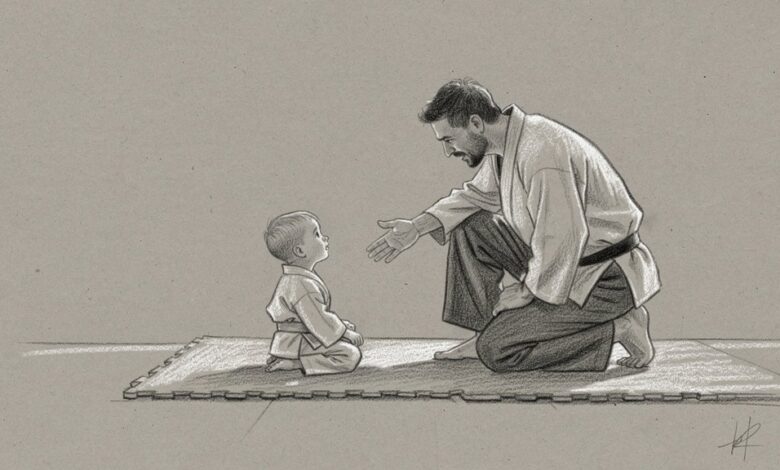
The moment another person’s sense of safety runs partly through you, you’ve taken on a caregiving role. For an instructor that happens on day one, and nobody hands you the manual.
Most people hear “caregiver” and picture a parent with a newborn or a nurse on a night shift (I did too, for about twenty years). It’s bigger than that. If you manage people, you’re a caregiver. If you coach, teach, sell, negotiate or lead a team, you’re a caregiver. If you’re raising kids, obviously.
The moment another person’s sense of safety runs partly through you, you’ve taken on a caregiving role whether you signed up for it or not. For the people reading this, that moment was the first time a seven-year-old looked up at you to find out whether the loud noise mattered.
There’s an operating manual for how human beings bond, trust and come apart under stress, and nobody hands it to you. It’s called attachment theory, and once you understand it you stop being surprised by people – you start reading them.
I’ve spent more than thirty years in a variety of worlds that look unrelated: running martial arts schools, being an engineer, a manager in large corporations, business consultant, Ph.D. student, and working as a psychotherapist. They all taught me the same thing. The adult who shuts down on you, the one who needs constant reassurance, the kid who runs to you and then hits you, they are NOT broken. They may have a different attachment style that they learned kept them safe a long time ago. Understand that and you can work with it instead of against it.
Why the system is wired in
A human infant is the most helpless creature on earth. It can’t feed itself, move itself or protect itself. The only thing between that infant and death is an adult who stays close and responds. Evolution built a behavioral system whose entire job is keeping the caregiver near: the baby signals, the adult comes, the alarm shuts off.
John Bowlby, the British psychiatrist who founded attachment theory, called it the attachment behavioral system. His colleague Mary Ainsworth took it into the lab. In the Strange Situation, she watched what one-year-olds did when a parent left the room and came back (Ainsworth & Bell, 1970). The leaving was never the interesting part… the REUNION was.
That system doesn’t switch off when you grow up. Cindy Hazan and Phillip Shaver were the ones who carried it into adulthood, showing that adult bonds run on the same machinery (Hazan & Shaver, 1987). They measured romantic relationships rather than working ones, so take the extension as a direction rather than proof. It runs in the background for the rest of your life. It’s why a team does bonding work before a hard season, why a new hire spends a month watching whether you actually have their back, and why a negotiation goes sideways the second somebody feels dismissed.
The instructor is an attachment figure, and it shows up in the numbers
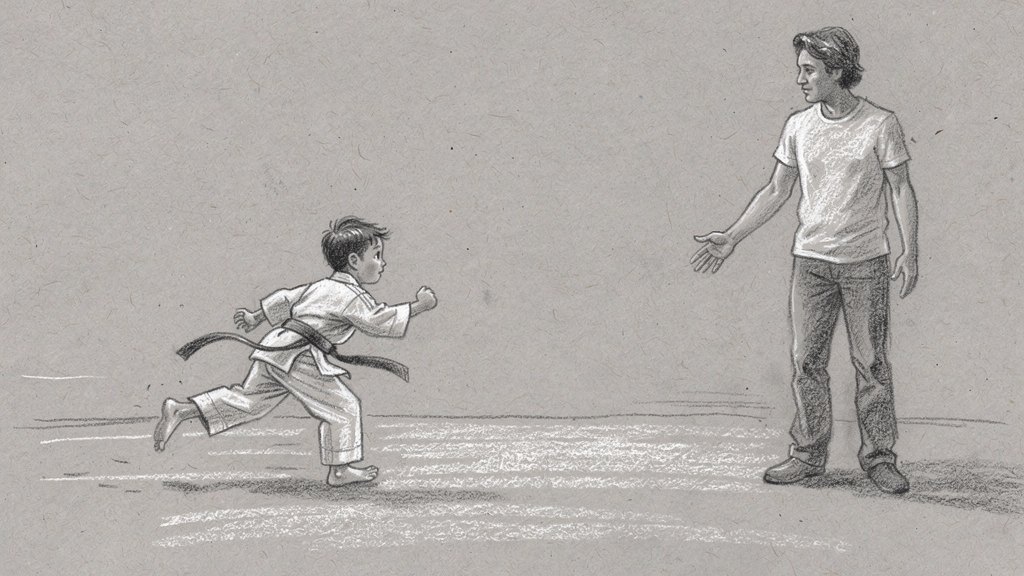
This isn’t only a parenting idea. Debora Roorda and colleagues pulled together a meta-analysis of how the affective relationship between a teacher and a student affects engagement and achievement (Roorda et al., 2011). The relationship between the adult and the kid does real work here, and it isn’t decoration around the teaching.
It was measured in classrooms rather than on training floors, and it’s a correlation across many studies. I’d treat it as a strong reason to take the relationship seriously, not as a number to put in a marketing piece.
Your version of that finding is easier to see than a classroom’s, by the way. You’re the adult a child looks at before deciding whether the hard thing is safe to try, and you do it standing in front of the parent.
One thing to be clear about before the patterns, because it matters. You’re not a doctor or a mental health clinician, and that’s not our role. What follows is a way to respond better to behavior you’re already seeing on your floor. It is not a way to diagnose a child, and none of it belongs in a conversation with a parent about what’s wrong at home.
Three patterns you’ll see on your own floor
They go quiet and flat when corrected, and you read it as not caring. For some kids, going quiet is what used to make a bigger reaction stop. You don’t know that about any particular student, and you don’t need to. Correct them, then stay near and keep talking about something ordinary. The staying is the message, not the correction.
They look at you after every rep. Before you treat it as neediness or a discipline problem, consider that they may not have evidence yet that you’ll still be there if they get it wrong. Give the evidence on a schedule rather than on demand, so it stops depending on them asking.
The hardest one to like, and the one that confuses new instructors most. Both moves are the same request. Be boringly consistent. It’s slower than you want, and it’s usually the thing that works.
The same three patterns run in the adults, which almost nobody tells a new school owner. The parent who won’t answer your calls and then complains they weren’t told. The staff member who over-apologizes. The one who needs to hear the plan four times before a change. You’re looking at a pattern somebody learned, not at who they are.
What to do with it this week
Pick one student you’ve privately written off as difficult and change one thing: what you do in the thirty seconds AFTER the correction. Stay near them. Talk about something else entirely. Then watch what happens to the next rep.
Do the same with one staff member you’ve been avoiding a conversation with. The avoidance is usually yours, and it’s usually about the same system running in you. (I’ve written about where the line sits between helping and taking over in Support Without Rescuing.)
Then go take the test yourself. The Experiences in Close Relationships scale is the established one and it takes about ten minutes, and the first person you need to understand here is you. If you’re the instructor who goes cold when a parent gets upset, that’s worth knowing before the next upset parent.
Count it after a month. Take the five students your instructors find hardest, and for each one write down the single behavior you’re going to respond to differently. The behavior, not a label for the kid. Then check the attendance on those five against the month before. That’s your number, and it’s where you’ll see whether any of this benefited you.
Common questions
What does attachment theory have to do with running a martial arts school?
The attachment system governs whether a person feels safe enough to try something hard, and it keeps running into adulthood. That makes it relevant to students on the floor, to parents at the counter, and to staff in a meeting about a change they didn’t ask for.
Is an instructor really a caregiver?
Whenever another person’s sense of safety runs partly through you, yes. A student deciding whether a hard drill is safe to attempt is checking the adult in the room first, which is a caregiving role whether or not the job description says so.
Why does a student go quiet when corrected?
Going quiet is often a pattern that once worked to make a bigger reaction stop. It reads as indifference and usually is not. Staying nearby after the correction, and continuing an ordinary conversation, tends to do more than the correction itself.
Does the instructor relationship actually affect results?
A meta-analysis of affective teacher-student relationships found associations with both engagement and achievement. It was measured in classrooms rather than training floors, so it supports taking the relationship seriously rather than supplying a figure to quote.
What was the Strange Situation?
Mary Ainsworth’s laboratory procedure observing one-year-olds as a parent left the room and returned. The informative moment was the reunion rather than the separation, which is also where you learn the most about a student after a hard correction.
References
Ainsworth, M. D. S., & Bell, S. M. (1970). Attachment, exploration, and separation: Illustrated by the behavior of one-year-olds in a strange situation. Child Development, 41(1), 49–67. https://doi.org/10.2307/1127388
Roorda, D. L., Koomen, H. M. Y., Spilt, J. L., & Oort, F. J. (2011). The influence of affective teacher–student relationships on students’ school engagement and achievement: A meta-analytic approach. Review of Educational Research, 81(4), 493–529. https://doi.org/10.3102/0034654311421793
Hazan, C., & Shaver, P. (1987). Romantic love conceptualized as an attachment process. Journal of Personality and Social Psychology, 52(3), 511–524. https://doi.org/10.1037/0022-3514.52.3.511
Moody, G. (2026, June 27). You’re a caregiver whether you signed up for it or not. mastermoody.com. https://mastermoody.com/articles
A version of this article first appeared at mastermoody.com.