
"How the Mastermind Effect Helped Me Find a Positive, Supportive Environment for Amazing School Growth and Personal Prosperity!"

An Interview with Ron Achenbach, NAPMA Inner Circle Member, by Toby Milroy, NAPMA COO
It’s easy to describe Ron Achenbach as the “everyman” school owner/chief instructor. He operates a median-size school of 180 students in a middle-size town: Karate America Leadership Academy in DePere, Wisconsin, a suburb of Green Bay.
What makes Ron’s story so different than many school owners’, however, is that he has first-hand experience with two systems, or approaches, to the operations of a school. The first was based on a dubious notion to cash out as many new students as possible.The second (which he uses today with growing success) relies on a more thoroughly developed business model of total school systemization, and, most importantly, includes the positive influence of the mastermind effect.
Ron’s moment of clarity occurred when he became a Stephen Oliver Coaching client, where he learned a more balanced approach that focuses on the four goals of every school: maximizing enrollments, renewals, retention and student quality.Your moment of clarity could occur when you read Ron’s story. It could help you challenge your static mindset, and become a member of a like-minded group of school owners, such as NAPMA’s Inner Circle or Peak Performers groups. Systemization of your school is a plan, but the support, sharing and effect of a mastermind group is what will make your plan successful and your future more prosperous. Visit NAPMAFreeOffer.com for more information.
Toby Milroy: Our guest for the Member Success Story is Ron Achenbach, who is a martial arts school owner from DePere, Wisconsin, a suburb of Green Bay. Ron has been a very successful school owner, and has experienced a big growth curve, especially, during the last couple of months.We’ll discuss many topics that should help to shift your mindset toward success, but we’ll specifically touch on how to make the winter a growth period of the year, even when you live in a wintry location, such as Green Bay, Wisconsin.We’ll also explain how important it is to be surrounded by successful people, which Ron has been learning for many years, as a long-time member of NAPMA and Stephen Oliver’s Coaching group.
Ron, give us just a quick rundown of your market, school and student body.
Ron Achenbach: DePere has a population of approximately 18,000. My school is 2,500 square feet in a standalone building; and my student count is approximately 150, 85% are children and 15% adults. I anticipate rapid growth during the next couple of months, due to what I learned during a recent mastermind meeting in Florida.
Toby Milroy: Ron, many martial arts school owners have a very closed-minded approach to how they operate their schools, often because of the cultures of the schools where they were students. Tell our Martial Arts Professional readers about how you changed your approach, your mindset, during the last few years.
Ron Achenbach: When I bought my school approximately seven years ago, I was part of a large organization, Karate American Wisconsin. Randy Reed started it during the late 80s and it became a very large organization in the state with 20+ schools. One thing led to another and it was disbanded.
I was fortunate to have that experience early because it introduced me to the big-picture mentality, although it wasn’t well organized. When I first started Master Oliver’s regular coaching program, I realized almost immediately that I had still had a bigger learning curve, if I was to maximize my opportunities as a school owner, especially when it comes to implementing systems and processes.
Master Oliver helped me change my mindset about some of the concepts that Karate America Wisconsin had introduced. The upside was that the other school owners and I learned some tighter systems, but the downside was a questionable approach to payments and the negative outcome.
Toby Milroy: Since NAPMA started helping school owners grow their schools in 1974, many other individuals and companies have introduced various systems and methods to operate a school. It isn’t a matter of persuading school owners which system is right or wrong, but comparing the results of those systems.
Certainly, one of the trends that swept through the industry a few years ago was cash-outs. NAPMA and Stephen Oliver, in his coaching program, has recommended moderation, and not an excessive approach to cash-outs; but there are systems being promoted that recommend that school owners should severely discount the total value of their training programs, so they can cash out as many students as possible. This concept assumes that retention rates will be bad, regardless of what you do, so grab all the cash you can upfront and you won’t have to worry about students as they dropout.
Ron Achenbach: Yes, the model was that every student would quit.
Toby Milroy: That’s OK. If that is a school owner’s opinion, then that is how he perceives his school, and its impact on his students. Ultimately, however, all the cash disappears, but the students remain with a large balance of untaught lessons. Should there be an economic downturn, a facility issue that costs some money, or any type of instability in the student base, then you the school owner has major financial problems that could close his school very easily and quickly.
Tell us about your negative experience with the cash-out model, which, to your credit, you were able to survive, and then change to a model that supports long-term growth in enrollments, upgrades, retention, student quality and revenues.
Ron Achenbach: As I stated, I was given a tight system that was supposed to generate plenty of revenue and profits. Through that experience, I did learn that we had a weak sales approach and poor phone skills, both of which we improved. The experience also proved to be exactly what you described: we would have killer months financially, just unbelievable months; but, all of a sudden, we would be starving the next month, scrambling for new students. It was either feast or famine, non-stop.
We tried to retain our students as long as possible, but the system made it very difficult. It created a little bit of negativity, and was one of the reasons why our organization, as a whole, started to disband. There were different mindsets within the group, and many said, “This just isn’t quite us.”
Toby Milroy: Much of what you said relates to the popularity of the book, The Secret, which is basically a rewrite of Wallace Waddles’ book, The Science of Getting Rich, of 50 years ago.
The point of The Secret is that your thoughts create reality, or that on which you focus expands the most. If you’re trying everyday to think about how to solve a problem, then, in most cases, you’ll find a solution; however, if you’re focused on the fact that the problem can’t be solved, then your brain stops trying to find solutions. Because your organization promoted the mindset of cashing out as many students as possible because most of them will quit soon, and you adopted that mindset, you created an environment and a mindset in students and parents that they should quit quickly.
Ron Achenbach: You’ve sabotaged your success because the system requires that your focus everyday must be to find 20 new students immediately, not to grow, but because you cashed out last month’s new students. It becomes an endless cycle of chasing your tail.
Toby Milroy: Carry that thought one step farther. As a school owner, you must be thinking about marketing, sales, instruction and retention. When you’ve assumed the mindset of “Don’t worry about it, everyone will quit,” you stop thinking about how to improve retention by creating an environment that will keep students long term; you stop thinking about how to implement the next system to plug the hole in the bucket; or how do you hold the next event at your school that will excite students, so they want to be students forever.
That’s the internal torpedo. You shoot yourself in the foot because you forget to think about and implement techniques to improve retention, which is one of the most important functions of your business, of your school.
Many school owners don’t have adequate financial management skills, so they shoot themselves in the foot in other ways. They see all that cash, and immediately buy an expensive car or house. Suddenly, there is a weather event that closes the school for a week or more, or some other unforeseen hiccups in their businesses and they’ll find themselves in a cash flow valley and they can’t pay the bills.
At Mile High Karate and many successful schools, the technique that stops that from happening is to consider your regular billing check, your residual tuition, as the steady funds that cover fixed expenses: payroll, rent, utilities, etc. Remember, the costs of doing business will come due with strict regularity, so you must have a revenue-generating, cash-flow model in place that will allow you to pay your bills on time.
Ron Achenbach: That was one of the bigger eye openers for me when I first started with Master Oliver. Cash is great, but make sure you can cover your costs; don’t be so focused on the cash. Our previous mindset was to collect enough cash to come close to covering our base cost. It took a year and a half to increase my monthly collections to cover costs, but, once I did, I relieved myself of a huge amount of stress.
Learn more about the NAPMA Inner Circle and how members, such as Ron Achenbach, can help you achieve greater success with your students. NAPMA.com/InnerCircle
Toby Milroy: That’s very liberating. You walk into your school on the first of the month knowing that the bills are paid, and you can focus on creating a great experience for your students or next quarter’s marketing, rather than scrambling to pay the bills.
You need to be free virtually every day of the month to focus on your four key goals that NAPMA and Master Oliver are always promoting: enrollment, renewals, retention and student quality. I know you have faced that challenge and have been able to implement the systems at your school. Tell us about that and the student experience at your school, from initial contact through enrollment.
Ron Achenbach: Yes, developing and implementing better systems for my school was our first big hurdle. It’s laborious work, but the outcome is great. It took me almost two years, but I first focused on my entire curriculum. It is now completely developed and detailed from 1st– to 3rd-Degree Black Belt. I no longer arrive at my school asking myself, “What will I teach today?” I know exactly what I’ll be teaching every day for the next seven years. That was a major load off my mind. Now, my instructors know what they are teaching today, next week and next month. We are no longer winging it.
I have also been developing and implementing, in great detail, the enrollment process, which generally follows the Mile High Karate model. It’s more than the phone and appointment skills and successful introductory lessons; it’s also about providing quality customer service as soon as a prospect becomes a student.
We’re constantly checking with new students about their initial experience and how we can serve them better; and part of that is starting the pre-framing process from the first intro lesson.
I think that is a concept that many school owners miss. They think, “They’re in the door and enrolled in a program; now, let’s hope they sign for an upgraded program at some point.” I’ve learned you can’t do it that way; you must take the initiative. You must be constantly asking those new students, “Is there something else you need; how else can we help you?”
It wasn’t easy implementing that customer service process in the beginning, but it works. I can tell because there is a different attitude among the students and their families and my staff. It’s different, and better, than it used to be.
Toby Milroy: That’s extremely important. To be frank, this is a sensitive and emotional topic for many school owners. In many cases, as soon as a school owner has experienced good financial results, others are ready to take a shot at him or her.
Several months ago, Master Oliver and I laughed about a quote, which reads, “Any imbecile can condemn, and most do.”
Operate a large school, with hundreds of students and generating above-average revenues and you are likely to be quickly condemned as only being in it for the money. Too many of those condemning have a made a leap of illogic that large, financially successful schools must have terrible student quality. “They simply can’t communicate with hundreds of parents as well as I do with only the parents of 50 students.”
The correct logic is quite the opposite: The only reason those schools have sustainable, strong financial and student quality results is because they’ve implemented and are operating all the necessary systems, including consistent follow-ups with clients and consistent communication with students and parents.
Ron, what systems do you use at your school to guarantee that little Johnny’s mom and little Johnny are engaged in your program from day 1 to day 50? What types of tools are you using to make sure you communicate with them on a regular basis?
Ron Achenbach: I’ve learned that a system must be flexible, so we are always trying to create more ways, or better ways, to make the system successful. I’m also working to emulate the Mile High Karate model of providing students and parents with a constant flow of information.
Two primary sources of information from my school are our newsletter and weekly emails. Students and parents know in advance the contents of the next class or the details about an event.
Prospects and new enrollments receive a series of letters during the course of two months that are filled with parenting tips, such as how to help little Johnny develop better self-discipline or Susie be more confident.
I have also started to recommend various personal development and success books to parents and students to read, and have even sent them copies of How to Win Friends and Influence People, for example, telling parents that its concepts will help their sons or daughters become better leaders.
Toby Milroy: You have a very robust communication system, using multiple media: e-mail, letters, phone calls, instructors during classes, students taking flyers home to parents, calendars, etc.
Another interesting point that many school owners miss is how busy parents’ lives are and how that influences communications with those parents. I heard a school owner say, “Toby, I send a calendar at the beginning of the month. Why can’t parents remember there were no classes last Tuesday?”
Ron Achenbach: You can send a calendar at the beginning of the month, send parents an e-mail everyday and tell students in class everyday that next Tuesday’s classes are cancelled and you will still have a parent or two state that you didn’t tell him or her.
Toby Milroy: Yes, that’s a daily frustration for school owners. Think about why that is because this is an important distinction that school owners should be able to conceptualize about their customers: Think about the daily life of the mother of a nine-year-old, or a nine-year-old and six-year-old. Think about all the steps required from waking a child in the morning to seeing that he or she is safely to school. Think about all the activities a non-working mother must do during the day to prepare for the care of her children; an employed mother must do all that plus do a job.
Added to the 10 tasks that mothers are doing is all the time to take their children to their martial arts classes. No wonder it takes a Herculean effort to communicate to those parents. They’re so busy; they have a whole life that includes much more than martial arts. So many activities and chores are occurring every day that a calendar distributed once a month simply won’t make much of an impact as a communication tool and make sure they remain engaged with your program and remain as students.
A calendar is certainly a tool that you must use, but what you described is much more effective. You’re communicating through multiple media.
Ron Achenbach: Dan Kennedy says you must contact each customer at least 52 times a year or they will start to quit, and take their business elsewhere. It would be nice to contact them just about every day, but at least once a week, minimum, is a must.
Toby Milroy: Those letters with parenting tips are especially powerful because you are involving parents in helping their children learn focus and discipline, and that communication tool is an external support to reinforce those lessons taught during class.
You made another interesting distinction that school owners overlook. You said that you want to communicate information that parents and students think is valuable, to them. Too many school owners communicate information that is important to them or their instructors. Remember, the customer is the person you are trying to serve, so you want to know his or her needs, and then provide them.
Ron Achenbach: Communication is a very strong retention tool. We’ve worked hard on our retention, which is now approximately 80%; and I know it will continue to improve because of our constant and open communication system.
Toby Milroy: Let’s now transition to another important system and that is operations, which includes staffing and on-the-floor activities. Please describe your instructors’ systems and processes not only for the curriculum, but also to help facilitate enrollments and renewals.
Learn more about the NAPMA Inner Circle and how members, such as Ron Achenbach, can help you achieve greater success with your students. NAPMA.com/InnerCircle
Ron Achenbach: The first point I’ll make is based on my experience and that of many school owners. I remember being a small school owner, the only guy running the show, and asking myself, “How will I do all this stuff?” Don’t hesitate to ask some of your parents to help.
If you’re a good quality instructor and parents like what they see you’ve been doing with their kids, then they’ll be more than happy to help you; sometimes, they’ll bend over backwards to help. A mother of a student approached me the other day and offered to help with our newsletter.
The secret is finding those resources in your school, among your parents or family members, or even friends of parents. You’ll definitely find people that are willing to help.
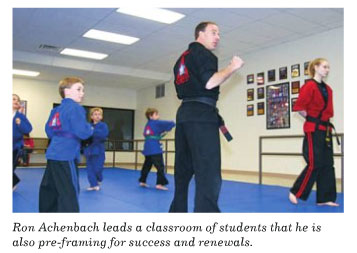
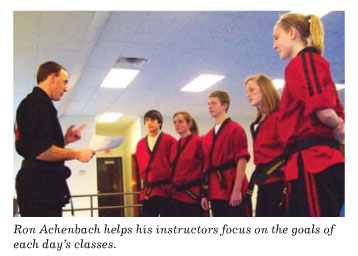
What makes our operations system work so well is our staff training. I have a rather complete instructor training program, but my instructors must be a part of our leadership program first. I want them to have developed a leader’s mindset and the leadership skills that are applied, whether you are teaching a martial arts class or running a Fortune 500 company.
We pre-frame our students early in the process that if you want to be an instructor, you must be able to lead yourself and others. As I mentioned, I have developed our curriculum through 3rd-Degree, which is seven years of instruction, so that is the game plan that our instructors must know, as well.
Part of our training also includes scripts for various processes: phone calls, making appointments, conducting the intro lessons, closing a sale, etc.
As I said earlier, it work at first, but it makes your life easier once those systems are in place. It’s just a matter of taking the time and doing it. Your systems won’t be perfect; you’ll always be tweaking it here and there. I think back to when I had no systems. I was at the school seven days a week, putting in umpteen hours each day; but, now, I’m at the school five days a week, six if I must; I try to avoid it. During the summer, I play golf every Thursday, and go boating at least once a week. There’s still the work to be done, but with the systems in place, it allows me to have a life outside the school.
Toby Milroy: I come from a very entrepreneurial family; my mother runs restaurants in the Midwest, which is a very tough business. One of the things that I learned through that process is that being an entrepreneur, in many cases, is a very lonely existence because there aren’t many other people with whom you can discuss being an entrepreneur. Another lesson from the restaurant business, or any small business, is that you must be very clear and define, in no uncertain terms, whether you run the business or the business runs you.
Many school owners (and entrepreneurs, in general) work 20, 30, 40 or more years and, at the end of the road, have not created lifestyles for themselves. They created jobs, but forgot along the way that the reason they worked so hard was to create great outcomes for their students, change their lives, contribute to a better world, and also be able to enjoy the world.
I talked with Miko Peled, one of the newer members of the Millionaire Wealth group. He operates a school in California. He is originally from Israel, and his ultimate goal was to be able to return home for a month or two every year. He was never able to do that until he systemized his martial arts school. Now, he’s able to create that lifestyle for his family and himself.
As part of the Millionaire Wealth group, how have you created a successful business that also facilitates the type of lifestyle that you want? What are your ultimate goals for your business and where do you want it to be five years from now?
Ron Achenbach: I was thinking about Miko the other day, after remembering that we talked during the last Mastermind meeting.
Until I heard how he had structured his school, so he could travel to Israel, I had never thought about taking five weeks off. I come from a farming background, so there were never any days off; and the constant mindset was just work, work and work some more. I think many businesspeople are caught in that trap, and find it hard to break that pattern.
I took my first vacation in seven years three years ago; and it was only for four days. Last year, I spent a week in Belize, and took another trip for three or four days. Now, my mindset is much different about having a life outside of Karate.
During the next few years, my goal is to hire a full-time instructor, so I can concentrate on operations. Before I realized that obvious strategy, I was focused on making a living for myself, but now I must create an environment where that full-time instructor can have a very good financial future. I want him or her to have a financially viable opportunity, so I have the option to step away from it. That has become much more of my focus; for lack of better term, it’s my exit strategy.
Toby Milroy: Your goal, which is the goal of many school owners, requires that change of mindset that I know you’ve accomplished. You must remove your ego from the equation for a second, and then learn how to take two steps from your business, so you can look at it objectively. Many business owners in this type of an industry, a small, tight-knit industry, tend to be so enmeshed in their businesses that their only results are subjective because they’re doing it all.
The seventh habit in the book, The 7 Habits of Highly Effective People, describes this mistaken mindset very well. The lesson of “Sharpen your saw” is someone sitting on a tree limb, sawing vigorously, but making no chips or sawdust. Someone walks by and says, “Why don’t you take a minute and sharpen your saw, so you can cut through the tree branch?” The person in the tree replies, “I can’t do it, I don’t have any time; I’m too busy, I can’t take the time to sharpen my saw; I must just keep sawing.”
Another example is keeping statistics, such as measuring call-to-conversion ratio. What’s the rate of people that call and make an appointment, and then honor their appointment? In many one-man shows, such as a martial arts school, that ratio is never tracked because it would reveal that the owner (doing everything, including answering the phone and making appointments) doesn’t do a very good job. He would have to fix himself, and most people don’t want to hear that.
Many entrepreneurs want to think that they’ll have the best ratios, simply because it’s their businesses. In my case, and those of many school owners, once my staff members were highly trained and very good at converting appointments made to appointment kept, their ratios were better than my ratios. My school’s call-to-conversion ratio improved, when I stopped answering the phone. The staff member that was answering the phone was concentrating solely on how to answer the phone and how to make a successful enrollment appointment. His or her mind wasn’t stuffed with all my other responsibilities and tasks.
Ron Achenbach: I had a similar experience. As the owner, I had to do this and I had to do that and the phone is ringing. I want to make an appointment with that prospect, but I have so many other things I must do. A program director can focus on motivating prospects to make an appointment and honor it.
Toby Milroy: You’re right. School owners have too many things on their minds, and, frankly, should be thinking about marketing, sales, curriculum, retention, etc. If you can train a staff member to take some of that load off your plate and do an excellent job, then, in many cases, he or she will be better at it than you. That’s definitely an eye-opening experience for many school owners.
Ron Achenbach: Another key to developing the correct mindset is deciding if you want to be a full-time, commercial school owner or a hobbyist. Too many instructors still have the mindset of a hobbyist, but think they can have a big school. It won’t happen until they adopt a big-school mentality, and are willing to make the necessary sacrifices.
Toby Milroy: Hoping certainly doesn’t lead to a big school. You must have a definite strategic approach.
Let’s now talk about your retention systems. What systems or tools are you using that Martial Arts Professional readers could implement to strengthen their retention rates?
Ron Achenbach: A key, but rather simple technique, is the instructor’s personal touch. We use the three-contact rule: Use students’ names, give them a personal touch on the shoulder or with eye contact, and then be in touch with students outside the school.
I make sure that just about every week one of my staff members writes and sends “Good Job” cards to five students. We rotate that method, so each student receives at least one card a year. That small gesture makes a big difference. Students who received that card eight years ago tell me that it is displayed in their bedrooms. Too many school owners miss these simple ideas because they equate simplicity with little results, but it doesn’t work that way.
Other retention tools we use include stripes and one special event every month. We work that event into our marketing because it is often a bring-a-friend or buddy event, which builds retention as it exposes prospects to your school.
Toby Milroy: As you expand your staff, you’ll want to send those cards more frequently. Our goal in the Mile High Karate system is that every student receives a Good Job note every three months, or four per year. We have many leadership students assisting during classes, so each of them selects a student from the classes they’ve taught to receive a card that day. By the end of the day, we’re mailing eight to 20 cards.
Of the four primary goals of every martial arts schools-enrollments, renewals, retention and quality-what student quality systems have you implemented recently that have been big winners for you? What type of quality control systems are you using? What type of measurements are you taking to track those results?
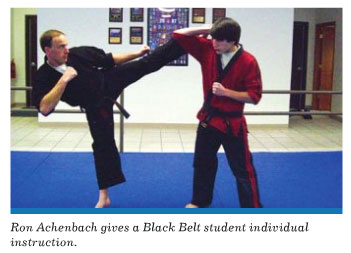
Ron Achenbach: My student quality improved as my instructors’ training improved, especially, holding students to a higher standard. When little Johnny has trouble with a kick, don’t just say, “Oh, it’s close enough.” Help little Johnny with the kick. Pull the kid aside and say, “Let’s bring you in for a private lesson. We want to help you learn that kick.”
Learn more about the NAPMA Inner Circle and how members, such as Ron Achenbach, can help you achieve greater success with your students. NAPMA.com/InnerCircle
Our process to evaluate students’ standard progress also improves student quality. As part of student promotion, we send their parents intent-to-promote letters. The parents are asked to provide some input, such as whether the student is thinking and acting like a Black Belt at home. We ask their academic teachers to complete a form that reviews students’ Black Belt character and behavior at school. If there is an issue either at home or academic school, then we want to address it, immediately.
Toby Milroy: Let me illustrate your point, using what happened to me as an example. At one time, my school was a part of a big organization, which started to lower the quality standards, one small step at a time. Each time the student requirements or standards were lowered, the students’ performance level would fall, instead of rise.
You might be saying, “My five-year-old students aren’t able to learn a 25-move form, so I’ll cut it in half and I’ll only teach them 10 moves.” It’s good thinking, a good concept, to make your curriculum age-appropriate for preschoolers, but that thinking starts to permeate the culture of your school, and the quality standard begin to fall, and your students stop striving to fulfill much higher quality standards.
During the last five years, I’ve completely reversed the reduction in our student quality. We now require more from every student than ever before, and the pass rate and outcome quality for each student is higher than ever. During a recent Black Belt exam, six- and seven-year-old students did 11 forms, four weapon forms, all sorts of sparring counters and sparring combinations, and then live-sparred for 10 or 15 minutes.
Had I continued to lower the bar, the quality standards would have fallen to the floor; but when your standards are as high as possible, and you expect your students to reach those standards, then they will. You must give them, as you said, as much help as possible. Make sure you’re giving them as much attention in class as they deserve and need, and extra attention, if necessary.
Ron Achenbach: I had a similar experience. We dummied the system for a long time, until there wasn’t much of anything left. When we turned it around, we introduced a rotating curriculum, so, depending on a student’s level, he or she will receive the same instruction two or three times, before they graduate from that level.
I always tell parents that their children will have plenty of curriculum materials to learn, so the first time through the cycle will be a little ugly, but that’s okay. By the time they are ready to graduate from that level, however, they will look sharp because we make sure they really learn it. I used to be super-critical about what students should be able to do early in the curriculum. I was thinking like an instructor only, but I learned to step back and realize that we were asking children to learn a big pile of stuff. My instructors and I now realize that it takes some time before students look the part; and we’re not afraid to explain that to parents; in fact, it’s better when we do.
Toby Milroy: The analogy that we always use is competence leads to confidence. Obviously, the goal, within the first few hours or days, of a person’s training is to make him or her feel competent, that he or she can accomplish something. That leads, through repetition, to confidence. When students know that they can accomplish a move or technique, they’ll be able to do it for their instructors and parents.
Let me ask you: What’s the next step in your career? What are you pushing yourself to accomplish?
Ron Achenbach: My big goal is to grow my school to a point that allows me to step from the day-to-day operations when I choose. I want to stop episodic marketing, and move forward with formatted marketing; a plan that includes x number of promotions or events every month.
I’ve already started implemented my plan with one major internal promotion and two or three minor promotions, plus, advertising and direct mail every month. I will continue to tweak my 2009 plan. My goal is 10 to 15 marketing and promotional ideas a month that will attract prospects that I can convert, using my enrollment and upgrade systems.
Episodic marketing was a problem at my school. Many small business owners have experienced the episodic results. We promote during one month and generate great results, but then don’t promote at all during the next two months, hoping the phone will ring. You must do what is necessary to make the phone ring everyday.
Toby Milroy: Too many school owners’ daily lives can be described as: you wake in the morning, you kiss your wife and you go to your school. You do whatever promotions you’re doing, you manage the business of the day, you teach classes during the evening and then you go home. During a typical day, almost anything in front of you is perceived to be more urgent than marketing.
The phone rings, so you stop what you’re doing to answer it. Someone walks in the door, so you stop what you’re doing to talk with him or her. There are so many distractions, and almost everything is more visually urgent than marketing.
There are very few goals that are more important than driving traffic to your school, but, all too often, the other, very important and urgent stuff becomes a barrier to focusing on the planning and implementation of your marketing.
NAPMA members have access to more marketing materials-flyers, ad slicks, postcards, direct-mail letters, press releases-than they’ll ever need for the lives of their schools. The challenge for many school owners is not the marketing materials, but taking the time to customize and use those materials, correctly.
Ron Achenbach: Even with all I’ve learned, I still must force myself to do my marketing. Part of it is changing your mindset. My mindset used to be, “Oh man, I don’t want to do it; it’s a pain in the butt.” Now, I’m excited about creating a marketing program and customizing materials. I’m traveling the right learning curve, studying copywriters and marketing experts and testing their techniques and ideas.
It’s a little bit of a load, but, finally, those ideas start to generate results and it excites me to create the next idea. Initially, it’s not fun, and I’d rather have teeth pulled than do it, but now my mindset has changed, as I’ve become a successful marketer.
Toby Milroy: Sequential, rather than episodic, direct marketing is most effective for small businesses. Test your marketing pieces, and don’t be afraid to try many media and messages to discover what works.
What happens, in most cases, is what you described: School owners do a big direct mail or e-mail blast, and generate a flood of new students. The school owners become so busy, however, serving those new students that they forget (or don’t take the time) to market for the next influx of new students. Thirty to sixty days later, enrollments and revenues have decreased significantly, and then they turn to another episodic marketing push.
You must be disciplined to do the marketing. You must be focused on your students, during classes, but you must use the time when there are no students at your school or during the weekend to focus on your marketing. That’s the lifeline of your business.
Ron Achenbach: I learned that one of the best ways to find the time to focus on marketing is delegating tasks and authority to your staff members. That is often a difficult change of mindset for most small business owners; I readily admit I was terrible at it.
You don’t have to be on the floor every class, every night. Let someone else teach one of those classes one day a week, so you can sit (undisturbed) in the office to plan and implement marketing, track and analyze your statistics, etc.
Toby Milroy: I mentioned above the repetitious nature of the average day of the average school owner; and there are not many opportunities during that day to interact with other entrepreneurs and discuss similar problems and challenges and share possible solutions.
Please describe your exposure to the mastermind effect. How important is it for you to surround yourself with other successful school owners and those who may have developed business skills better than yours? How have you’ve been benefited by that experience?
Ron Achenbach: The mastermind effect opened my mind to a much bigger reality. I remember when the Millionaire Wealth group met in Ft. Lauderdale, and the International Boat Show was occurring at the same facility. The parking lot was filled with Ferraris and Maseratis, and multi-million dollar boats are on display everywhere. Suddenly, I realized that there is much more to the world than I might have thought. Whenever I sit in a meeting with the other members of the Millionaire Wealth group, I see more of that bigger picture, and understand more about how to aspire to claim my part of it.
Another benefit is that I’ve learned, although I don’t have other entrepreneurs to speak with everyday, I can read books written by those who are operating and achieving at a higher level than me. I try to read a chapter or two everyday. I want to learn how and why others are better at sales and marketing and being a successful entrepreneur. What you read and learn can serve as that barrier you often need between yourself and others who don’t understand your vision of being an entrepreneur. That’s why it can be a lonely existence.
I’ve also learned to interact with as many influential people as I can. I’ve looked and found them in my school. The children of the CEO of one of the largest independently owned trucking companies in the United States attend classes at my school. I talk with him regularly. I like his many different ideas and attitudes about business, finances and life. It doesn’t have to be the CEO of a big company, however. There are many influential people from whom you can learn who have operated successful small businesses in your community for years, even decades.
Toby Milroy: The lonely existence of the entrepreneur often extends to your family and friends. Your family members love you; they will always love you. They will always be there for you, but, in most cases, if they’re not entrepreneurs, business owners, then they don’t think like a business owner. They probably have the mindset of an employee or a contract worker.
As entrepreneurs, we’re forced to think about how to create a service that is very valuable to our customers, over-deliver massively on the customers’ needs and grow a successful business. An employee thinks about how to spend the next eight hours, so he or she can earn a paycheck. Being an entrepreneur is a very different mindset. It’s important to disregard the negative naysayers, and listen and learn from those with positive ideas to grow your school.
There may be ups and downs in the economy, but there’s always a huge amount of wealth in the world because there are so many successful people. You can either surround yourself with them or with those who are not as successful. That decision is yours, but make a conscious decision.
Ron Achenbach: It’s the old saying: You’re income is about the same as your five closest friends. If you don’t like your income level, then find five new friends.
Toby Milroy: You don’t choose your friends, but you can choose the environment from which your friends come. If you’re trapped in a negative, anti-supportive environment, then you’ll have negative, anti-supportive friends. Escape to a positive, supportive environment and you’ll have positive, supportive friends.
A major benefit of the student experience is being surrounded with other goal-oriented students. Instead of being in the high school gang or the elementary school group of miscreants, a child or teenager can choose to be surrounded with students who are training on a regular basis, goal-oriented and focused on accomplishing a big goal, Black Belt and beyond.
That’s an important message for parents to understand because the student experience can have a massively positive impact on their children that they can continue throughout their lives.
Ron Achenbach: Just think about how much more energized you feel at the end of that day, when you participate with a group of students that is driving hard to reach that next level. It makes you want to go that much harder, and achieve that next level of business.
Learn more about the NAPMA Inner Circle and how members, such as Ron Achenbach, can help you achieve greater success with your students. NAPMA.com/InnerCircle
- "I Experienced Amazing School Growth When I Filled My School Calendar with Events, Promotions and Community Activities!"
- “I Want to Share My Amazing Business Secrets That Will Help You Overcome the Obstacles to Your Success!”
- Tony Robbins, Personal Development Expert
- How My School’s Gross Income Increased by 300% and My Net Income by 1,000% in Just Twenty-Four Months – And Why I’m Richer Than Ever
