
"My School's Growth and Retention Rate Dramatically Improved, When I Developed a Stripe-Based, Rotating Curriculum."

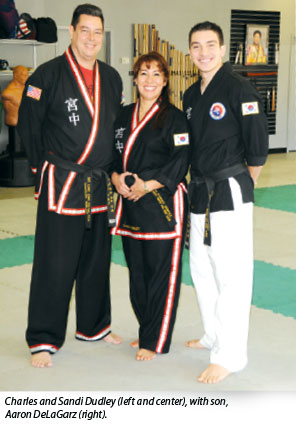 Charles Dudley, NAPMA Inner Circle member, was taught to maintain the tradition of the complex Korean styles in which he trained for 37 years; but, as much as he honored his long-time teacher, Master Dudley realized that he had to adapt the Korean arts to an American audience, so he could succeed in an American market.
That wasn’t the last step in the development of his entrepreneurial mindset. He then created an annual lesson plan, presented in a rotating curriculum, which includes a rather extreme stripe system; but it’s all part of a highly systemized process to keep parents involved in and informed of their children’s progress-resulting in a 97.5% retention rate!
Another important lesson from Master Dudley’s experience is that he is an average-size school (fewer than 200 students) in a middle- to upper-middle-income suburb in San Antonio, Texas. He has lived a concept that NAPMA promotes repeatedly: Developing systems and processes to run your school successfully has nothing to do with the style you teach, the location of your school and the number of students you serve.
Master Dudley’s success story can be yours-just as he helped a friend adapt Master Dudley’s system to transform a part-time school to a full-time, profitable business. You can learn how to follow the same path to success, when you visit NAPMAFreeOffer.com.
Interview by Toby Milroy, NAPMA Vice-President of Sales and Marketing
Toby Milroy: Our Success Story guest this month is Charles Dudley, a NAPMA Inner Circle member.
Charles, let’s start with your martial arts background, an overview of your school and a little about you.
Charles Dudley: I’ve been training for approximately 37 years in five different systems. I have a 5th-dan in Taekwondo, a 4th-dan in Kung Jung Mu Sul and Black Belts in the others. Our school is located in San Antonio, Texas, and currently teaches Kung Jung Mu Sul, which is one of the three original root systems of Korea. It’s a very traditional system and I’m a very traditional instructor.
We run our school, based on historical tradition. For example, throughout history, as a general rule, a martial arts school was central to its town. Martial artists often served like the sheriff or the protector of the village. The school was also the public library or school of education; it was essentially the cultural center. We’ve adapted that concept at our school, when it comes to our relationships with our students. We’ve established that perception of our school in the marketplace.
Toby Milroy: What are the demographics of your market area?
Charles Dudley: Our school’s community is upper-middle income, but I find that doesn’t make much difference, if you’re running your school properly. It’s a question of what people value the most in their lives.
A good friend of mine that has a school on the south side of San Antonio, which is often considered a low-income area of the city. He now runs an incredibly good school, but, for a long time, he was struggling, working a day job and teaching martial arts during the evenings. He did that for a number of years, but he wanted to become a full-time school owner, and benefit from that opportunity, as I have.
I wanted to help him, so I started showing him what I was doing, which we adapted for his school. He was able to quit his job and run a full-time martial arts school very successful. His wife also quit her job and is working with him at the school.
Toby Milroy: The underlying principle of you and your friend’s experience in San Antonio is that the success of a martial arts school, or any local business, has more to do with your business structure than the surrounding demographics, including income levels.
Stephen Oliver and I and others on our NAPMA executive team have many opportunities to interact with other trade associations and their members, who operate various businesses that are similar to martial arts schools, including chiropractic and dental practices and cosmetic surgery physicians.
Many of them have had the same experience as you. In fact, two cosmetic surgeons who are members of a mastermind group in which I also participate prove that two businesses offering the same service can operate in an excellent market, but one is highly successful and the other is mediocre.
These two cosmetic surgeons are located in Miami, which you would think is one of the best markets for their services in the U.S.; however, the first surgeon makes the kind of money you would expect a cosmetic surgeon to make, while the other earns less than $100,000 a year. Presumably, they have the same education and are licensed by the state, but there is a huge difference in their incomes. The real difference is in how they market and operate their practices.
Toby Milroy: The reason I asked about your surrounding demographics is that I want our readers to realize that your school is located in a very average area. School owners, reading this NAPMA Success Story, shouldn’t think that their schools are so different that they couldn’t duplicate your business structure, positive experiences and success.
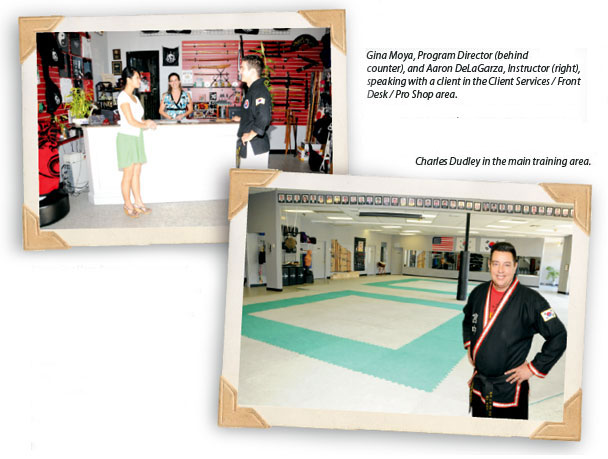
When NAPMA ran a demographic study of your school, it revealed that there were approximately 1,300 to 1,400 leads in a five-mile radius. These were families with more than $60,000 in annual income and had children 4-12 years of age in the household. That’s a very typical demographic profile.
Let’s return to your style, Charles. You said that you’re a very traditional stylist; and my background is very traditional Korean, as well. My root style is Tang Su Do, which in one way or another is descended from Sabaku, which was one of the other traditional Korean styles you mentioned. How has your traditional curriculum been affected, modified or strengthened during the last five or six years, as you’ve modernized your school?
Charles Dudley: I’ve made quite a few changes. My instructor is Grand Master Sun Ta Yung; he is the worldwide head of the International Kundun Federation. He’s Korean and very traditional. Of course, I was taught to teach my students as I had been taught. That was great because when I started martial arts it was real hardcore. I started in Isshinryu, and my instructors had just returned from ‘Nam; they were Marines and it was pretty rough. I enjoyed it, but very few people did.
I was 16; and I think I was the youngest in the class. As a matured as a student and instructor, I realized that the U.S. is not Korea and my students weren’t Koreans. How the martial arts are taught in Korea is congruent with its culture; however, Americans learn differently than Koreans and vice versa. For instance, Americans are taught to question everything, whereas, in Korea, that is not the norm.
“Students retain the curriculum much better; and they and their parents clearly understand the upcoming training modules and their benefits.”
I decided to adapt the lessons I had learned, so they could be communicated in modern terms, and specifically for my student body. Seven-year-olds or 12-year-olds and their mothers don’t understand the intricacies of a Korean martial arts style, but I could still teach those valuable lessons, in a more appropriate manner that everyone could understand.
Kung Jung Mu Sul is a very traditional system, and it consists of kicks and punches, hand techniques, and kicking techniques similar to Taekwondo, for example, because of being a root system. My style also includes joint-lock, pressure-point techniques similar to Hapkido; redirection of force similar to Aikido; throwing principles similar to Judo; ground fighting similar to Ju Jitsu; and a multitude of different weapons. Acrobatics and other physical training is part of Kung Jung Mu Sul. It’s a very broad-based martial arts system, and the real challenge was how to teach it to a large number of students in contrast to Grand Master Yung’s traditional linear teaching method.
I reviewed my entire curriculum and the requirements for first-, second- and third-degree and other advanced belts. I rearranged it into a rotating curriculum, and organized it into various groups: beginner level of three belts, intermediate level of three belts, advanced level of three belts, and then first-degree and higher.
Next, I determined the difficulty level of the curriculum, and then created three, three-month segments. Now, all the students are performing the same materials and it’s much easier to teach.
Even though joint-lock-pressure techniques can be intricate, I’ve devised a method, so one instructor and an assistant can teach 30 to 40 people. Previously, that wasn’t possible because it was too labor-intensive. The results have been much-improved students that retain the curriculum much better; and, most importantly, they and their parents clearly understand the upcoming training modules and their benefits.
I’ve also created stripe levels within the belt system for first-, second- and third-degree Black Belts. Most martial arts systems have stripe levels, but I’ve almost taken it to an extreme, with 18 different stripe levels within a single belt. My stripe system makes it possible for any instructor in my school to look at any student’s belt and know his or her skill level, even if the instructor has never seen that student in a class.
It’s so much easier to teach because all you must do is keep each student focused on the next stripe to earn. Our stripe system motivates students to put forth genuine effort because they are working toward a reward. When students earn that next stripe, they know that they have reached a higher level than other students.
When we are ready to reward a stripe, we stop class, which is called to attention. The student bows to his or her parent (“thank you mom, thank you dad”), and then everyone claps and cheers because another member of our family is stronger. We want students to be publicly acknowledged for what they have just done.
Our stripe system and class presentation of stripes create a real success mindset for our students. Even if the parents weren’t there, when they come to pick up their children, the stripes will be clearly evident, and their children can explain what they accomplished to earn them. That makes it so clear in parents’ minds that there’s constant progression.
We discovered that, in a belt-only system, the amount of time between belts causes a negative perception in parents that their children are not making progress. The only way they would notice their children’s advancement would be to observe every class, which, of course, most of them can’t do.
Learn more about the NAPMA Inner Circle and how members, such as Charles Dudley, can help you achieve greater success with your students. NAPMA.com/InnerCircle
A complementary tool to our stripe system is a progress report. I used the typical 6-week or 9-week schedule of many academic school districts as a model. Regardless of their schedules, they send regular progress reports, plus reports cards to parents at the end of each term. Those reports inform parents of their children’s progress, so I use the same system to keep our parents informed.
Another great benefit of creating my stripe system was that it caused me (or forced me) to create a complete annual lesson plan, with a written lesson for every day of the year. Name a date and I can tell you that day’s lesson. This plan isn’t carved in stone; instructors can deviate a slight bit, if they consider it necessary.
My annual plan/rotating curriculum removes all the guesswork for instructors. Traditionally, in many cases, the instructor stepped on the matt and flew by the seat of his pants. The lesson structure not only simplifies the instructional process, but also makes it easier for an assistant instructor, G.O.L.D. Leadership Team member or parent-volunteer to be on the same page with instructors, and assist them in more meaningful ways.
Toby Milroy: Charles, you’ve made at least seven very vital points, but I want us to return to one of those points, so we can help the relatively new school owner think about how to develop the structure his or her school, and the experienced school owner tweak his or her processes and systems.
Please describe your vision of the cultural differences of the way martial arts was taught and the way you’re teaching it now. Decades ago, the martial arts were taught in Korea as a method of survival and warfare, and, as a byproduct, students became more confident, focused and self-disciplined individuals.
In the modern school environment, we want to teach martial arts as an activity that’s fun, exciting and productive, with the same outcomes: more confident and focused and the ability to defend themselves in any situation. What did you specifically modify in your teaching approach to make your Korean style palatable to the family market?
Charles Dudley: Let me begin with some background that inspired our approach. Throughout history, every culture has had a warrior class that rose to the top levels of that culture. They earned their status because they literally had the power of life and death in their hands. They looked at death in the face all the time; and that experience taught them to appreciate life in a much more meaningful way than the average person.
Many warrior classes lived by a code of ethics: Chivalry in Europe, Bushido in Japan and Hwarang in Korea, for example. We promote those same codes of ethics at my school. Frankly, I tell all parents when they first visit my school that I have no intention of being politically correct. I make it very clear that this is a martial arts school, not goo-goo world. That doesn’t mean we beat each other black and blue or put students in an injury-causing situation. I’m a big stickler on safety; however, our training changes people’s lives, and help them protect those lives. People and their lives matter to me.
To be honest, our society is not much different than those of the past. We may not be fighting in the streets, but there are still many incidents of individual violence that is very similar to being attacked by highwaymen in medieval Europe.
Recently, just such an incident occurred in my community, which is typically very safe. One of my students, who is a first grader at a local elementary school, was attacked in the bathroom-by another first-grader!
“We discovered that, in a belt-only system, the amount of time between belts causes a negative perception in parents that their children are not making progress.”
Typically, students are permitted to go to the bathroom, but in pairs. The second first-grader pulled a knife on my student, twisted his arm, pulled him to the floor, put the knife to his throat, and told him he would cut his head off if he told anyone.
You can change the ages of the attacker and the victim and place them in different locations and time periods, but it’s still person-on-person violence that has occurred throughout time.
Another example is one of the high schools in the San Antonio area. The students come from very affluent parents; yet, the school has the highest drug rate of any school in the county.
Just because we don’t have massive combat in the streets doesn’t mean that the lessons of chivalry, the Bushido code and the Hwarang code don’t apply to modern life. We may not be living in caves or without electricity, cars and electronics, but life, even today, is still a matter of physical survival.
When you consider our school environments, the content of TV and the many other societal issues that are affecting our children, it’s quite obvious that they need to learn and live by these codes of ethics. I explain to new parents that what we offer is not an activity; it is martial arts training. Obviously, they don’t know the difference, but that’s okay; I’ll teach them.
Part of my school’s structure is a little bit different than many martial arts schools. New students enroll for a two-month class that we consider an evaluation period. I don’t frame it as them evaluating us, but us evaluating them: Do I want them as students at my school? The determining factor is whether the parents are on the same page and if they believe in their children. Are they confident that their children are capable of excelling and being more productive? Are they as dedicated to the success of their children, as I am? Only then they can be members of my school.
If they’re looking for just an activity, such as soccer, baseball or dance, then that’s fine, I’m not mad at families that want an activity; but I will refer them to a school down the street. That policy of mine caused me quite a shock at one of our Inner Circle meetings. The members were sharing their school statistics with the entire group, and when I stated my retention rate, Rob Colasanti made the comment that he had never heard of one that low. I didn’t know any different.
Toby Milroy: I think it’s very clear that the culture you’re trying to create in your school is very important. The next point you made that I think deserves some expansion is that school owners, regardless of their current development, should have a very systematic approach to their curriculums and managing their classes and the progress of their students.
You also mentioned that you have an extensive stripe system to track every element of your curriculum and character development material. As students learn those elements, you integrate them as not only a reward system, but also a tracking system for you and your staff, and you’re applying that in your rotating curriculum.
A rotating curriculum is a concept that most school owners seem to understand; and they experience great results when they implement it, while others become stuck in the mud. They’re missing one or two key details and, for some reason, it’s a complicated concept to understand if they don’t see it in operation, but you had a very eloquent description of your rotating curriculum. You have basic, intermediate and advanced levels; and students progress through a rotation, so everyone at a particular level is learning the same material at the same time.
Tell me a little bit about how your thinking had to change or how your implementation had to evolve to be able to make a rotating curriculum work, and then one or two details on how you divided your curriculum. What had to happen internally in your mind to make that system work for you?
Charles Dudley: Initially, I was frustrated because I wanted to expand my school, but it was physically impossible for me to be involved in all the classes and teaching. I had to find a solution and, although I had heard about the rotating curriculum and easily understood why it would work with Taekwondo, I didn’t think it would work with my style.
Of course, I was wrong because a rotating curriculum can be used with any style. Every school has a ranking system of some sort, so all you must do is separate your system into component parts. In my case, White Belt is a separate component because those students don’t know anything. My other parts were Yellow, Senior Yellow and Blue Belts; the colors are immaterial.

Within a given grouping, some techniques are not necessarily interchangeable because they’re different techniques for different purposes; but I devised a module system, so when a student is promoted to Yellow Belt, for example, he’s now in the beginner series.The beginner series is separated into three modules, which makes my system a bit more complicated. Each of the three modules includes specific hand techniques, foot techniques, throwing principles, falling principle, etc. I realized that was okay because, those particular katas, forms or whatever designates a beginner student separates him or her from an intermediate student.
An intermediate student ranges from the top of the beginners to the bottom of the advanced students. I then determined the range that defines an advanced student, a Black Belt, etc.
I have nine belts after White Belt and before Black Belt, which are separated into three interchangeable modules of three belts each. When a student becomes a beginner, he starts as a Yellow Belt, and learns the first module. Once he has completed that first module, he moves to Senior Yellow Belt, and completes another module; and if he completes two of the three, then he moves to Blue Belt. After Blue Belt, he completes the third module in that series. Now, he’s ready to become an intermediate student and the process starts again.
“Another great benefit of creating my stripe system was that it caused me (or forced me) to create a complete annual lesson plan.”
Toby Milroy: It’s really irrelevant at what point you enter a rotating curriculum because you will still train in the three modules at that level.
As you mentioned, you must begin by taking a close look at your curriculum. For example, if you’re a traditional Taekwondo stylist teaching chung gi, then you must ask yourself is tang so doo that much more difficult than chung gi? The answer is not really. There are a couple of different hand techniques, but does it really matter if a student learns the second before the first? Again, the answer is not really. We know that a front kick is much easier than a side kick, but a new student doesn’t know it, so he or she can learn those kicks in any order.
Many of our readers are familiar with the traditional system, and may still be using it; however, you can easily explain to parents the effectiveness of a rotating curriculum and why you are changing to it.
“Mrs. Jones, martial arts schools with a traditional class organization could have as many as five groups of students in one class training at different belt levels. For example, White Belts have one set of materials, Green Belts another, Gold Belts a third, etc. What this means is that the instructor may only be able to spend one-fifth of his time with students in any one group, and that includes your son.
“A rotating curriculum is different because all of the students in a class are learning the same technique, so the instructor can spend 100% of his time with the entire group, and your son, Johnny. Students may be at different belt levels, but they learn all of the techniques, just in a different order.”
As you mentioned above, for instructors, a rotating curriculum allows them to use their time more effectively. It benefits parents because they perceive that they are receiving more value and their children more quality education. Parents also have a perception of martial arts training that all the students in a class are performing the same technique in perfect unison, similar to the opening scene in Enter the Dragon, where thousands of student are doing synchronized punching. Although parents don’t know much about martial arts, the sight of all the students learning the same technique seems logical and what they expect to see.
Don’t misunderstand me, having five different groups of students learning different techniques is also a correct teaching method; it’s just that to parents’ untrained eyes it looks a little chaotic. The sight of 30 or 40 students kicking at the same time in the same direction with the same intensity looks more organized to non-educated observers.
Charles Dudley: Another benefit of the rotating curriculum and training in unison is that it increases the intensity of the class because everyone is feeding off each other’s energy. It makes it much more exciting; and students feel more involved in what they’re doing. It’s also easier for an instructor to recognize the student that needs a little extra help. He or she is not lost in the crowd.
Toby Milroy: It’s easy to notice the student that’s not chambering in a line of 10 students doing front kicks from an instructor’s side view.
Another point of yours to explore is that you have developed class planners for your rotating curriculum for an entire year. This provides instructors with some flexibility to teach the techniques that they think are important during any particular class, but still with the framework of your curriculum planner.
In a traditional setting, the instructor reviews the class for five minutes and decides that everyone’s round kick sucks, so today the class will practice round kicks. That approach is effective in some environments, but not when you’re teaching a class of 40 students.
Explain how your class planning evolved and what it looks like today. How can other school owners implement class planning in their schools?
Charles Dudley: I felt I had to evolve if I was to grow my school, my business, spend more time with my family and protect the asset that is my school, if I can became sick. The school can’t solely be dependent upon me to stay in operation, especially if I depend on that school for my economic livelihood.
Learn more about the NAPMA Inner Circle and how members, such as Charles Dudley, can help you achieve greater success with your students. NAPMA.com/InnerCircle
Toby Milroy: Excuse me for interrupting, Charles, but the point you are making is so powerful. Let’s frame it from the unfortunate mindset of many small business owners. They think, whether they own martial arts schools, pet stores or auto repair shops, that their livelihoods, financial security and futures are totally dependent upon their personal involvement in every part of their businesses. Unfortunately, that’s the surest route to big trouble because, as you said, when you are force to be absent from the business or want to take a vacation, it can’t operate independent of you.
Miko Peled, who is a good friend and a Stephen Oliver coaching client, stated during his interview for a Martial Arts Professional Member Success story that his mindset, when he moved into his new location in Coronado, California, was that the business existed to serve him. It existed first to provide him with the means to live the lifestyle he wanted; second, create great students and provide a phenomenal service to the community; and third, visit Israel, his homeland, and his family there several weeks every year.
Now, there is a certain level of piety and humbleness that we all have as martial artists and sometimes that becomes a barrier to structuring our businesses, so they serves us as well as our students and communities.
It’s clear that you share a similar mindset with Miko: you wanted to revolutionize or evolve your business, so you had the time to lead a private life.
Charles Dudley: Yes, but I do love what I do, but we also live in a society that makes certain demands of us. I want my time and commitments to my business to be flexible enough to allow me to attend some of our students’ graduations, a particular event, funeral or other social or family function. I can’t shut my school, whenever I choose to take time for my personal life and pursuits. That runs counter to my students’ goals, which is to train regularly, so they expect the school to be open for them.
With school systemization and class planners, all my instructors are on the same page. Whether I’m at the school on any particular day or at any particular time is immaterial.
They know what to teach. Now, I couldn’t be gone for a year; I’m not yet that comfortable with my systems, however I can leave for a week or two because my instructors know what teach, they have a timeline and a goal, which is another point. What are you trying to achieve?
We’ve organized our rotating curriculum to match the typical nine-month cycle in the lives of most children: nine months of educational school and three months of summer vacation. Children, parents and our instructors understand that cycle because we’ve all experienced it; it’s ingrained into our culture.
Our beginner students’ curriculum is also nine months, which means by the end of nine months they should be ready to move to the next level.
When school owners avoid that kind of structure and fly by the seat of their pants, they are adding stress to their jobs and their instructors’. Instructors and parents become confused because there’s no frame of reference that they can understand.
My assistant instructors begin the day by looking at the planning chart that shows them exactly what to teach. When I step into the class, it’s when I choose; otherwise, my instructors are rocking the floor. I don’t have to worry about it.
This master planning or structure is also important when we’re training new instructors in our leadership program and junior instructors assisting during classes. I want them on the same page too.
Those instructors-in-training know what to look for before the class even starts. That gives them so much more confidence, which is passed to students and parents, who, when they see our instructors-in-training doing so well, want their children to emulate those traits, which results in more upgrades.
As instructors, it is our duty to guide our students. Of course, our instructors are also our students. Consequently, we must provide them with the tools to be successful as well.
Our structure includes more than just martial arts self-defense. We also want to teach our students financial, spiritual and emotional self-defense. These are all areas of life that must be developed and managed simultaneously. It’s our duty to create a successful system, so our students can prosper and grow stronger. How else will we attract more people to martial arts? Lord knows the world needs what we teach in a big way.
Toby Milroy: To this point, we’ve discussed the third of the three fundamental components of a martial arts school business. We’ve also discussed these during our Inner Circle meetings and members are working to develop all three components. They are marketing or new student acquisition; sales, which is persuading a student to exchange value for the value your training provides; and delivering your service, which is what you very eloquently described in your class management system.
To become a much bigger school, grow into a multi-school business, with hundreds of students, or become an absentee business owner/entrepreneur, you need all three components, especially very robust marketing and sales systems to generate new leads and convert them to students.
Now, it may appear that you addressed these three fundamental components backwards, but what you’ve actually done is to systemize the floor activities first, so you’re free to systemize the other two components. No doubt you’ve discovered, and other school owners should realize, that those marketing and sales components could become just as automated as a curriculum-delivery system.
You were smart enough to realize that it would take less time and effort to systematize your curriculum, the minute-by-minute, day-by-day and on-the-floor teaching, and train your staff to do their jobs according to your system. As martial artists, it’s only natural that school owners would understand the curriculum component better than marketing and sales.
Now, I want to turn to your phenomenal retention rate that you mentioned earlier. What was your retention rate at the end of 2007?
Charles Dudley: Including January 2008, it was 97.3%, or a 2.7% attrition rate.
Toby Milroy: How many students do you teach at your one location?
Charles Dudley: 165.
Toby Milroy: At 2.7% per month times 12 months is 32.4%, or approximately a 33% turnover a year, compared to the average school that experiences a 100% annual turnover.
Learn more about the NAPMA Inner Circle and how members, such as Charles Dudley, can help you achieve greater success with your students. NAPMA.com/InnerCircle
Our statistics reveal that it may be even more dramatic; the industry average is probably more accurately 100% turnover within 10 months, which means some schools are replacing all their students during an even shorter period of time.
I’ve had this conversation again and again with NAPMA members and other school owners.
“Mr. Jones, what are your retention numbers?”
“I have great retention; I have quite a few 4th-Degree Black Belts.”
“Okay, that’s great. How many students do you have?”
“Approximately 100.”
“How many new enrollments did you add last year?”
“I enrolled approximately 12 new students a month.”
“Twelve times 12 is 144, so you enrolled 144 new students. You had 100 students when you started the year and 100 students when you ended the year, so your retention rate is actually more than a 100% turnover.”
Charles, what do you think are the two or three biggest keys to achieve a 2.7% attrition rate?
Charles Dudley: The first key is don’t try to be all things to all people. That was my previous approach: to attract and enroll as many warm bodies as possible, but then I started to think about what I was doing-or not doing. I decided I had to define the audience or target audience I wanted to teach. I was not interested in creating an environment with various groups of parents starting trouble because I accepted anyone who wanted to join my school.
I started to be very selective of who would become students at my school. As I mentioned earlier, I have a thorough evaluation process, and only those that qualify are asked to join us. If new students and their parents are not completely on board, then I refer them to another school. I don’t have problem parents and that makes it more fun to come to the school.
The other benefit of a student-selective process is that those families that qualify attract similar families. They share the same value system.
Another key was that I raised my tuition. Master Oliver told me a long time ago, “Charles, you must raise your rates.” I increased my tuition substantially, but it was the smartest decision I ever did. Not only does it make me more money, but also it attracts the quality of students that I want training at my school.


Toby Milroy: Charles, you’ve explained a very important concept that appears in many books, and that is price determines perception of value. That is a constant in almost every case. A simple example of this concept is the perception you would have if you saw an ad for a Mercedes for $5,000. Your immediate perception is that it must be either a 1971 Mercedes or a wreck that the owner is selling for parts. The opposite perception occurs when you see an ad for a Mercedes for $100,000. You’re convinced that the car is of great value.
The theory behind this concept almost states that, at a certain level, the concept starts to work against you, but virtually no school owners will be faced with that extreme situation. Conversely, if you only charge $30 to $75 a month, for example, then the perception of the value of what you offer is the equal of that same low price.
A higher tuition attracts those who understand the concept (or, at least, responds to it subconsciously) because they want value for their money, and value what you do at a higher level.
Plus, people that are willing to pay more for your training also expect it to be valuable at that level, so you must be able to hold to that promise. If you can give them that value, then they respect it much more, they treat it much better, they behave much better and they tend to be much better customers. What are some other reasons you’ve been able to maintain such an excellent retention rate?
Charles Dudley: I consciously established who I am and the values of my school and never compromise those values. Our students come to our school for the same reason they go to a doctor or attorney: to solve a problem.
I’m sure many of your readers have experienced students and parents who come to their schools and start telling instructors how they want to be taught or treated. At my school, we tell our students and families what kind of environment we maintain, but we do it by highlighting the great benefits of being students.
The success of our retention rate is also based on the fact that we love our students and we will stop at nothing and take it to whatever level necessary to help them to become very successful.
They feel it and know it, and so much so that principals of public schools in the local district constantly refer students to me. As a matter of fact, we’ve done practically no marketing, but we’ve grown and been very stable because everyone recognizes who we are and our value to the community. I think that is probably most responsible for our retention rate.
Toby Milroy: In conclusion, you attract qualified prospects to a higher level of perceived value, but also because the people who ultimately believe in what you’re doing are referred at a high level. You also have a well-developed school culture that easily reveals your purpose, mission and goals. Finally, you have been able to articulate that culture to your students and their parents. You’ve given them something that they believe is valuable.
Another lesson for our readers, who are school owners, is that the worst way to run a successful martial arts schools is to let parents think their opinions matter. What I mean by that is parents comes to you because you are the expert to develop focus, self-esteem, self-confidence and self-defense skills in their children. If the parents thought they had the skills to “fix” their children, then they wouldn’t be coming to you. Their opinions about how you should teach their children are immaterial.
To reach a 97.3% retention, or 2.7% loss rate, parents must understand what you’re doing and why and perceive you as being the expert, and then delivering on that promise. This requires very robust systems to communicate that value to parents on a daily, weekly and monthly basis and instructors who periodically stop their classes to explain to parents, as they explain to their students, why it’s important to bow when stepping onto the mat or why it’s important to shake each other’s hands when doing an activity together.
Finally, Charles, please share with our readers your experience as a NAPMA Inner Circle member, your interaction with other members and your objectives as a member.
Charles Dudley: My first impression was incredible. The other members are operating schools at a very high level. What I also like is that everyone has a specific strength to share and have individual needs to grow their schools, but we all share the same mindset: to improve the performance of our schools.
My goal, as a NAPMA Inner Circle member, is to develop my marketing system, especially external marketing. I also want to take the systems and culture I’ve developed to a much higher level, which could include multiple schools. The other Inner Circle members are the professionals that will help me reach those goals.
Learn more about the NAPMA Inner Circle and how members, such as Charles Dudley, can help you achieve greater success with your students. NAPMA.com/InnerCircle
- Locking a Steel Cage Around Your Student Body…the Keys to Ironclad Student Retention, Part 1
- Locking a Steel Cage Around Your Student Body…the Keys to Ironclad Student Retention, Part 7
- Locking a Steel Cage Around Your Student Body…the Keys to Ironclad Student Retention, Part 6
- Locking a Steel Cage Around Your Student Body. The Keys to Ironclad Student Retention, Part 5