How I Generate 120 Leads Per Week with Internal-Referral Events!

Sascha Williams is an 8th-Degree Black Belt Associate Master in the Ed Parker style of Kenpo as well as a Mile High Karate Franchise school and Stephen Oliver Coaching Client. He also served the Parker organization as the officials director for the IKC international tournament, a regional director for the International Kenpo Karate Association, and started and operated its business conference. He operates Mile High Karate-Fresno, formerly Williams Kenpo Karate, with his wife, Renee, in Fresno, California.
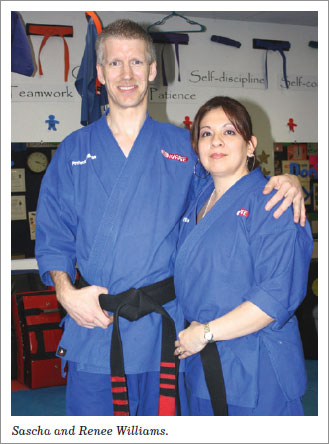
Having been born in Germany and moved to Texas at 17, Sascha Williams considers himself half-German and half-Texan. If there was any apprehension about his new home, then it quickly disappeared when he started his martial arts training; in fact, his attraction to becoming an instructor began with almost the first class.
“I knew that I wanted to teach, almost as soon as I started my first couple of classes,” said Williams. “I was an assistant instructor by the time I was an Orange Belt or Purple Belt; I always enjoyed it.
“If I had the opportunity, then, I wanted to spend my life teaching martial arts, so even before I earned my 1st-Degree Black Belt with Mr. Parker, I had already opened my first school, with a partner. I then decided to go solo, when I received my Black Belt in the mid-80s.”
Williams trained with Ed Parker Kenpo for approximately 30 years, establishing a relationship with Mr. Parker that led Williams to focus completely on his style. “I was fortunate to work with him until his untimely death in 1991; he was only 59 years old,” Williams said. “I also worked with many other Black Belts, such as Tom Kelly, Bob White, Larry Tatum, Jeff Speakman, John Sepulveda and Jeff Hancock; they’re all great Kenpo Black Belts, first-generation Black Belts. I consider myself very lucky to have been in that group.”
Having been a direct student of Mr. Parker’s, Williams was also invited to teach Kenpo internationally, in Sweden, Spain, Greece, Portugal, Netherlands, Germany and other countries. He is also a published author, with four martial arts books in the market.
Today, Williams has become a master not just of the martial arts, but also, you might say, a master of internal referral programs, with student interaction, birthday parties and similar events. During this interview, he presents some strong nuts-and bolts concepts and great action steps you can implement at your school.
Toby Milroy: Let me start with a series of questions that are all inter-related. You’ve been operating schools since the 1980s.What led to that transition from a hobbyist to a business owner? How did you learn the school operator’s mindset? When was it that you decided that you wanted to run a serious business?
Sascha Williams: At first, I was not well versed in what it would take to run a successful martial arts studio, so I made many of the common mistakes that many school owners are still making to this day. I probably treated my studio and its program more as a hobby. I was so focused on the pursuit of the art itself and producing excellent students that I did not spend enough time initially making sure that I had the business knowledge.
In addition, there was not much information about the business of operating a martial arts school available in the early to mid-80s. The industry, as we know it today, did not exist, in terms of the support that so many school owners receive from NAPMA. I had to learn by trial and error at first, slowly acquiring an education from books and materials from Zig Ziglar and similar authors and speakers. I then decided to stop working a job on the side and focus only on the martial arts. I was close enough, financially, that I thought I could make it work, so I took the leap. Of course, there was still plenty of trial and error and lessons learned the hard way.
The larger transition occurred during the mid-90s, when Century hosted an event in San Francisco that I attended. It was a great event, and NAPMA had its first booth. I became a member immediately. I was especially impressed with NAPMA’s marketing campaign artwork because I certainly was not able to produce it myself. They were very professional looking, and were the primary benefit of my membership.
Learn more about the NAPMA Peak Performers and how members, such as SaschaWilliams, can help you achieve greater success with your students. NAPMA.com/InnerCircle
I then started to read more of the reports and other materials, which helped to develop my Black Belt Club, and give talks at local academic schools, even though those ideas took a while to penetrate my thick brain. I was exposed to some materials and ideas that didn’t have value for me until I saw another school owner implement and benefit from them.
I continued to acquire knowledge as NAPMA grew; and its growth also made me aware that there were many more studios in a situation similar to mine and, in a way, that gave me strength because I didn’t feel so alone anymore.
Toby Milroy: I think your experience is extremely important for our readers because your growth and subsequent success was directly related to how involved you were in NAPMA.
Members can receive their packages every month, open them and let them sit on their desks, or they can share the NAPMA Innovations DVD content with their staff members; listen to the Sounds of Success CD in their cars; and assign staff members to read the various Black Belt Reports, extract the value and share it during staff meetings. It’s a matter of surrounding yourself with other school owners who are growing, and can help you not go it alone. Peter Drucker says you’ll become the average of the sum of the five people with whom you spend the most time; and, in your case, as a NAPMA Peak Performers member, you’re spending time with other successful schools owners. There may be distance between you, but you are spending time with the same information, and that’s useful.
You did what any school owner who wants to make the paradigm shift from being a part-time hobbyist to a full-time school owner, and a successful one at that. You decided to surround yourself with your peers who will push, pull and drag you toward success, and also share best practices and what’s working in the industry. What always excites me about talking with someone like you, Sascha, is that what we are discussing isn’t theory, but ideas that are actually working.
The activities that are working are those that create leads, and from which you can build relationships. For example, you’ve had some amazing success at driving traffic with birthday party marketing. Your numbers are amazing! You told me you have four to five birthday parties each week, and each of them generates 20 or 30 new prospects, which means you have 120 prospects a week!
That kind of performance would solve the problems of most average schools, indefinitely. We also want to discuss how to build strong relationships with those leads, so a maximum number will enroll as students.
Let’s start at the beginning, however. How did the birthday party concept become a huge lead generator for you? How did it start and evolve into the success it is today?
Sascha Williams: I started promoting birthday parties simply because I heard that other school owners were doing it. My first birthday party was probably two years ago; and I made so many mistakes that I almost discontinued the program. I discovered that I needed a larger base of potential customers than I could draw from the 100 to 150 students at my school; and I made it too complicated.
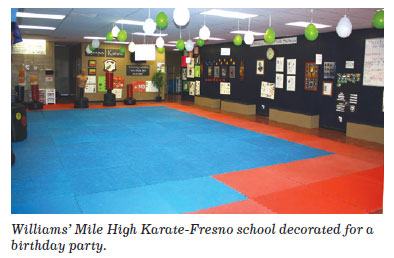
I tried to attract students as their birthdays were approaching, to catch them ahead of the date, so they would schedule their birthday parties with us. The positive change came when I scheduled one birthday party every three or four months, and included a blurb about the parties in whatever ad or direct mail piece I was using in my regular marketing program. That blurb directed people to my extremely simple, extremely basic one-page Web site, with the domain name, fresnobirthdayparties.com.
Once I tied all these methods together, I began to notice that those to whom I was directing my regular advertising were starting to visit the birthday party Web site. The site has a form, so interested parties can opt-in by providing their email addresses, so they can receive additional information.
It’s been extremely easy to convert those interested respondents into booked parties. Our incentive is a regular $299 party for only $125. Of course, we also state the parties are limited. The parties are only held at one location and typically on the weekend, so we can add some urgency to our message.
We don’t limit how many children can come to a birthday party. We do screen those interested, so we know they understand that the purpose of the party is more than a celebration. We want them to be interested in our philosophy, and that we’ll teach some of the positive aspects of martial arts: respect, discipline and focus. The response has been phenomenal. I estimate that 30-40% of the birthday parties we book are from our students, which means the other 60-70% are from people we don’t know.
Toby Milroy: Sascha, let me review some of your important points, and emphasize them for our readers; these are points they should add to their marketing plans. Not only do these points relate directly to the type of referral-generating activity to use, but also having a marketing mindset.
The first point is that you’re not only generating leads from your student body, but also your cold ads. You created space in your newspaper ads, direct mail pieces and other marketing materials, so you can include a birthday party message. The technique is communicating the right message to the right market with the right media.
You went to the market with a different message. The lesson for school owners is that if they observe a decline in the pulling power of a media that they know works, then it’s time to change the message. Communicate a different benefit; provide a different service, such as your birthday party program.
Sascha Williams: Stop trying to be everything to everyone. I focus my message on parents through my ad in Parents Magazine. I’m the only school in this area in that publication, so I don’t have any competition.
Toby Milroy: Returning to your important points, the second is that you created a very simple Web site with predominately a birthday party message and only a brief reference to martial arts; although that message is important because, as you said, you want them to understand what will occur during the party and your school’s mission.
The third important point is your Web site may be simple, but it is also a sales mechanism with an opt-in feature. Your birthday party Web page would be virtually worthless, if it didn’t collect data from visitors.
Sascha Williams: Let me add that what changed my mindset about the correct use of a Web site is when I learned that most of the public doesn’t search the Web for local karate classes. People do use the Internet to find more information when it’s convenient for them. The public is more likely to visit your Web site when they are directed to it from your ads and other marketing materials, or maybe heard about it word-of-mouth. Once they visit your Web site, they are more likely to respond to emails, too. If you are the one school in town that uses the Internet effectively, then you are the one school that is reaching the prospect audience through that medium.
Toby Milroy: Again, it’s the right message to the right market with the right media. The people you are driving to your Web site are “web-centric”; they understand the Web and email, so you can communicate with them by email effectively.
You could buy a cold list of email addresses from a list broker, but you don’t know how it was compiled, how up-to-date it is or if those on the list are even listed in martial arts training. In your case, however, you’re communicating with people who raised their hands, electronically, giving you permission to communicate with them.
Now, let me reveal one of the Internet secrets we’ve learned at NAPMA during the last 12 months. The mechanism that is widely used to drive traffic to a Web site is to push them to a page where you collect information in exchange for an incentive. You then put them into an auto-responder sequence, which are automatic emails that they continue to receive. This mechanism is very effective, but what’s even more effective is if you add an outbound telemarketing call as a second or third step.
When leads are generated by your Web site, they automatically go into your auto responders, but after a couple of days it cues someone at your school to call those leads: “I saw that you visited our Web site yesterday and you opted-in for the free report on how to develop rock-solid focus in your 9-year-old. Was the report useful and helpful? It was? Fantastic. Have you ever thought about involving your son or daughter in a program that will teach him or her focus as well as many other character lessons?”
Now it’s an info call. Adding that outbound telemarketing call has become a huge results generator for schools throughout the industry, including Mile High Karate. All of our NAPMA Web sites work exactly that way.
Sascha Williams: Keep in mind that your opt-in form needs to be somewhat simple, but I do collect names, addresses and phone numbers, and there is also a section to write comments. As far as I’m concerned, if they give me their phone numbers and addresses, then they can’t be upset when I call them. I’ve never had an objection. Why else would you provide your phone number, unless you expect a return phone call?
There is one additional tool I use to drive traffic to the birthday party Web site, which works better with birthday party Web sites than regular martial arts Web sites, and that is simply Google Adwords as well as the Yahoo equivalent. I survey everyone who contacts us, so I always know how they heard about us. I noticed, specifically for birthday parties, people will go to Google and simply search for local birthday parties, which provides them with much better information than if they searched for local Karate.
Toby Milroy: Another data collection secret we’ve learned at NAPMA and in our martial arts school businesses is to survey visitors, when they opt-in, with a series of optional questions. This is a more advanced tool, and should be used only after you’ve fixed your Web site, so it collects data, and you’ve introduced the follow-up telemarketing call.
I used this technique as an ascending close of four questions, each with yes and no boxes to check:
- Would you like more free information about anti-abduction and child safety programs?
- Would you like more information about character development and leadership development programs?
- Would you like more information about self-defense and self-esteem building programs?
- Would you like more information about free Karate lessons at Mile High Karate (or Williams Kenpo Karate)?
The boxes they check help to identify prospects’ interests.
Sascha Williams: The other benefit is that you’re also educating the public by the very fact you’re asking those questions.
Toby Milroy: Absolutely. If you didn’t ask those questions, then they are likely to have a wrong or confused perception of what your business offers and the real benefits it provides. They might think it’s only about punching and kicking, but by asking those questions you are directing prospects’ to think of you differently, “Wow I didn’t know martial arts was about character development and leadership skills. I didn’t know it was about self-esteem.”
You can never take the public’s perception of martial arts training for granted. You and I and all our Maximum Impact members may know it, but that doesn’t mean they do.
Sascha Williams: I’ve seen that change of perception occur at every birthday party. A parent, who knows nothing about martial arts, will come to a party with their child and after 10 to 15 minutes into the party you can literally see the change of attitude on his or her face. It’s a look of gratitude when the parent sees us take control of the kids, ask them to be respectful and address adults with yes, sir and no, sir.
Learn more about the NAPMA Peak Performers and how members, such as Sascha Williams, can help you achieve greater success with your students. NAPMA.com/InnerCircle
Toby Milroy: Think about how powerful that change is for parents. Fifteen to 24 new, fresh prospects walk in the front door, and their parents expect a Chuck E. Cheese atmosphere, with running, out-of-control kids creating chaos. Instead, the kids and parents are exposed to lessons in confidence, concentration, discipline, self-esteem, etc. It’s definitely a paradigm shift.
You have a great mechanism to attract families from outside your school for your birthday parties, but how do you promote parties to your current students?
Sascha Williams: I’ve learned not to reinvent the wheel, so I adapted a simple idea from Matt Young, a Mile High Karate school operator in Denver, Colorado, and that is don’t try to book individual birthday parties.
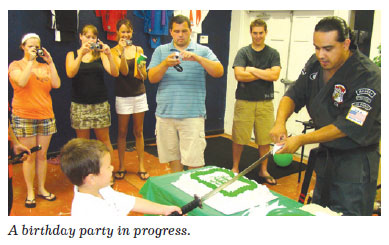
He books as many of his students’ birthday parties at the beginning of the year for the entire year. He gives them a discount, $125, instead of $299, if parents book by a specific date. Like him, I promote the service throughout the school with a sign-up poster, flyer for parents, classroom announcements, etc. You can actually start before the first of the year; it only takes a few weeks of effort, and you can easily schedule 10 to 20 birthday parties just from your student body. It’s much less complicated than trying to remember everyone’s birthday.
Toby Milroy: Another twist on that technique is to book those birthday parties when new students enroll. As you’re finishing the enrollment paperwork, tell the parent that as a free bonus of the basic program his or her child receives a free birthday party at the school. You know the child’s birth date from the data you’ve collected, so you can ask mom or dad to book the party on the closest date to the child’s actual birthday.
Sascha Williams: That is also an excellent method to justify or put a positive spin on the down payment. If you are charging a $200 down payment, for example, then you can state that it includes a free birthday party.
Toby Milroy: Now that you’ve driven outside traffic to your Web site and promoted your birthday party package internally to your students, what are the next steps?
Sascha Williams: The first step is to implement a series of mailings and emails. The added benefit of emails is that once you set up the series, you’re done, no postage, and they are all sent automatically. If you’re advertising in the local paper or magazine, then make copies of the ads and send those to everyone on your mailing list.
I would hope that all school owners are obtaining the names and addresses of anyone who calls. Many people don’t react to your marketing, right away. You can literally make your competition disappear by being the only school that continues to stay in touch. That usually means you mail something once a month. More frequent mailings are rarely necessary.
Depending on how close you came to scheduling an appointment during your first contact, you might want to add phone calls to your sequence of communications. An important point that too many school owners miss is that it’s probably a good idea to remain in contact with prospects that didn’t enroll during the initial enrollment conferences.
They might not have been ready at that moment, but at some point they will. The soccer team or a scheduling problem is no longer an issue, or parents’ jobs change, so their children are then ready to start classes. There may have just been one little obstacle that prevented you from closing them today, but you can convert them into students six months later. If you continue to communicate with them and present your best benefit statements, then they are likely to enroll with you.
Toby Milroy: Let’s explore that behavior a bit deeper. Martial arts is a sales-focused business, so we must sell our lessons. The public doesn’t inherently know what we do, and they don’t inherently know how to value what we do at any level, so we must persuade them, which is selling.
Many, if not most, martial arts instructors start as hobbyists and enthusiasts, and then one day find themselves running businesses. Most of us also wear our hearts on our sleeves. We’re very passionate about what we do; we love to train, and we all take that very personally, and when we’re in that emotional state, we tend to personalize everything. We tend to personalize when a prospect says no; they’re stabbing us in the heart! When a student or parent is irritated with us; we feel horrible.
As high quality martial arts instructors, we think that if we’re quite good at what we do, then everyone should just come flocking in the front door. Some school owners send letters to prospects that describe their schools’ programs, but when they don’t respond to those messages, those school owners take it personally, when it probably means that the prospects don’t value what is being offered. You must externalize that rejection.
Let me expand on that concept just a bit more. If a prospect heard from you once, and you haven’t followed up or communicated with him again, then why you would think that the one message you sent matches or describes accurately what he wants from martial arts? It might describe what you wanted to tell him, but it doesn’t describe what benefits he wants.
For example, a 24-year-old male is your prospect, and what he wants to learn is Jiu Jitsu, so he can train like UFC fighters. If you send him a letter or postcard extolling the benefits of Kenpo, however, then he won’t immediately identify the message as a solution of his need. He’ll probably disregard your message, and trash the letter.
If you never communicate with him again, it’s a dead lead; but if you communicate with him multiple times, and each communications contains a different message, then you’re more likely to match one of your messages with his need.
I think the reason that martial arts school owners are resistant to that idea is because they take what they perceive to be rejection very personally, and constant communication with prospects appears to be too much work.
Sascha Williams: Use your behavior as a consumer as a guide. How many advertising messages cause you to respond the first time you read or hear them? Probably not many. Like most consumers, you are more likely to save a coupon of interest and set it aside, and use it next week or next month. A prospect might be very receptive to your message and offer, but he just can’t act or won’t act today or this week.
Learn more about the NAPMA Peak Performers and how members, such as Sascha Williams, can help you achieve greater success with your students. NAPMA.com/InnerCircle
Toby Milroy: Stephen Oliver always says your prospects are ready to buy when they’re ready to buy, not when you’re ready to sell to them.
To return to the birthday party process, what are the methods you use prior to the parties to make sure that everyone comes?
Sascha Williams: One of the big selling benefits of our birthday party program is that we send the invitations before and thank-you notes after the party. Of course, our motivation is to obtain complete contact information of all the guests. An early step in the process, therefore, is to obtain a list of the guests, with their phone numbers, from the family that booked the party. That can be a bit challenging because the host of the birthday party tends to be a little bit relaxed about when he or she gives you the list, so you sometimes must process the invitations quickly.
Of course, you must do some planning to make sure the guests have plenty of fun at the party. Make a list of the supplies and refreshments you’ll need: pizza, beverages and a birthday cake. I don’t recommend many decorations, just some balloons, streamers, etc.
We do include an RSVP form inside the invitations, but we never receive them all, so you must have a table just inside your front door. Don’t let the guests pass, until they complete the form. Some people are a little bit nervous about the form, but if you do it with the right mindset, then there’s no problem at all.
Let them know that you must have a parent’s signature for insurance purposes. This is also a good time to encourage parents to join the party, as it distracts them from your form. Tell them there’s plenty of opportunities for parent involvement, or they’re welcome to watch. Tell them that you will send them a thank-you note, which is another method to put them in a positive frame of mind. Be civil and sociable, but obtain the information of all guests at the front door!
Make sure you have an information packages ready because some parents will show interest in your training program during the party, and will ask for information.
Of course, it’s better to be proactive, and not wait for them to ask. During the party, we talk with the parents and ask them questions, such as, “How would you like it if your child went home after the party and started addressing you with “yes, sir’ and ” yes, ma’am’? How would you like it if he cleaned his room?” It’s hard to imagine a parent not responding positively to those questions.
We’ll make them an offer during the party, “If we can change your child’s behavior with today’s activities, then we want to reward your child.” We then announce to the children that they can earn a free uniform and three free lessons if they start using the seven magic words-yes sir, no sir, yes ma’am, no ma’am, please, thank you, you’re welcome-and complete their chores at home. That offer usually causes one or more parent to respond with interest.
One unique factor that you must keep in mind is that you are reaching children and parents that are not necessarily ready to commit to your training program during a birthday party. The majority of prospects that enroll from a birthday party event don’t do so until three, six, nine or 12 months later. That’s why it’s of utmost importance to remain in communications with them once a week. Make sure your message is not too commercial; don’t make them think you’re pushing junk mail on them, but just stay in touch. That’s the hard work to which I referred earlier.
That work becomes harder if you don’t enter everyone’s contact information in your computer, right away, Don’t let all the birthday party applications sit on your desk, thinking you’ll do them next month.
Another part of the party that is important is to photograph each guest with the birthday boy or girl; you could also add an instructor to the picture. We do this during the party, so the pictures are taken and printed from the photo printer we have at our school. We make sure that everyone’s contact information has been entered in the computer and the thank-you-note envelopes have been addressed before the end of the party. We want to know that when they leave the party, all those steps have been completed, and now all we must do is activate our regular communications with them.
Toby Milroy: Once again, Sascha, you’ve presented five or six points of important information that I highly recommend that our Martial Arts Professional readers review a couple of times.
The birthday party and similar concepts are so important during the current economic climate. It’s a real challenge for school owners because they must make a paradigm shift, right now, from relying on a cold market to a warm lead list of prospects; and you create that warm list and relationships with the prospects on it with events, such as birthday parties.
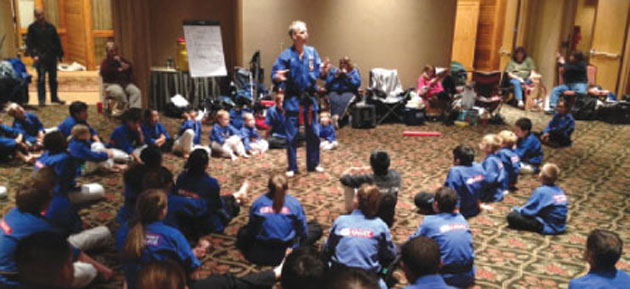
Imagine two different school scenarios. The first has absolutely no lead pipeline, whatsoever, and it must go into the cold market every day to find new students. That’s a very difficult place to be, right now. The second school hosts birthday parties, two or three a week, is involved in community-outreach activities, and conducts various summer camps, Spring Break day camps and other events. Through these events and activities, it has a flood of warm leads.
Of course, you want to be the second school, building a warm list of prospects with whom you’ve been creating relationships. You’ll receive more value from that list during the next 12 months than pursuing prospects who don’t know you in the cold market. If you’re relying on the cold market today, then you are apt to experience some difficult months during 2009. On the other hand, if you have a deep, long lead pipeline and you can return to that list again and again to create more solid relationships with those leads, then you have plenty of leverage with those potential customers.
By the way, this lead-generating concept works in adult-oriented schools, too. Instead of a birthday party, however, at Mile High Karate, we host a health or wellness clinic, or a business-to-business event with a local hospital. Its staff members are invited to the school for a relaxation or stretching class.
Sascha Williams: Let me add one thought, in terms of your mindset, during economic downtimes. Remember, not everyone in your community is affected by the poor economy; in fact, a great majority of them are not. Even if 20% of the people in your community had lost their jobs (which is an extreme rate), the other 80% are still working. It’s a false assumption that 30% of your prospects (you pick the number) are less likely to enroll or spend money.
In statistical terms, you may typically convert 10 info calls into eight enrollments, but now you may only close six enrollments. You just need to generate more info calls. The people with jobs are doing fine; they’re doing just the same as they did a year ago. There is no change for them.
Toby Milroy: Stephen Oliver and I recently did an hour-and-ten-minute resource-sharing session on the four steps you need to take to give your school recession immunity. That has been sent to all NAPMA Maximum Impact members (and it’s available to you when you become a Maximum Impact member at NAPMAFreeOffer.com).
One of the concepts we discussed that you and I have presented today is marketing to the right people, the right list, to find the right customers. Think of this concept in terms of the following scenario, which is a bit over-exaggerated because every community is different, but it applies to the average.
If the only marketing media you’re using to drive traffic to your school is the “Penny Saver, “Penny Pincher” or similar coupon-based advertising circulars, then you are probably reaching the lower end of the local audience, which is the group most affected by the economy. The audience for those types of advertising circulars want to save money, they’re looking for a discount; they’re looking for low-end products.
The smart school owner would rather be in a magazine, newspaper or other media that targets the more affluent segment of the local community because they’re least affected by a recession. Currently, 59% of expendable income is controlled by 26% of the homes. It’s better to market to those 26% than the other 74%. That’s just good marketing sense.
What’s next for you, Sascha? What’s the next step for you to make these things even a bigger homerun?
Sascha Williams: I plan to refine my systems, continue to implement the marketing concepts that work and test new ones.
What has changed my mindset, my outlook, the most is that I am now married to one of my adult Black Belt students, who started training at my school approximately 15 years ago. With that marriage came three stepchildren, 16, 18 and 20 years of age, who are also all Black Belts with me.
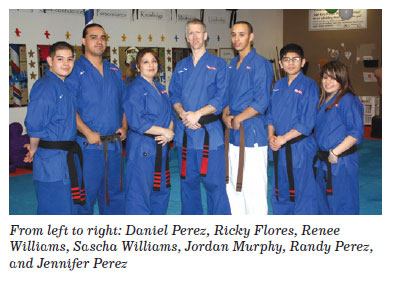
Approximately, three years ago, Renee, my wife, and I started running my school as a team, which was a tremendous change for me because I had been running it as a one-man show. I had to learn how to step back from the frontline. I don’t teach many classes now, except our higher belts. I do most of the staff training and supervise classes, but my wife and the stepchildren do much of the other work.
My wife and I do the behind-the-scenes work, while the stepchildren and another staff member do virtually all of the teaching, and have assumed the roles of program director and head instructor, which took plenty of nerve. It’s only natural that when you replace yourself in the classroom, you always think you can teach better.
When I relinquished the reins, I considered it an investment. Initially, our stats decreased, since it took my stepchildren some time to gain the experience; and they made plenty of mistakes at first, as we all did. That transition period has now passed, and I have an incredible and formidable team. The investment is paying off because now we can multiply tremendously. Each of my stepchildren can run the school.
I want to continue to refine one of the concepts I learned at a NAPMA event. It was 2003 in Orlando, Florida, if I remember correctly, and I attended a Stephen Oliver seminar during the event. He stressed how important it is to charge the proper tuition and that you understand the value of what you’re giving. I must have raised my rates about five times since; and I’m now at a point where I charge probably three times as much as five years ago.
The second part of that concept is to know how to communicate that value to parents, so they understand what their children will experience during the next three, four or five years as they progress toward Black Belt. If you are good at painting a picture and showing parents that future and the benefits of martial arts, then they will pay whatever is necessary.
Some parents won’t pay no matter what you do. Those that recognize the value not only will become well-paying students and parents of students, but also your number-one fans. They will be a pleasure to teach, and the students and parents you want associated with your school. You might think it is wise to compromise your rates, during this economic climate, but that would be a big mistake because you’ll only attract those people who are looking for a bargain.
I encourage all Martial Arts Professional readers to attend NAPMA events; you really can’t afford to miss them. To be surrounded by 40, 50, 100 or 200 school owners that are in the same situation more or less as you, pursuing the same goals, and then to witness how many of them have succeeded, is a priceless experience.
As a matter of fact, I make sure to take my whole family, even though it’s expensive, but it’s another worthwhile investment. If you’re not willing to do bring your entire staff, then you should take a close look at what you’re investing for their growth and future success. You should invest in your motivation and success and theirs.
I think it was Tom Hopkins who said, never take advice from someone who is more screwed up than you are. A NAPMA event provides a clear contrast because you have the opportunity to hear and network with the highly successful school owners who are already doing what you should duplicate to experience the same level of success. Under no circumstances should you look at other schools in your community and copy what they do, unless, of course, they are very successful, but most of them probably are not. If you want to be successful, then do the exact opposite, in most cases.
Toby Milroy: I had that very same paradigm shift in my life in the martial arts business, when I attended a summit of the martial arts millionaires: Bill Clark, Tommy Lee, Dave Kovar, Steve LaVallee, Keith Hafner, Stephen Oliver, Rick Bell and Rob Colasanti. These were the giants of the industry, all in one room. They revealed their best practices for 12 hours; it was an amazing event and experience. Not only did I learn a great amount of strategies that I could implement and mind shift changes that would help my school grow, but also, and more importantly, I realized that these millionaires are very smart, but they’re not that much smarter than me. If they can do it, I can do it.
They’re very bright people, and they have all of my respect; however, I realized they were also human, just like me. They had faced the same challenges, the same student, staff and landlord issues. They’re humans, but they have slightly different mindsets, and run their schools a bit different than the rest of us.
Once I was able to wrap my brain around that concept, it became clear that I was my biggest problem. I was the person standing in my way. I had to learn, as Lee Milteer teaches, to surround myself with a culture of self-support. You must surround yourself with people who won’t listen to your excuses or empathize with you when you’re externalizing your failures; in fact, they’ll call you on it. They won’t hesitate to tell you that you’re externalizing your failure, and that you need to fix it.
Sascha Williams: We should keep in mind how lucky we are. Those small business owners in the general retail industries don’t have as much industry support as martial arts school owners. We have the absolute, best support in the world, and we’d be crazy not to benefit from it. I can totally relate with what you were saying about having to penetrate your thick skull with these concepts. How many of us have made the mistake of saying, “That won’t work in my city?”
Many products and services cost the same or nearly the same, regardless of where you buy them; but, for some unknown reason, too many school owners don’t think they should charge as much as Bill Clark, Stephen Oliver, Tommy Lee or other martial arts millionaires. It’s just not true. The most important lesson is that if that they can do it, then you can duplicate their systems and success. Surrounding yourself with those kinds of people is your best opportunity to learn how to run a successful martial arts school.
Learn more about the NAPMA Peak Performers and how members, such as Sascha Williams, can help you achieve greater success with your students. NAPMA.com/InnerCircle