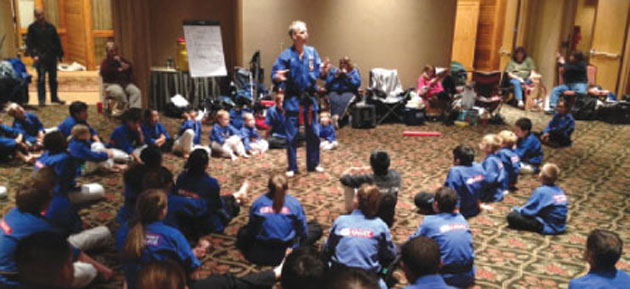

Grand Master Stephen Oliver – 8th Degree Black Belt
Academic Background
– 1992 Master's Degree in Business Administration (MBA) University of Denver, Denver, Colorado
– 1982 Bachelor's Degree (AB.) With Honors Georgetown University. Washington, DC;
– 1978-1980 University of Tulsa – two years, as a University Scholar, National Merit Scholar.
Martial Arts Background
Stephen Oliver began martial arts training in 1969 in Tulsa, Oklahoma with Bob Olinghouse and Gran Moulder – Black Belts teaching for the Jhoon Rhee Institute based In Washington, DC. He began actively teaching 1974 and founded his first school in 1975. In 1976 and 1978 he traveled to Washington, DC to train with Jeff Smith and others at the Jhoon Rhee Institute Headquarters, completing his Black Belt in 1978 t with one of the highest scores ever given on the Jhoon Rhee Black Belt Exam. In 1980, he moved to Washington, DC and worked first as a head instructor then as a branch manager for the Jhoon Rhee Institute while attending school at Georgetown University. He has continued to train and contribute to the Martial Arts and was promoted to 6th Degree Black Belt in 1994 by Jhoon Rhee (Father of American Tae Kwon Do) and, then in 2001 was promoted to 7th Degree Black Belt by former World Champion 9th Degree Grand Master Jeff Smith and.. More recently he was promoted to 8th Degree Black Belt by Jeff Smith. He has trained in Tae Kwon Do, Kickboxing, Goju, Judo, Escrima and several other styles of martial arts.
Stephen Oliver's Mile High Karate®
In 1983, Stephen Oliver moved to Denver, Colorado and founded Mile High Karate. He opened 5 locations in the first 18 months. In the many years since additional Mile High Karate locations have been opened throughout the world. (Mile High Karate is the #1 martial arts school for Character Development Education in the World.) and has promoted 1,000’s Black Belts ranging in age from 5 to 76.
The Mile High Karate Classic and The North American Sport Karate Association
In 1989, he began the Mile High Karate Classic international martial arts competition which merited the highest rating possible – NASKA's World Tour designation from 1989 until 1999.. Through his work in Sport Karate, he has was appointed to the Board of Director's for the North American Sport Karate Association and served on that Board and as that organization's national sanction director from 1989 until 1999.
International Speaking, Consulting and Writing
Since opening Mile High Karate, Stephen Oliver has been a sought after consultant for marital arts schools internationally first as Board of Director's member of Educational Funding Company (serving on that Board from inception until 2001) then as the lead developer of the NAPMA Squared program (currently “Maximum Impact”) for the National Association of Professional Martial Artists and the founder of the first high level coaching program for martial arts school owners. He has been recognized as the U.S. Martial Arts Association’s #1 multi-school operator. Additionally, he was recognized as one of the top 200 school operators by Andrews International and was inducted into the U.S. Martial Arts Association Hall of Fame in 2000. He has been featured on the Cover of “Martial Arts Business Magazine,” “Martial Arts Professional Magazine,” “The Eagle Express,” “the EFC All Stars,” and “Martial Arts Business” among others. He also served on the Entrepreneurship and Venture Management Board for the University of Denver.
National Association of Professional Martial Artists & Martial Arts Professional Magazine:
He became the CEO and Chairman of the National Association of Professional Martial Artists (NAPMA.com) which he has had a consulting relationship with since prior to it’s founding in 1994. He has been a columnist for over 10 years for Martial Arts Professional Magazine which is distributed to 23,000 professionals in the Martial Arts Industry. He became the publisher of Martial Arts Professional Magazine in 2007 (www.MartialArtsProfessional.com.) Additionally, he hosts “Bootcamps” and “Mini-Bootcamps” and, the “NAPMA Extreme Success Academy” and “Quantum Leap” Event for instructors and school owners throughout the world to teach them professional teaching and management skills for martial arts schools.
Charity and Community Outreach
Master Oliver and the staff and students of Mile High Karate have been very active in charitable activities and community outreach since 1983. Mile High Karate has been the #1 contributing school to Chuck Norris’ Kick Drugs Out of American program, actively supports The Children’s Hospital Foundation, and has volunteered in 100’s of area schools while raising well over $100,000.00 annually for local Elementary Schools. Mile High Karate throughout the United States contributes to our Educational Foundation Outreach as well as “Fostering Leadership” Program.
Stephen Oliver's Mile High Karate®
The History and Evolution of our Martial Arts Style
The style we teach has evolved from ancient and traditional Korean styles that grew to be called Tang Soo Do in the early 1900's. Won Kook Lee who taught the Chung Do Kwon system (Chung Do Kwon is an actual school in Seoul, Korea), was the original teacher of Jhoon Rhee, who became the first Korean instructor to professionally teach Korean Martial arts in the United States beginning in 1956.
When Jhoon Rhee first arrived in the United States, he referred to his style as Tang Soo Do and as karate (a Japanese term that means "empty Hand"). In 1957, the South Korean government at the urging of Choi Hong Hi adopted the term Tae Kwon Do to encompass all Korean styles of martial arts and gradually Jhoon Rhee and others in the United States incorporated that term to reference their art (officially Jhoon Rhee's art was often referred to as Chung Do Kwan – Tae Kwon Do). Tae Kwon Do is loosely translated from Korean as way of breaking and smashing with hands and feet.
In the United States Jhoon Rhee first started teaching in Texas. His first two Black Belts were Allen Steen and Pat Burleson who went on to become early tournament champions and the premier instructors in the Texas-Oklahoma region. Many early students evolved from the Jhoon Rhee – Allen Steen/Pat Burleson schools in Texas including Pat Worley (who would become the #1 point fighting champion in the United States). Jeff Smith (who would become the #1 point fighting champion then evolve into the World Light- heavyweight full-contact champion). Larry Carnahan (who would become a highly rated lightweight full- contact fighter, then President of the North American Sport Karate Association), Gran Moulder and Bob Olinghouse (who would in 1969 become Stephen Oliver's Instructors in Tulsa, Oklahoma).
Jhoon Rhee in 1962, moved to Washington, DC to establish The Jhoon Rhee Institute of Tae Kwon Do, which would become world famous as the #1 institute of its kind in the world. In the Mid-1960's, Jhoon Rhee developed a friendship with Bruce Lee and Chuck Norris (both would later become internationally famous as actors.) Bruce Lee was an early innovator in modernizing martial arts instruction in order to become more effective in Self-Defense application as well as an advocate of high level athletic conditioning for martial arts. The Jhoon Rhee Internationals was one of the first major tournament events in the United States – and, became a hub for budding champions and famous martial artists such as Bruce Lee, Chuck Norris, Joe Lewis, Jeff Smith and many others.
Through Jhoon Rhee's association with Bruce Lee and through the many sport and contact karate champions that developed at the Jhoon Rhee Institute, our style gradually evolved to what we now refer to as American Freestyle (others refer to similar arts as Jeet Kune Do.)
These early associations led the Jhoon Rhee Institute to flourish in the Washington. DC area and led Jhoon Rhee to develop a curriculum that combined three key and distinct elements:
1. Practical Self-Defense without adherence to impractical tradition.
2. Personal development through positive self-esteem, goal setting, and personal discipline.
3. Artistic content through martial ballet (musical forms).
In the early 1970's. Jhoon Rhee developed padded sparring equipment that allowed students to practice without injuring on-another and concurrently added to the realism of practice (a joint goal with Bruce Lee), while creating a flourishing sport through both point tournaments and full-contact karate. Additionally, he invented musical forms to add to the beauty of martial arts performance.
Through the 1970's, Jeff Smith became an internationally recognized and respected fighter and Instructor. Jhoon Rhee taught Mohammed Ali, Sugar Ray Leonard and other world-famous boxers, and Jhoon Rhee students flourished on the international tournament scene. Jhoon Rhee's schools gradually became more oriented towards teaching children and Jhoon Rhee rapidly saw the self development advantages of Tae Kwon Do instruction. The curriculum orientation evolved toward personal development with emphasis on educational excellence, community values, and personal excellence with practical self-defense and competition opportunities as a valuable by-product. Jhoon Rhee since the late 50’s has taught many internationally respected and famous students including Tony Robbins (a Jhoon Rhee Black Belt,) George Allen, Jack Valenti, and many, many, many Senators and Congressmen.
Although Jhoon Rhee through his style: Jhoon Rhee Tae Kwon Do, gradually abandoned the more traditional roots with the traditional hyungs or katas (Chonji through Chung Mu under Black Belt), Grand Master Oliver and Grand Master Smith at Mile High Karate have accelerated the personal development aspects of the program through implementing the nine qualities of Black Belt and many associated goal-setting and personal development aspects. Master Oliver continues to expand our curriculum to keep it "state of the art" and continues to implement new teaching techniques which accelerate a student's progress while reinforcing the traditional philosophies of honesty, courtesy, integrity, perseverance and self-control. Additionally, at Leadership levels, Master Oliver has continued the Jeet Kune Do philosophy by adding Philippino weaponry, traditional Ko-Budo (traditional Okinawan weaponry), modern boxing, kick-boxing basics, and grappling curriculum from jujitsu and judo.