
There has been a long-running dispute among the “experts” about certain exercises used in many fitness workout routines. Some say that there are contraindicated exercises that should probably be eliminated from any program that targets a general audience.
Other experts want to see scientific evidence that certain exercises are harmful before they consider modifying their programs.
Health and fitness professionals should take a conservative stance and utilize only those exercises considered the safest for a wide audience. Problem areas for many people are the back, knees and neck. This month, I’ll explain the supine leg lifts that many exercise leaders still use in their routines.
Health and fitness professionals should take a conservative stance and utilize only those exercises considered the safest for a wide audience.
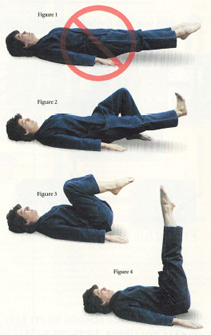
Since there are millions of Americans with lower back problems (young as well as old), you should take care not to exacerbate any preexisting conditions with an exercise that strains this area. The supine leg lift is certainly in this category. Lifting both legs from the floor in what many coaches and instructors call the “six-inches” exercise (see Fig. 1) may hyperextend the lower back, causing muscle strains and possibly an overstretching of the sciatic nerve.
Some instructors even call for the students to raise their legs to 90 degrees, then lower the feet to the six-inch mark and raise them again. You can feel the lower back start to arch and the strain start to concentrate in this area. Although placing the palms of the hands under the buttocks relieves some of the stress of this exercise, an even safer alternative is to bend one leg with the foot flat on the floor (Fig. 2) as you lift the opposite leg.
You can also bring both knees to the chest (Fig. 3), and then extend them straight toward the ceiling (Fig. 4). This allows the lower back to stay flat on the floor.
Keith D. Yates, M.A., is a veteran martial arts teacher who earned his first Black Belt in 1968. He served for several years on the Physical Education faculty at Southern Methodist University in Dallas, where he introduced the first martial arts program for credit in a southwestern university in 1971.